
How grading works at KIIT University
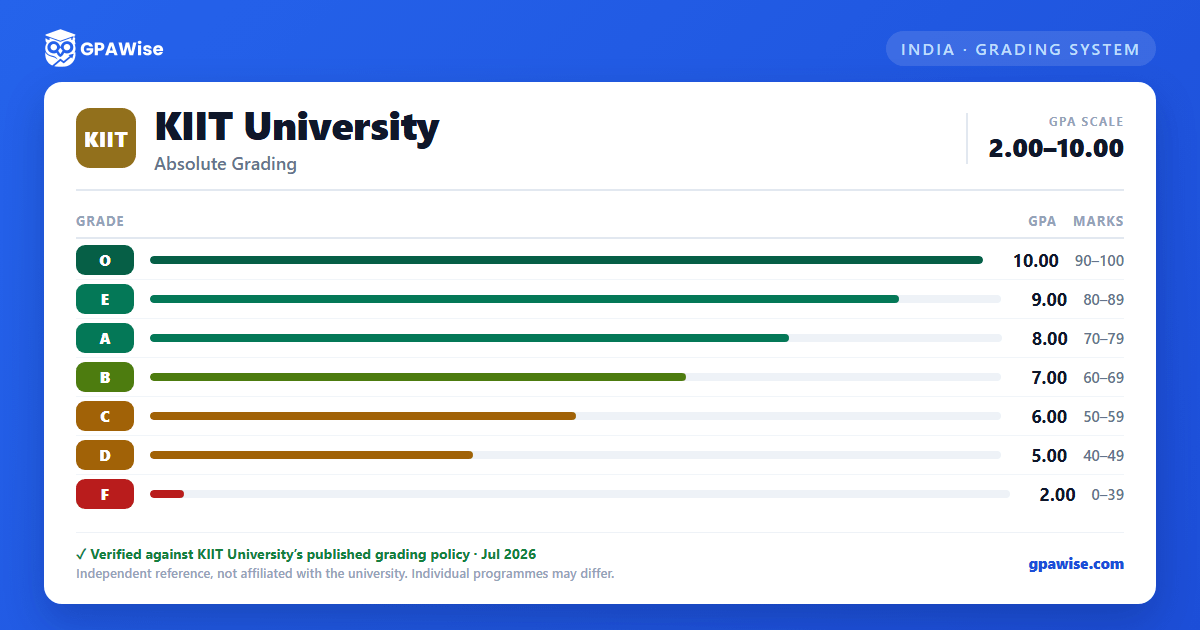
KIIT (Kalinga Institute of Industrial Technology) uses an absolute grading system: a seven-point grading scale on a 10-point scale, where every letter grade is set by a fixed percentage cut-off published in the university's own Examination Regulations — there is no class curve, and your grade depends only on your own marks in each subject.
This table applies to Stream (A), KIIT's general-population evaluation stream — Engineering Sciences, Computer Applications, Social Sciences, Applied Sciences, Law, Biotechnology, Management, Rural Management, Yogic Sciences, Architecture, Fashion, Film, Mass Communication, Public Health, Languages, and most other schools. It does not apply to Medicine, Dental, or B.Sc. Nursing programs, which follow separate, non-GPA or differently-tabled evaluation systems under their respective professional councils.
Every band is a contiguous, non-overlapping run of whole-number percentages covering 0% to 100%, so every possible mark maps to exactly one grade. One feature is unusual compared to most Indian universities: KIIT's own regulations print a grade point of 2, not 0, for a Failed (F) result — verified directly against the university's own published table, not a typo.
Source: Academics & Examination Regulations 2022, §8.1 "System of Evaluation for Stream (A)" — verified Jul 2026
How KIIT calculates SGPA and CGPA
KIIT reports a Semester Grade Point Average (SGPA) and a Cumulative Grade Point Average (CGPA), both credit-weighted:
- CREDIT POINT = Credit × Point, for each course item.
- CREDIT INDEX (CI) = the sum of Credit Points for all course items in a semester.
- SGPA = CI ÷ total credits, for that semester.
- CGPA = (sum of CI across all previous semesters up to the current one) ÷ (sum of credits across all previous semesters, including the current one).
A four-credit course therefore moves your average twice as far as a two-credit course.
Source: Academics & Examination Regulations 2022, §8.1 points 2-5 — verified Jul 2026
Supplementary exams, backlogs, and probation at KIIT
Supplementary examinations. Held annually, at the end of each academic year and before the next one begins, for current-level theory subjects only. A student may attempt failed papers up to a maximum of 50% of that year's total subjects (both semesters combined, rounded off). Ordinarily, a supplementary attempt is capped one grade below what the student actually earns (down to a minimum of C), unless the student attended at least 75% of summer term classes for that subject, in which case there is no grade reduction at all. Students with a C or D grade may also re-sit up to 3 subjects a year purely to improve their grade, without any grade penalty.
Promotion to the next academic year (revised w.e.f. August 2025) requires bona fide regular registration, a clean disciplinary record, and meeting the revised progression criterion: a student may not carry more than 50% backlog subjects from the immediately preceding academic year (both semesters combined). Exceeding that limit means repeating the year ("Year-Back") and re-admission under university norms — this supersedes any earlier, more lenient backlog-limit rule.
Clearing backlogs. Back-paper exams run alongside the normal end-semester exam of the matching semester parity (odd with odd, even with even). A student may register for at most 5 backlog subjects per semester alongside their regular load, clearing the lowest year's backlogs first; anything beyond 5 carries forward. A student who fails to clear the 1st-year program within two attempts (End Semester + Supplementary) is placed on probation for one more year (a further "year-back"); failing again after that results in termination from the university.
Source: Examination Regulations, "Supplementary Examination Rules and Regulations", "Promotion to Next Academic Year (Revised w.e.f. August 2025)", "Guidelines to Appear for the Backlog" — verified Jul 2026
What CGPA you need to graduate from KIIT
KIIT's Degree is awarded at a CGPA of 6.0 or above, with no backlog (F/Fail or I/Incomplete grade) remaining on any subject. One exception: UG programmes from the School of Social Sciences graduate at a lower floor, CGPA 5.0 — both also require a minimum D grade in every theory course and a minimum C grade in every practical/sessional component (minimum C across all components, theory included, applies to M.Tech 2020+ admits, M.Sc from the School of Applied Sciences, and LLM). No separate class/division is awarded at either semester or final-degree level.
Students may also improve their CGPA: those without a backlog can sit an improvement examination in up to 3 theory papers (starting from the 3rd semester); students with fewer than 3 backlog papers can combine backlog-clearing with improvement papers, up to the same cap of 3, backlog papers first. The improvement chance is available only in the very next end-semester exam sitting — if the grade doesn't improve, the original grade stands.
Source: Academics & Examination Regulations 2022, §8.1 point 6, §19; Examination Regulations, "Rules for Improvement in CGPA" — verified Jul 2026
Minor and Honours degrees in B.Tech at KIIT
B.Tech students who complete an Honours track have it reflected on their Provisional and Final Degree Certificates as "BACHELOR OF TECHNOLOGY (Honours) in XYZ Engineering"; a Minor is shown as "...with Minor in ABC"; both together combine on one certificate. Honours subjects appear in the Final Grade Report marked (Hons.), and their grades count toward both SGPA and CGPA in the ordinary way.
Minor subjects work differently: only the two Minor subjects taken in the 6th and 7th semesters (6 credits total) count toward the B.Tech program's own SGPA/CGPA, in place of Open Electives — the remaining Minor subjects are tracked on a separate consolidated grade report with no SGPA/CGPA calculation of their own. A student must clear every Minor subject to be awarded the Minor alongside the B.Tech degree; if any Minor subject remains a backlog, the student still receives the B.Tech degree, just with no mention of the Minor.
Source: Examination Regulations, "Information for Students Opting for Minor and Honours in B.Tech Programs" — verified Jul 2026
Frequently asked questions
What grading scheme does KIIT University use?
Where does this KIIT University grade scale come from?
What CGPA do you need to graduate from KIIT?
A minimum CGPA of 6.0 is required to be awarded a degree at KIIT, with no backlog (Fail or Incomplete grade) on any subject. UG programmes from the School of Social Sciences graduate at a lower floor of 5.0 CGPA instead.
Source: Academics & Examination Regulations 2022, §8.1 point 6, §19 — verified Jul 2026
What is the minimum passing grade at KIIT?
Below 40% marks in a subject earns an F (Failed) grade — worth 2 grade points on KIIT's 10-point scale (not 0, unusually for an Indian university, but this is what KIIT's own Examination Regulations state). The lowest passing grade is D (Below Average), awarded for 40-49%, worth 5 grade points.
Source: Academics & Examination Regulations 2022, §8.1 — verified Jul 2026
When is a KIIT student placed on probation?
A student who fails to clear the 1st-year program within two attempts — the End Semester exam plus the Supplementary exam — is placed on probation for one additional year (a "year-back"). Failing again after that results in termination from the university.
Source: Examination Regulations, "Guidelines to Appear for the Backlog" — verified Jul 2026
How many backlog subjects can a KIIT student carry?
Under the progression criterion revised from August 2025, a student cannot be promoted to the next academic year if they carry more than 50% backlogs from the immediately preceding academic year (both semesters combined) — exceeding that means repeating the year as a "Year-Back" case. Within a semester, a student may register for at most 5 backlog subjects alongside their regular course load, clearing the lowest year's backlogs first.
Source: Examination Regulations, "Promotion to Next Academic Year (Revised w.e.f. August 2025)", "Guidelines to Appear for the Backlog" — verified Jul 2026
Can a KIIT student improve their CGPA?
Yes. A student without a backlog can sit an improvement exam in up to 3 theory papers, starting from the 3rd semester onward, in the very next Autumn or Spring end-semester exam. Students with fewer than 3 backlog papers can combine backlog-clearing and improvement papers up to the same cap of 3 (backlog papers must be registered for first). If a subsequent attempt doesn't improve the grade, the original grade remains in force.
Source: Examination Regulations, "Rules for Improvement in CGPA" — verified Jul 2026