
What a CGPA-to-Percentage Conversion Really Is
A CGPA-to-percentage conversion multiplies your grade-point average by a factor your institution chooses — it isn't a law of arithmetic, and the factor isn't fixed. A CGPA compresses everything you scored across every semester into a single number on a 10-point scale, or sometimes a 5- or 4-point one; a percentage re-expands that onto the familiar 0–100 line. The bridge between them is a single multiplier, and whoever issued your CGPA decides what it is. That is why the same CGPA can surface as one percentage on your transcript and a noticeably different one on a friend's from another university: the two schools simply picked different factors. Your own number lives on your transcript legend or in your exam handbook, not inside a generic converter — the converter only guesses at the most common factor. And before any of that, it helps to know which scale your CGPA sits on, because the rule that turns a 10-point average into a percentage is not the one that fits a 5- or 4-point average.
The Common CGPA-to-Percentage Formula (× 9.5)
When you just need the number, multiply your 10-point CGPA by 9.5. An 8.2 CGPA becomes 8.2 × 9.5 = 77.9%; an 8.0 lands at 76%. This is the multiplier most people mean by "the CGPA formula," and it has a genuine pedigree — it's the rule CBSE published for its Class-X 10-point CGPA in Circular 24/2010, later borrowed by scores of colleges that wanted a ready default. The same × 9.5 works whether you're converting a single semester's SGPA or your cumulative CGPA; the arithmetic doesn't care which average you feed it. To run it backward, when a form gives a percentage and asks for the CGPA, divide by 9.5 instead. Just hold one caveat in view: × 9.5 is one board's choice, not a national standard, so it's the right answer only when your institution actually uses it — and plenty don't.
Reverse: CGPA = Percentage ÷ 9.5 — e.g. 76 ÷ 9.5 ≈ 8.0.
CGPA to Percentage Conversion Table (10-Point)
The table below runs the × 9.5 rule across the 10-point range, from a perfect 10.0 down toward a pass mark. Read it as a reference for CBSE-style conversion, not a verdict for every college: a school that multiplies by a flat 10 lands a few points higher on each row, and one that subtracts 0.75 before multiplying lands lower. Where your transcript disagrees with this table, your transcript wins.
| CGPA (10-point) | Percentage (CGPA × 9.5) |
|---|---|
| 10.0 | 95.0% |
| 9.5 | 90.25% |
| 9.0 | 85.5% |
| 8.5 | 80.75% |
| 8.0 | 76.0% |
| 7.5 | 71.25% |
| 7.0 | 66.5% |
| 6.5 | 61.75% |
| 6.0 | 57.0% |
| 5.5 | 52.25% |
| 5.0 | 47.5% |
Why There's No Single “Official” CGPA-to-Percentage Formula
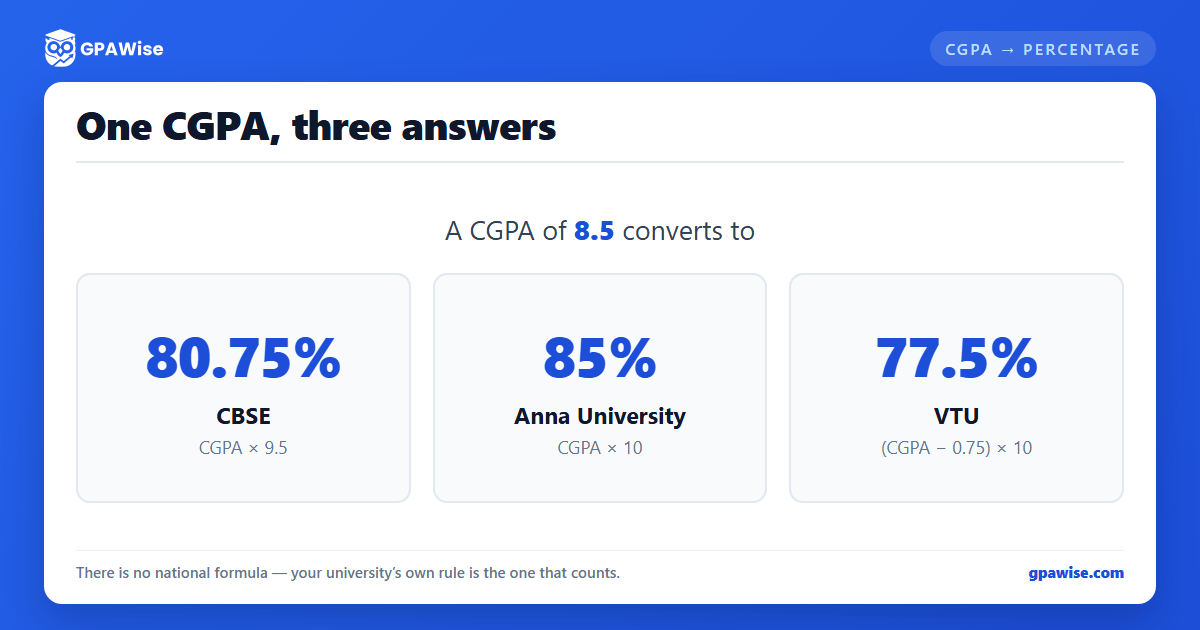
There is no official CGPA-to-percentage formula, because the body that standardized India's 10-point CGPA never wrote one. The UGC's Choice Based Credit System defines the grade scale — O is 10 points, A is 8, on down to F at 0 — and the credit-weighted method for computing SGPA and CGPA, and it stops there. It publishes no conversion multiplier and no marks-to-grade bands. So the popular claim that “(CGPA − 0.75) × 10 is the UGC standard” is simply invented; that UGC standard does not exist. What fills the vacuum is a patchwork of institutional choices: CBSE settled on × 9.5, Anna University on a flat × 10, VTU on (CGPA − 0.75) × 10 — which is why one 8.5 CGPA is 80.75%, 85%, or 77.5% depending only on whose rule you apply. So the honest question is never “what's the formula?” but “which multiplier does my university use?”
Source: UGC Guidelines on the Choice Based Credit System — defines the 10-point grade scale and SGPA/CGPA computation; no percentage-conversion formula.
Is Your CGPA Out of 10, 5, or 4?
Before reaching for any multiplier, check what your CGPA is out of — the conversion changes completely with the scale. A 10-point CGPA, the Indian default, uses the institution-specific rules already covered above. A 5-point CGPA divides differently: (CGPA ÷ 5) × 100, the same as × 20, so a 5.0 maps to 100% and a 4.0 to 80%. The 4-point scale is where the popular shortcut goes wrong. Multiplying a 4.0-scale CGPA by 25 — the ÷ 4 × 100 trick — treats the scale as perfectly linear, but no 4.0 system assigns marks that way. Pakistan's HEC is the clearest case: it maps each grade to a band of percentages and awards the band's floor, so a 3.00 CGPA is 71% in HEC's own guidelines, not the 75% that × 25 promises. A 4.0 or 5-point CGPA isn't a smaller 10-point score you can scale up; it's a different grading system with its own rules, and borrowing a 10-point multiplier for it produces a number no registrar would recognize.
Source: HEC Policy Guidelines, §13.1: a CGPA is assigned the minimum percentage of its grade band.
Do You Even Need to Convert Your CGPA?
Often, you don't need to convert at all. Plenty of universities abroad read a 10-point CGPA directly and would rather see it than a percentage you derived yourself; when they do want an independent number, a credential evaluator like WES or another NACES member recomputes your record course by course, not through any national multiplier. A self-converted percentage rarely does the work students assume it will on a foreign application. Where the conversion genuinely matters is closer to home: Indian employers, government-recruitment forms, and some postgraduate applications still ask for a percentage, and many print a hard cutoff you have to clear. For those, use the exact rule your university issues and put both figures on the form — "8.2/10 (77.9%)" leaves no room for a recruiter to apply the wrong multiplier and undershoot your marks. As for the minimum-CGPA thresholds that circulate for this country or that program, treat them as rough guidance: no single authority publishes them, and they shift by course, intake, and year.
CGPA-to-Percentage Formulas by University
When your university publishes its own rule, use it and ignore every generic multiplier. The Indian boards and universities below each fix their own conversion; the Pakistani universities work on the 0–4.00 scale, where the percentage comes from HEC grade bands rather than a multiply — tap any of them to run your CGPA through that school's real scheme. Your institution's actual formula always beats a borrowed one.
| Institution | Official conversion | Source / calculator |
|---|---|---|
| CBSE (India, Class X) | Percentage = CGPA × 9.5 | CBSE Circular 24/2010 |
| Anna University (India) | Percentage = CGPA × 10 | Anna University R2021 (ACOE) |
| VTU (India) | Percentage = (CGPA − 0.75) × 10 (2015–18 schemes) | VTU official |
| Mumbai University (India) | Percentage = (CGPA × 7.1) + 11 (CBCS era†) | University of Mumbai |
| COMSATS University Islamabad | 0–4.00 CGPA → % via HEC grade bands | Open calculator → |
| Lahore University of Management Sciences | 0–4.00 CGPA → % via HEC grade bands | Open calculator → |
| NED University of Engineering and Technology | 0–4.00 CGPA → % via HEC grade bands | Open calculator → |
| University of the Punjab | 0–4.00 CGPA → % via HEC grade bands | Open calculator → |
| Quaid-i-Azam University | 0–4.00 CGPA → % via HEC grade bands | Open calculator → |
| University of Engineering and Technology (UET) Lahore | 0–4.00 CGPA → % via HEC grade bands | Open calculator → |
| Institute of Business Administration | 0–4.00 CGPA → % via HEC grade bands | Open calculator → |
| Air University | 0–4.00 CGPA → % via HEC grade bands | Open calculator → |
† Mumbai University reportedly repealed its formula-based conversion in 2026 (Circular Exam/Result/803 of 2026) in favour of a marks-based conversion certificate issued on request — treat the (CGPA × 7.1) + 11 rule as historical and confirm the university's current policy.
How to Convert Your CGPA Reliably
Converting a CGPA reliably is a four-step habit, not a single multiply.
- Settle the scale — 10-point, 5-point, or 4.0 — since each takes a different rule.
- Find your institution's own conversion on the transcript legend or in the examination handbook; that published rule outranks anything a converter assumes.
- Apply it — a 10-point CBSE CGPA uses × 9.5, an Anna University CGPA a flat × 10, and a 4.0-scale HEC CGPA a grade-band lookup rather than a multiply.
- For anything official, state the CGPA and percentage together, and prefer your university's issued conversion certificate over a figure you calculated yourself.
The step people skip is the second one, and it's the only one that turns an estimate into an official number. Say your transcript shows 8.2 on a 10-point scale: CBSE's × 9.5 puts that at 77.9%, but if your university actually mandates a flat × 10, the honest figure is 82% — nearly four points you'd lose by trusting the wrong rule. That gap is exactly why a recruiter wants to see the CGPA alongside the percentage. Keep × 9.5 for the back-of-envelope check of whether you clear a rough cutoff, and reserve the official rule for the form itself; if the two figures ever disagree by more than a point, that discrepancy is the tell that you've used a multiplier your institution doesn't.