
What Converting a Percentage to GPA Actually Means
A percentage and a GPA describe the same performance in two different languages, so moving between them is an approximation, not a fixed exchange rate. A percentage is a continuous 0–100 mark. A GPA is an average of grade points, where each course earns points from a letter grade — A is 4.0, B is 3.0, and so on — weighted by its credit hours. Nothing in that chain reads your raw percentage directly. Your mark first becomes a letter using your institution's grade bands, and only then a number of grade points. That extra step is why two students with the same 78% can land on different GPAs: their schools draw the A and B lines in different places. It also explains why the person who decides your official GPA is rarely you. For a domestic transcript that's your registrar; for an international application it's usually a credential evaluator such as WES, working from your transcript rather than a single blended percentage.
The Quick Percentage-to-GPA Formula (4.0 Scale)
When you just need a number, divide your percentage by 25. That is the shortcut behind almost every online converter, and it is identical to multiplying by 4 and dividing by 100. An 85% becomes 85 ÷ 25 = 3.4; a 70% becomes 2.8. To run it backward — say an application asks what percentage a 3.5 GPA implies — multiply by 25 instead: 3.5 × 25 = 87.5%. Keep the result in perspective. This single-step math spreads your marks evenly across the 0–4.0 range, which no real grading scale does; a genuine 4.0 needs an A in every course, not a 100%. Use the divide-by-25 estimate for a quick self-check or a ballpark on a rough application shortlist, and reach for the letter-band method further down when the number has to hold up.
Reverse: Percentage = GPA × 25 — e.g. 3.5 × 25 = 87.5%.
Percentage to GPA Conversion Table (4.0 Scale)
The table below is not any one school's scale. For each letter it gives the grade points and the lowest percentage that the verified US college scales on GPAWise with plus and minus grades print most often, so read it as a guide rather than a law. The D starts at 63 because the table includes a D−; scales with no D− most often start the D at 60. There is no national US grading scale, most college scales print no percentages at all, and those that do disagree: one starts the A at 90%, another at 93%. Scales without plus and minus most often start the A, B, C and D at 90, 80, 70 and 60. Your own institution's bands override anything here; when they differ, use theirs. The counts behind each figure are on the GPA scale page.
| Percentage | Letter grade | GPA (4.0) |
|---|---|---|
| 93–100% | A | 4.0 |
| 90–92% | A− | 3.7 |
| 87–89% | B+ | 3.3 |
| 83–86% | B | 3.0 |
| 80–82% | B− | 2.7 |
| 77–79% | C+ | 2.3 |
| 73–76% | C | 2.0 |
| 70–72% | C− | 1.7 |
| 67–69% | D+ | 1.3 |
| 63–66% | D | 1.0 |
| 60–62% | D− | 0.7 |
| Below 60% | F | 0.0 |
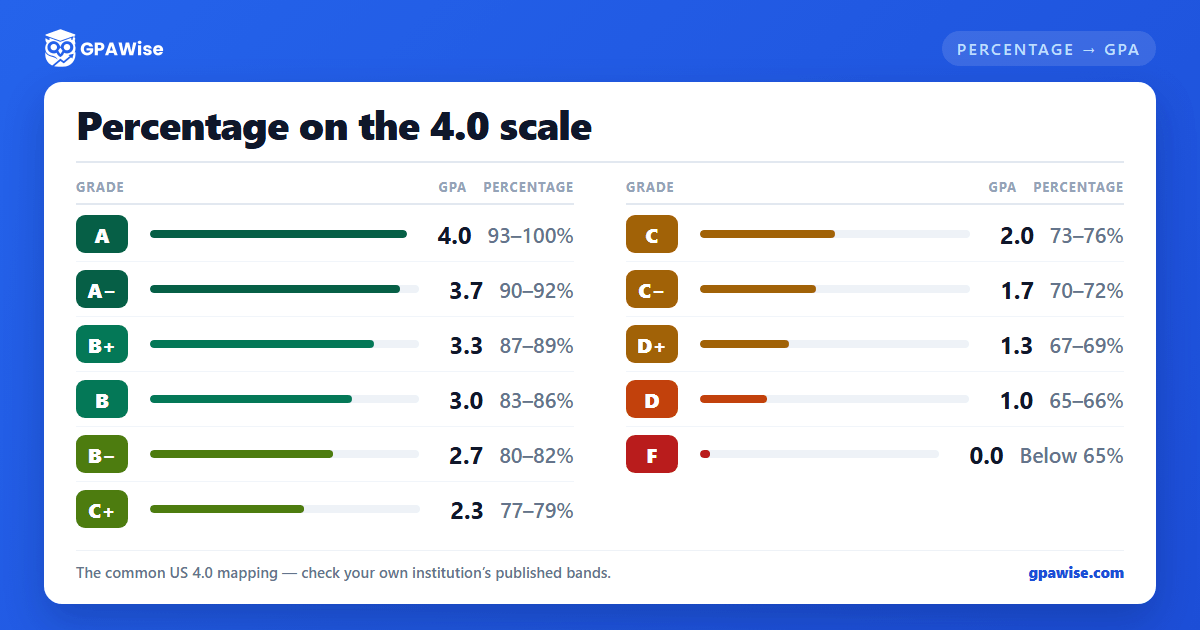
Why “(Percentage ÷ 100) × 4” Isn't an Official Rule
No university, examination board, or government publishes the divide-by-25 formula — it survives because it is easy, not because it is sanctioned. Even calculators that lead with it concede there is “no universally accepted formula.” What actually happens to your grades is more deliberate. A US registrar never touches your percentage; it builds a GPA from letter grades, multiplying each course's grade points by its credit hours, summing, and dividing by total credits — so three A's and a C weigh by course size, not by a flat average. For international applicants, WES and other evaluators go a step further, reading each course individually against your institution's and country's grading norms before assigning a US letter grade, then credit-weighting the result. They don't publish a formula because there isn't one to publish. Two smaller traps are worth naming while we're here: dividing by 20 gives a 5.0-scale number, not a 4.0 one, and multiplying by 5 isn't a real 5.0 conversion at all.
Converting a Percentage to a 10-Point CGPA (India)
If your target is India's 10-point CGPA rather than a US 4.0 GPA, the arithmetic — and the source — changes. The most common rule is CBSE's Percentage ÷ 9.5, so a 76% is about 8.0, but that 9.5 is one board's figure, not a universal constant: Anna University divides by a flat 10, VTU adds 0.75, and the UGC publishes no formula at all. Our dedicated percentage to CGPA calculator runs each rule and shows the exact formula applied.
4.0 vs 5.0 vs 10-Point: Which Scale Do You Need?
Pick your scale from where you're applying, not from which number looks better. US colleges almost all grade on the 4.0 scale, though no national rule sets it: an A is 4, a B 3, a C 2 and a D 1, and only a few count an A+ above 4.0, such as Stanford's 4.3. The 5.0 scale trips people up because it isn't a percentage conversion at all — it's a weighting system US high schools use to reward harder courses, adding roughly 0.5 for honors and 1.0 for AP or IB classes. So a 92% in an AP class doesn't “become” a 4.6 through any formula; the 4.6 comes from the bonus, not the mark. The 10-point CGPA is India's convention, home of the ÷9.5 and VTU rules above. None of the three is more correct than the others — they answer different questions. A student applying to a US master's needs the 4.0 number an evaluator will recognise; a student reporting to an Indian university needs its CGPA. Convert toward the system that will actually read the result.
What Your Target University Actually Requires
Before you trust any converted number, check who has to accept it. Many US and Canadian graduate programs won't take a self-calculated GPA from an international transcript at all; they ask for the transcript itself or an official evaluation from a credential service such as WES, ECE, or another NACES member, which recomputes your GPA on their terms. A figure you worked out with divide-by-25 can be a useful planning number, but it rarely appears on the application as-is. Minimum-GPA thresholds deserve the same skepticism. The specific cut-offs that circulate online — this country supposedly needs one number, that one another — aren't published by any single authority; they're rules of thumb that vary by program, department, and year, and competitive courses quietly expect more than the stated floor. Treat them as orientation, then read the actual requirement on your target program's admissions page or ask the evaluator handling your file. The real bar lives there, not in a generic conversion chart.
Official Formulas by Institution
Skip the generic formula when your institution publishes its own. The boards and universities below use fixed, official conversions; the Pakistani universities each map percentage marks onto a 0–4.0 GPA through their own HEC-based grade bands, which the per-university calculator applies exactly. Your school's real scheme always beats a one-size estimate.
| Institution | What it does | Source / calculator |
|---|---|---|
| CBSE (India, Class X) | Percentage = 9.5 × CGPA (so % → CGPA = ÷ 9.5) | CBSE Circular 24/2010 |
| VTU (India) | Percentage = (CGPA − 0.75) × 10 (2015–18 schemes) | VTU official |
| COMSATS University Islamabad | Percentage marks → 0–4.0 GPA via grade bands | Open calculator → |
| Lahore University of Management Sciences | Percentage marks → 0–4.0 GPA via grade bands | Open calculator → |
| NED University of Engineering and Technology | Percentage marks → 0–4.0 GPA via grade bands | Open calculator → |
| University of the Punjab | Percentage marks → 0–4.0 GPA via grade bands | Open calculator → |
| Quaid-i-Azam University | Percentage marks → 0–4.0 GPA via grade bands | Open calculator → |
| University of Engineering and Technology (UET) Lahore | Percentage marks → 0–4.0 GPA via grade bands | Open calculator → |
| Institute of Business Administration | Percentage marks → 0–4.0 GPA via grade bands | Open calculator → |
| Air University | Percentage marks → 0–4.0 GPA via grade bands | Open calculator → |
How to Calculate Your GPA the Accurate Way
The dependable way to turn percentages into a GPA takes four steps and mirrors what a registrar does.
- Convert each course's percentage to a letter grade using your school's own grade bands — not a generic table.
- Look up the grade points for each letter (A = 4.0, B = 3.0, and so on, to your institution's values).
- Multiply each course's grade points by its credit hours to get that course's quality points.
- Add up all the quality points and divide by your total credit hours.
The division by credits is the part the shortcut skips, and it's what makes the result honest: a four-credit course moves your GPA more than a one-credit elective. Worked through, an A (4.0) over 3 credits, a B (3.0) over 3 credits, and a C (2.0) over 2 credits give 12 + 9 + 4 = 25 quality points across 8 credit hours, or 3.13. The two methods diverge most when your marks sit near a grade boundary: an 86% and a 90% look close as percentages, yet they land on a B and an A− — 3.0 versus 3.7, roughly two-thirds of a grade point apart — once your school's bands round them. That difference is what the credit-weighted method captures and a flat divide-by-25 can't. Use the accurate version whenever the number counts — a scholarship form, a graduate application — and keep divide-by-25 for the back of an envelope.