
How to calculate CGPA from SGPA
Cumulative GPA on the 10-point scale is a weighted average of every semester's SGPA, with credits as the weight:
Example: four completed semesters with SGPAs 8.2, 8.6, 7.9, 8.5 and credits 22, 24, 24, 22.
- Multiply each pair: 8.2×22 = 180.4, 8.6×24 = 206.4, 7.9×24 = 189.6, 8.5×22 = 187.0
- Sum the weighted values: 180.4 + 206.4 + 189.6 + 187.0 = 763.4
- Sum the credits: 22 + 24 + 24 + 22 = 92
- Divide: 763.4 / 92 = 8.30 CGPA
If every semester has the same credit load, the weighted average reduces to the plain average of your SGPAs — but most engineering and science programs vary credits per term, so weighting matters.
SGPA vs CGPA — what's the difference?
SGPA (Semester Grade Point Average) is the credit-weighted average of grade points for a single semester. CGPA (Cumulative Grade Point Average) is the credit-weighted average of SGPAs across every semester you've completed. The math is the same; the scope is different.
- SGPA is what appears on each semester's result sheet.
- CGPA is what appears on your final transcript and is used for placements, higher-studies applications, and most ranking cut-offs.
- CGPA is always between your lowest SGPA and your highest SGPA — adding a new semester pulls it toward the new SGPA in proportion to that semester's credit weight.
CGPA for engineering, B.Tech, BSc, and MBA students
The formula is identical regardless of program — what varies is the typical credit load per term and the published grade mapping:
| Program | Typical duration | Credits / semester | Common scale |
|---|---|---|---|
| B.Tech / BE (Engineering) | 8 semesters | 20–28 | 10-point |
| BSc / BA | 6 semesters | 18–24 | 10-point |
| MBA | 4 semesters | 20–30 | 10-point or 4.0 |
| MTech / MSc | 4 semesters | 18–24 | 10-point |
The Quick mode above is fastest if you already have published SGPAs. If you only have per-course grades (e.g. you're mid-semester and want to project a final CGPA), switch to Detailed mode and enter each course's credits and letter grade.
How Indian universities calculate CGPA (CBSE, AKTU, VTU, Anna)
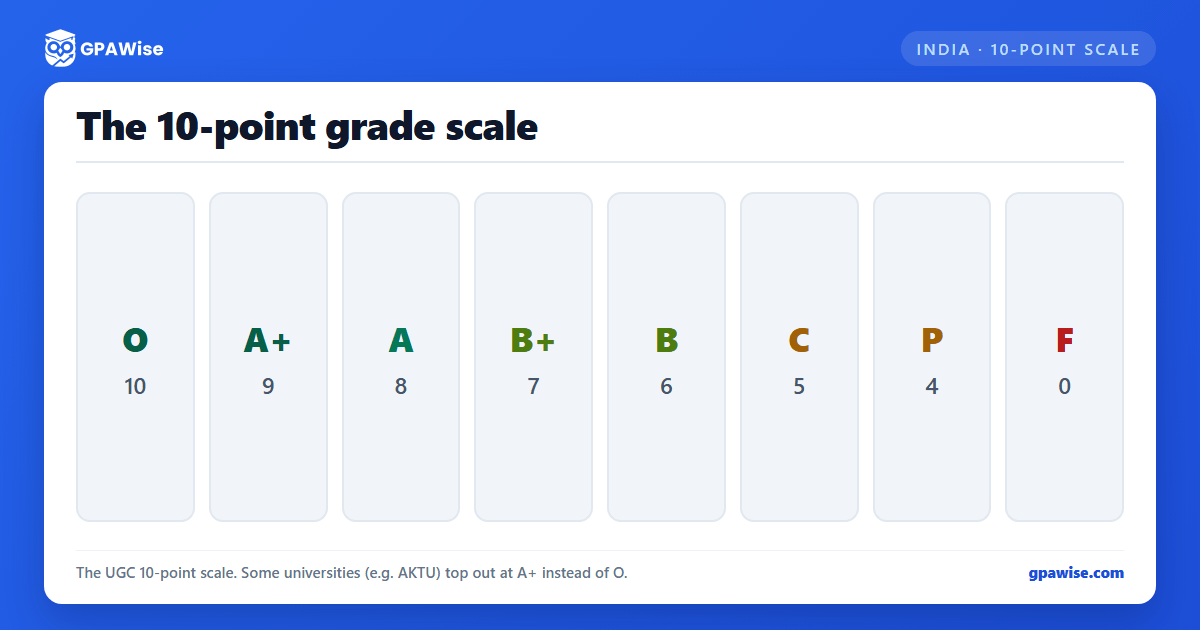
The credit-weighted-average formula is uniform across Indian universities — the only thing that differs is the letter grade → grade point mapping:
- CBSE (school-level, 10th & 12th): O=10, A+=9, A=8, B+=7, B=6, C=5, D=4, E=fail. School-leaving CGPA uses these.
- AKTU (Abdul Kalam Technical University, UP): A+=10, A=9, B+=8, B=7, C+=6, C=5, P=4, F=0. The "A+" is the top grade (not "O").
- VTU (Visvesvaraya Technological, Karnataka): O=10, A+=9, A=8, B+=7, B=6, C=5, P=4, F=0 — matches CBSE letter labels.
- Anna University (Tamil Nadu): O=10, A+=9, A=8, B+=7, B=6, C=5, RA=0 (RA = re-appear/fail).
- Mumbai University, Delhi University: Both use a 10-point credit-weighted scheme, but each publishes its own percentage rule — Mumbai University historically used (CGPA × 7.1) + 11 (reportedly replaced by a marks-based certificate in 2026), which is nothing like CBSE's × 9.5. Check your transcript legend for the exact one.
Once you have the grade-point per course, every university applies the same Σ(GP × credits) / Σ(credits) formula. If you need your university's exact letter mapping baked into the calculator, pick your school — every supported university has its scheme stored separately.
Converting CGPA to percentage (placements, government jobs)
There is no single official CGPA-to-percentage formula — the multiplier depends on your university, and the UGC (which defined the 10-point CGPA) publishes none. The most widely used, and CBSE's own rule, is:
That is CBSE's Class-X rule (Circular 24/2010), not a national standard. Common variations by institution:
- Anna University: Percentage = CGPA × 10 — a flat multiplier, per its R2021 regulations.
- VTU: Percentage = (CGPA − 0.75) × 10 for its 2015–18 schemes — a university-family formula, not CBSE's.
- Mumbai University: Percentage = (CGPA × 7.1) + 11 — its CBCS-era rule, reportedly replaced by a marks-based certificate in 2026.
- Some autonomous institutes: Percentage = CGPA × 10 flat — check your transcript legend.
Use our CGPA to Percentage calculator to apply each rule side by side and see the exact formula.
Converting CGPA to U.S. 4.0 GPA (grad school applications)
The simple linear conversion, used by most chance calculators and self-assessment forms:
So a 9.0 CGPA becomes a 3.6 U.S. GPA. Important caveat: most U.S. graduate programs require a WES or ECE credential evaluation, which does a course-by-course evaluation against the country's standard — the linear conversion is fine for shortlisting and ballpark, but it is not the number WES will produce. Use this calculator's scale toggle to see the linear 4.0 figure, and our converter shows the math step-by-step.
For a German application, convert with the CGPA to German grade calculator, which asks for your degree minimum.
Want your university's exact scheme?
This page uses a generic 10-point mapping that matches most Indian universities, but your school may have a slightly different letter-to-point table. GPAWise has per-university calculators for 1424+ institutions, each with the official scheme baked in:
→ Pick your university for the exact calculator
Want to track CGPA semester-by-semester?
If you're saving results across multiple visits, our per-university calculator pages include a CGPA Tracker tab — save each semester as you finish it, watch your cumulative number evolve, and see the per-semester trend. Pick your university above to use it.