
What Converting a Percentage to a CGPA Really Means
Converting a percentage to a CGPA re-expresses one scoring system as another by dividing — and the divisor is a choice your institution makes, not a fixed constant. A percentage sits on the familiar 0–100 line; a CGPA folds the same performance into a cumulative grade point average, usually out of 10 in India, built up across every semester. Moving between them means picking a number to divide by, and that number belongs to whoever issued the result — a board, a university, an examination office. So a 78% can read as one CGPA on your transcript and a slightly different equivalent on a friend's from another university: the two simply divide by different figures. A generic converter only assumes the most common divisor; your own lives in your transcript legend. One thing settles before any of it — which scale the CGPA uses. The rule that turns a percentage into a 10-point CGPA is not the one that fits a 5-point or 4.0 system, so “out of what?” comes before “divided by what?”
The Common Percentage-to-CGPA Formula (÷ 9.5)
When you just need the figure, divide your percentage by 9.5: an 80% becomes 80 ÷ 9.5 = 8.42, and a 76% lands at 8.0. This is the divisor most people mean by “the CGPA formula,” and it has a real pedigree — it's the reverse of the rule CBSE published for its Class-X 10-point CGPA in Circular 24/2010, where Percentage = 9.5 × CGPA. The same ÷ 9.5 works whether you're converting a single semester's SGPA or an aggregate across your whole degree; the arithmetic doesn't care which average you feed it. To run it the other way, when a form already has your CGPA and wants a percentage, multiply by 9.5 instead. You'll also see stories about why the number is 9.5 — that it's the midpoint of the 90–100 band, or a top-performer average of about 95 — but those are after-the-fact rationales, not anything CBSE states. One caveat: 9.5 is one board's divisor, the most widely used default, not a national standard, so it's right only when your institution actually uses it.
Reverse: Percentage = CGPA × 9.5 — e.g. 8.0 × 9.5 = 76%.
Percentage to CGPA Conversion Table (10-Point)
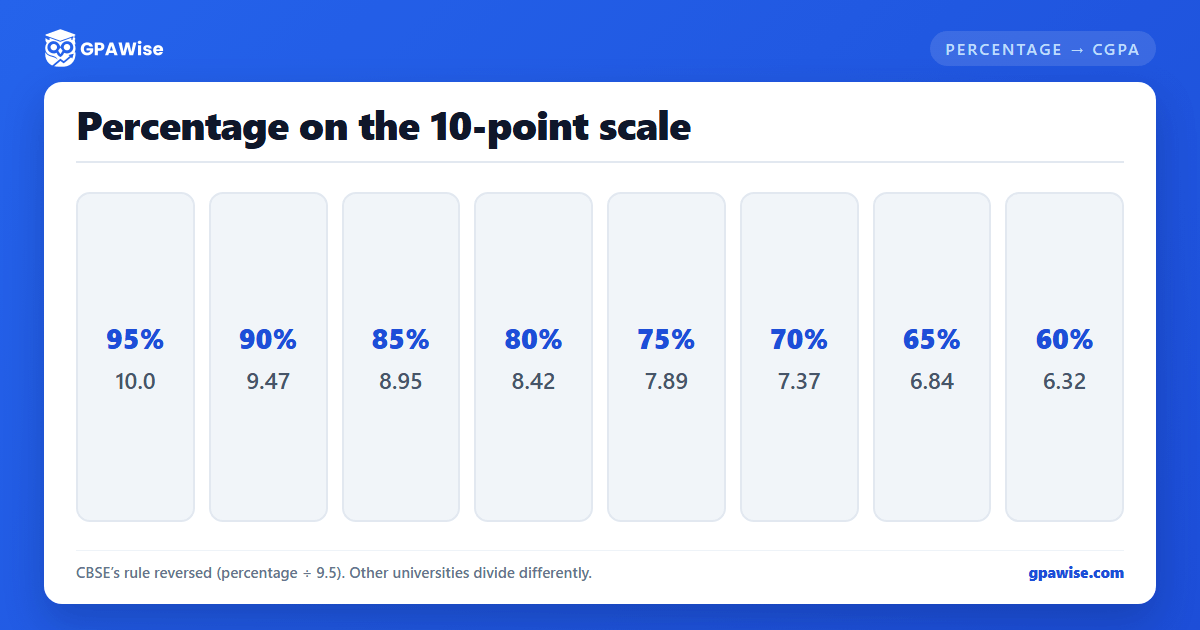
The table below runs the ÷ 9.5 rule across the range, from a near-perfect 95% down toward a pass. Read it as a CBSE-style reference, not a verdict for every college: a university that divides by a flat 10 lands a few tenths lower on each row, and one that adds 0.75 lands higher. Where your transcript disagrees with this table, your transcript wins.
| Percentage | CGPA (Percentage ÷ 9.5) |
|---|---|
| 95% | 10.0 |
| 90% | 9.47 |
| 85% | 8.95 |
| 80% | 8.42 |
| 75% | 7.89 |
| 70% | 7.37 |
| 65% | 6.84 |
| 60% | 6.32 |
| 55% | 5.79 |
| 50% | 5.26 |
Why There's No Single “Official” Percentage-to-CGPA Formula
There is no official percentage-to-CGPA formula, because the body that standardized India's 10-point CGPA never wrote one. The UGC's Choice Based Credit System defines the grade scale — O is 10, A is 8, down to F at 0 — and the credit-weighted method for building an SGPA and a CGPA, and it stops there. No conversion divisor, no marks-to-grade bands. So “divide by 9.5 because the UGC says so” is invented. Worse, the converters that fill the gap contradict each other: several sites — including a university's own page — label VTU's (Percentage ÷ 10) + 0.75 as Anna University's rule. It isn't. Anna University uses a flat ÷ 10; the +0.75 belongs to VTU's 2015–18 schemes. Run one 80% through all three and you get 8.42 from CBSE, 8.0 from Anna, and 8.75 from VTU — three answers, because the real question is never “what's the formula?” but “whose rule applies to my transcript?”
Source: UGC Guidelines on the Choice Based Credit System — defines the 10-point grade scale and SGPA/CGPA computation; no percentage-conversion formula. VTU's own CGPA formula confirms the (CGPA − 0.75) × 10 rule this reverses is VTU's, not Anna's.
Is Your CGPA Out of 10, 5, or 4?
Before reaching for any divisor, check what the CGPA is out of — the conversion changes completely with the scale. A 10-point CGPA, the Indian default, uses the ÷ 9.5-family rules already covered. A 5-point CGPA works differently: multiply the percentage by 0.05, or equivalently divide by 20, so 100% maps to 5.0 and 80% to 4.0 — a plain scale-normalisation, not a grade rule. The 4.0 scale is where the popular shortcut breaks. Dividing a percentage by 25 — the “4 points across 100 marks” trick — assumes the scale is perfectly linear, but no real 4.0 system assigns grades that way. Pakistan's HEC is the clear case: it maps each grade to a band of percentages, so its own guidelines pair a 3.00 CGPA with 71%, not the 75% that ÷ 25 would hand it. A mark near 71% sits in the B band there, not at a tidy 3.00. Treat a 4.0 or 5-point CGPA as a different grading system with its own bands, not a 10-point number you can rescale — borrow a 10-point divisor for it and you produce a figure no registrar would accept.
Source: HEC Policy Guidelines, §13.1: a CGPA is assigned the minimum percentage of its grade band (3.00 → 71%).
Do You Even Need to Convert to a CGPA?
Often, you don't need to convert at all. Plenty of universities abroad read an Indian percentage or CGPA directly and would rather see the number on your transcript than one you derived; when they do want an independent figure, a credential evaluator like WES or another NACES member recomputes your record course by course, not through any national divisor. A self-converted CGPA rarely does the work students expect on a foreign application. Where the conversion genuinely matters is closer to home: Indian college-application fields, employers, and some government-recruitment forms still ask for a CGPA, and a few print a hard cutoff. For those, use the exact rule your university issues and state both numbers — “80% (8.42/10)” leaves no room for the reader to apply the wrong divisor and shave your record. As for the minimum-CGPA figures that circulate for this course or that country, treat them as rough guidance: no single authority publishes them, and they move with the program, the intake, and the year.
Percentage-to-CGPA Formulas by University
When your university publishes its own rule, use it and ignore every generic divisor. The Indian boards and universities below each fix their own conversion; the Pakistani universities work on the 0–4.00 scale, where a percentage maps to a CGPA through HEC grade bands rather than a divide — tap any of them to run your marks through that school's real scheme. Your institution's actual rule always beats a borrowed one.
| Institution | Official conversion (% → CGPA) | Source / calculator |
|---|---|---|
| CBSE (India, Class X) | CGPA = Percentage ÷ 9.5 | CBSE Circular 24/2010 |
| Anna University (India) | CGPA = Percentage ÷ 10 (flat) | Anna University R2021 (ACOE) |
| VTU (India) | CGPA = (Percentage ÷ 10) + 0.75 (2015–18 schemes) | VTU official |
| Mumbai University (India) | CGPA = (Percentage − 11) ÷ 7.1 (CBCS era†) | University of Mumbai |
| COMSATS University Islamabad | Percentage → 0–4.00 CGPA via HEC grade bands | Open calculator → |
| Lahore University of Management Sciences | Percentage → 0–4.00 CGPA via HEC grade bands | Open calculator → |
| NED University of Engineering and Technology | Percentage → 0–4.00 CGPA via HEC grade bands | Open calculator → |
| University of the Punjab | Percentage → 0–4.00 CGPA via HEC grade bands | Open calculator → |
| Quaid-i-Azam University | Percentage → 0–4.00 CGPA via HEC grade bands | Open calculator → |
| University of Engineering and Technology (UET) Lahore | Percentage → 0–4.00 CGPA via HEC grade bands | Open calculator → |
| Institute of Business Administration | Percentage → 0–4.00 CGPA via HEC grade bands | Open calculator → |
| Air University | Percentage → 0–4.00 CGPA via HEC grade bands | Open calculator → |
† Mumbai University reportedly replaced its formula-based conversion with a marks-based certificate in 2026 (Circular Exam/Result/803 of 2026) — treat (Percentage − 11) ÷ 7.1 as historical and confirm the university's current policy.
How to Convert Your Percentage to a CGPA Reliably
A reliable conversion is a short routine, not a single divide.
- Settle the scale — 10-point, 5-point, or 4.0 — since each takes a different rule.
- Find your institution's own divisor on the transcript legend or in the examination handbook; that published rule outranks anything a converter assumes.
- Apply it — a 10-point CBSE result uses ÷ 9.5, an Anna University result a flat ÷ 10, and a 4.0-scale HEC result a grade-band lookup rather than a divide.
- For anything official, quote both the percentage and the converted CGPA, and prefer your university's issued conversion where it offers one.
The step people skip is the second, and it's the only one that turns an estimate into a number a registrar will accept. Say your marksheet reads 82%: CBSE's ÷ 9.5 puts that at 8.63, but if your university mandates a flat ÷ 10, the honest CGPA is 8.2 — four-tenths of a point that can change which cutoff you clear. Keep ÷ 9.5 for the ballpark check of whether you're in range, and reserve the official rule for the form itself. If your quick estimate and your transcript ever diverge by more than a few tenths, that gap is the tell that you've borrowed a divisor your institution doesn't use.