
What Is a Middle School GPA?
A GPA gathers all of your graded classes into one number on a 0.0 to 4.0 scale. Each letter grade is worth a set number of points, and the average of those points across your subjects is the figure people call your grade point average. Through the middle grades — sixth, seventh, and eighth — it reads as a running temperature check on the term, not a mark that follows you anywhere permanent.
Not every middle school calculates an official GPA, and some replace letter grades with standards-based grading that never converts to a 4.0 number. Your report card may simply list a grade per subject and leave the math there. That's the gap a calculator fills — it does the averaging your school might skip — but read the result as a solid estimate of where things stand, not a figure the school has formally recorded.
How to Calculate Your Middle School GPA (No Credits Needed)
To calculate a middle school GPA, give each class's grade its points on the 4.0 scale, add the points, and divide by the number of classes. No credit hours enter into it, so every class counts once.
- List every class on your report card, electives included.
- Give each grade its points. Take a seventh grader with an A in English (4.0), a B+ in math (3.3), an A− in science (3.7), a B in social studies (3.0), an A in band (4.0) and a C+ in gym (2.3). A grade given as a percentage converts to its letter first; if the report card prints both, enter the letter.
- Add the points: 4.0 + 3.3 + 3.7 + 3.0 + 4.0 + 2.3 = 20.3.
- Divide by the number of classes: 20.3 ÷ 6 = 3.38.
20.3 ÷ 6 = 3.38
Band and gym pull exactly as hard as English here: on an unweighted scale, nothing is worth more than anything else.
If your school gives each class a credit value, one step changes. Multiply each grade's points by that class's credits, add those, and divide by the total credits. Howard County, Maryland, works its high school GPA that way.
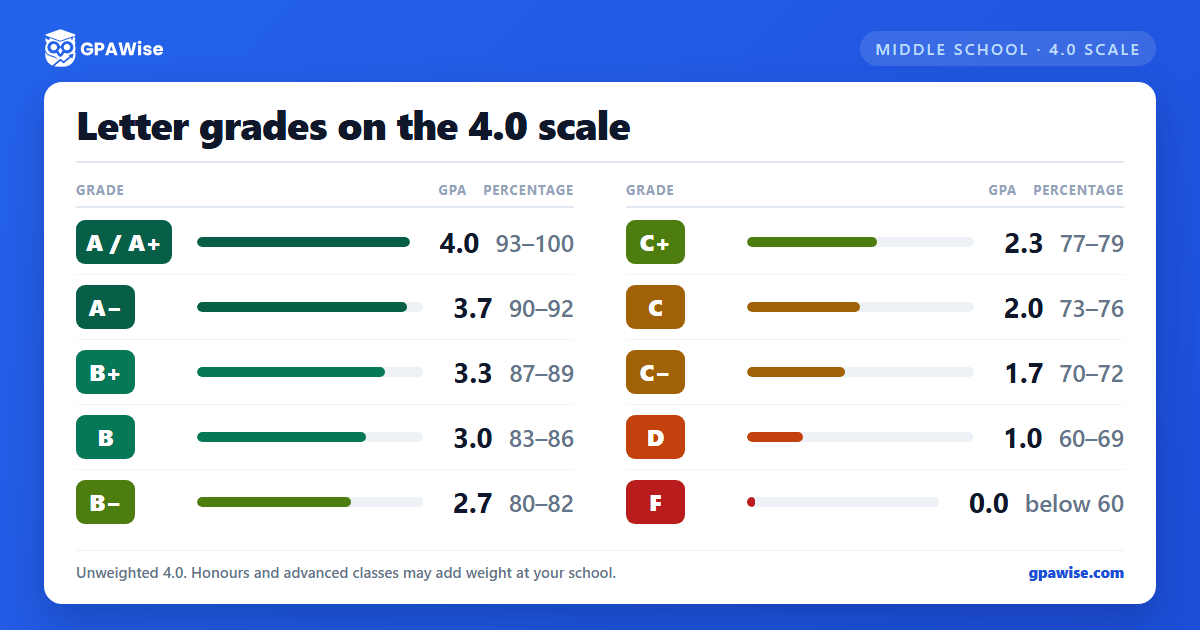
The points above are one plus/minus scale, the one this calculator uses. Where your school publishes its own, its handbook wins; the table below shows how far the percentage bands can move.
Past middle school, or not sure which plus/minus scale your school uses? The same equal-weight math, with a choice of scales, is on our GPA calculator with no credits.
Middle School Grade-to-GPA Conversion Scale
The table below is one unweighted 4.0 scale. Treat the point column as reliable and everything around it as a starting point. Published scales disagree on where a failing grade starts: below 60 in Howard County, Maryland (an E) and in North Carolina's high school policy, below 65 on College Board's chart. Howard County drops plus/minus entirely, and its GPA chart gives an E 0 points, as an F gets on this page's scale. A scale your own school publishes always beats a generic one.
| Letter grade | Grade points | Example % band |
|---|---|---|
| A / A+ | 4.0 | 93–100 |
| A− | 3.7 | 90–92 |
| B+ | 3.3 | 87–89 |
| B | 3.0 | 83–86 |
| B− | 2.7 | 80–82 |
| C+ | 2.3 | 77–79 |
| C | 2.0 | 73–76 |
| C− | 1.7 | 70–72 |
| D | 1.0 | 60–69 |
| F | 0.0 | below 60 |
Sources: HCPSS Policy 8020 · North Carolina Policy GRAD-009 · College Board.
Weighted vs. Unweighted GPA in Middle School
Where a middle school keeps a GPA, its handbook says whether it is weighted. Unweighted means one flat 4.0 scale where a hard class and an easy class are worth the same at the same grade. Weighting is the alternative — honors or advanced courses earn bonus points. Howard County and North Carolina each add half a point for honors and a full point for AP, so an A can reach 5.0. South Carolina's state scale is not a 4.0 scale at all: a 100 earns 5.0 in a regular class, and the same half and full point go on top.
All three are high school rules, and the bonus is the root of a stubborn misunderstanding. On an unweighted 4.0 scale an A is the ceiling; an A, or even an A+, is worth 4.0 and stops there. On a 4.0 scale the only path above 4.0 is weighting — never an A+ on its own. If your middle school does weight honors classes, its handbook will name the exact bonus, so don't assume one is waiting for you. Once those honors and AP classes arrive, the GPA calculator for high school shows both figures.
Sources: HCPSS Policy 8020 · North Carolina Policy GRAD-009 · South Carolina Uniform Grading Policy, Administrative Procedures (archived copy).
Cumulative vs. Semester GPA (and the averaging mistake)
A semester GPA covers one grading term; a cumulative GPA covers every term stacked together. The shortcut people reach for — averaging the two semester numbers — quietly breaks the moment the terms hold different numbers of classes.
The dependable method works from the points, not the finished averages: add every class's grade points across all terms and divide by the total number of classes. Picture a fall term of six classes at a 3.50 (21.0 points) and a light spring term of two classes at a 2.00 (4.0 points). Averaging the GPAs suggests 2.75, but the honest cumulative is (21.0 + 4.0) ÷ 8 = 3.13, because the six-class term simply carries more of the total than the two-class one. Howard County's policy works from the points too: for its high school GPA it multiplies each course's quality points by its credits, sums them and divides by the credits of the courses taken. (Quality points are the policy's name for grade points.) Enter the grades your school records as final for each term, whether it runs quarters, trimesters or semesters; cumulative here means across every term you enter.
Source: Howard County Public Schools — Policy 8020, Grading and Reporting: Middle and High School.
Does Your School Even Use GPA? What to Do If It Doesn't
Before chasing a number, check whether your school issues one at all. Some define a GPA only at the high school level, and some use standards-based grading in the middle grades — marks like 1 through 4 against specific skills, with no 4.0 average behind them. A card like that has no GPA of its own; use the school's own key if it gives one. Howard County is a documented case: its policy lays out a high school GPA in detail but assigns middle school no formal GPA calculation.
When a school does publish its own scale, those numbers outrank any table here. When it doesn't, a 4.0 scale like the one above gives you a usable estimate to plan around. The reason a generic table can only estimate is that real scales genuinely diverge:
| Grading approach | Scale style | Weighting |
|---|---|---|
| Howard County (HCPSS), MD | Whole letters A–E, 10-point bands, E below 60 | High school only |
| Plus/minus scale (as on this page) | A− / B+ … on a 4.0 scale | Honors/AP adds 0.5 / 1.0 in high school |
Source: HCPSS Policy 8020 — defines a high school GPA but not a formal middle school GPA.
What's a Good Middle School GPA? Honor Roll, NJHS & the "Average" Myth
None of the bodies this page cites publishes a verdict or an average for a middle school GPA. Honor roll tiers are set school by school, so your school's exact lines may differ:
| Recognition | Example GPA |
|---|---|
| Principal's List | 4.0 |
| High Honor Roll | around 3.7+ |
| Honor Roll | around 3.0+ |
What is published is a minimum for one purpose: the lowest Scholarship requirement a National Junior Honor Society chapter may set is a cumulative 85, B or 3.0 on a 4.0 scale, or an equivalent standard, and each chapter can set a higher one. The "average middle school GPA" of 2.8 to 3.2 that some websites quote cites no source. The national figure that is published, from the federal transcript study, is for high school graduates: 3.11 in 2019, so it is no middle school benchmark either. Read your own GPA as a trend, not a rank against an unsourced number.
Sources: NJHS, How to Become a Member · NAGB, 2019 High School Transcript Study.
Does Middle School GPA Matter?
For college, the answer points to high school. Four-year colleges in NACAC's survey rated grades in high school courses and the strength of the high school curriculum as the most important factors in admission (Fall 2023).
Closer to home, it carries real weight. A strong middle school record can decide placement into honors and accelerated lanes. A course taken for high school credit in middle school is different: in Howard County it appears on the high school transcript but stays out of the GPA, while South Carolina applies its uniform grading policy to high school credits earned in middle school. The study habits set now walk straight into ninth grade, where high school grades begin. Worth taking seriously; not worth losing sleep over.
Sources: NACAC — Factors in the Admission Decision · HCPSS Policy 8020 · South Carolina Uniform Grading Policy (archived copy).
Which Classes Count Toward Your GPA?
On an unweighted scale every class with a letter grade counts, and each counts the same. Electives are not a footnote — art, music, PE, world languages, and technology average in exactly like math or science. A course marked pass/fail, or with a mark such as S or U instead of a letter, has no grade points to add (Howard County leaves courses marked with a P code instead of a letter out of the cumulative GPA), and your school's policy decides the rest.
A handful of middle school courses do more than feed the middle school GPA. A course your district offers for high school credit, taken in seventh or eighth grade, can appear on the high school transcript — the point where grades eventually become visible to colleges. Because it turns on district and state rules, confirm it with a counselor rather than assuming it either way.
How to Improve Your Middle School GPA
Raising a GPA is mostly a matter of aim, not extra hours. Find the one or two classes dragging the average down and spend your effort there — lifting a single C to a B adds a full grade point to the total, as much as three or so plus/minus steps spread across other classes.
Check your GPA every marking period instead of waiting on the final report card; if your school posts grades in a portal like PowerSchool, Infinite Campus, or Skyward, a slide shows up while there's still time to fix it. Keep every assignment and due date in one place, and reach a teacher the week the material stops making sense, not the week before finals. Skip the comparisons to friends' numbers — the only benchmark worth watching is your own last term.