
How to calculate GPA without credits
A GPA with no credits is a plain average: every class counts once, so nothing gets multiplied. College Board describes it to high school students in one line: “you add up all the GPA points from your courses and divide them by the number of classes you’ve taken.”
The whole letters barely vary: among the college scales we have verified, the five values above hold wherever a scale lists the letter, with one exception. What does vary is the worth of a plus or a minus, so check that part against your own handbook before trusting any calculator, this one included.
Take a report card of five classes graded A, A−, B+, B and B+. On the most common plus/minus scale those letter grades are worth 4.0, 3.7, 3.3, 3.0 and 3.3, a sum of 17.3. Divide by five and the grade point average is 3.46. A class marked pass/fail or satisfactory earns no grade points, so leave it out of both the sum and the count.
- List each class that has a final letter grade.
- Give each letter its grade points on your school’s scale.
- Add the grade points.
- Divide that sum by how many classes you listed.
(4.0 + 3.7 + 3.3 + 3.0 + 3.3) ÷ 5 = 17.3 ÷ 5 = 3.46
Source: College Board, How to Calculate Your GPA on a 4.0 Scale.
High school: when a no-credits GPA matches your transcript
A no-credits GPA matches a high school transcript when every class on it carries the same credit, and it drifts as soon as one does not. The usual cause is the semester class. A year-long class worth 1.0 credit counts twice as much as a one-semester class worth 0.5, so a single row for each will not reproduce the transcript.
Say Algebra (an A in both semesters) and English (a B in both) run all year, and Health is a one-semester class with a C. One row per class gives (4 + 3 + 2) ÷ 3 = 3.00. The transcript, counting each class by its credit, says (4 × 1.0 + 3 × 1.0 + 2 × 0.5) ÷ 2.5 = 3.20. Enter a row for each semester grade instead (A, A, B, B, C) and the no-credits average becomes 16 ÷ 5 = 3.20, the same figure. Where a year-long class shows only one final grade, enter that grade twice.
The University of California recalculates applicants’ GPAs without credits in just this way. For the college-preparatory courses it counts, each semester’s letter grade is one grade, and its instructions add that pluses and minuses don’t count. For honors and AP weighting, use the high school GPA calculator.
Source: University of California Admissions, GPA requirement.
Middle school: every class counts once
If a middle school report card lists no credit beside each class, there is nothing to weight: add the grade points and divide by the number of classes. Whether the school keeps a GPA at all is a separate question. Howard County, Maryland, for one, defines a GPA for high school and none for middle school, so treat your result as an estimate unless the school publishes its own. For honors weighting and honor roll benchmarks, use the middle school GPA calculator.
Source: Howard County Public School System (Maryland), Policy 8020.
Plus and minus grades: there is no single scale
No rule fixes what a plus or a minus is worth. We read the published grading scale behind each of 978 verified US calculators on this site, all of them colleges and universities. 458 of those scales use whole letters only. The other 520 have a grade between B and A and disagree on its value, as the table shows.
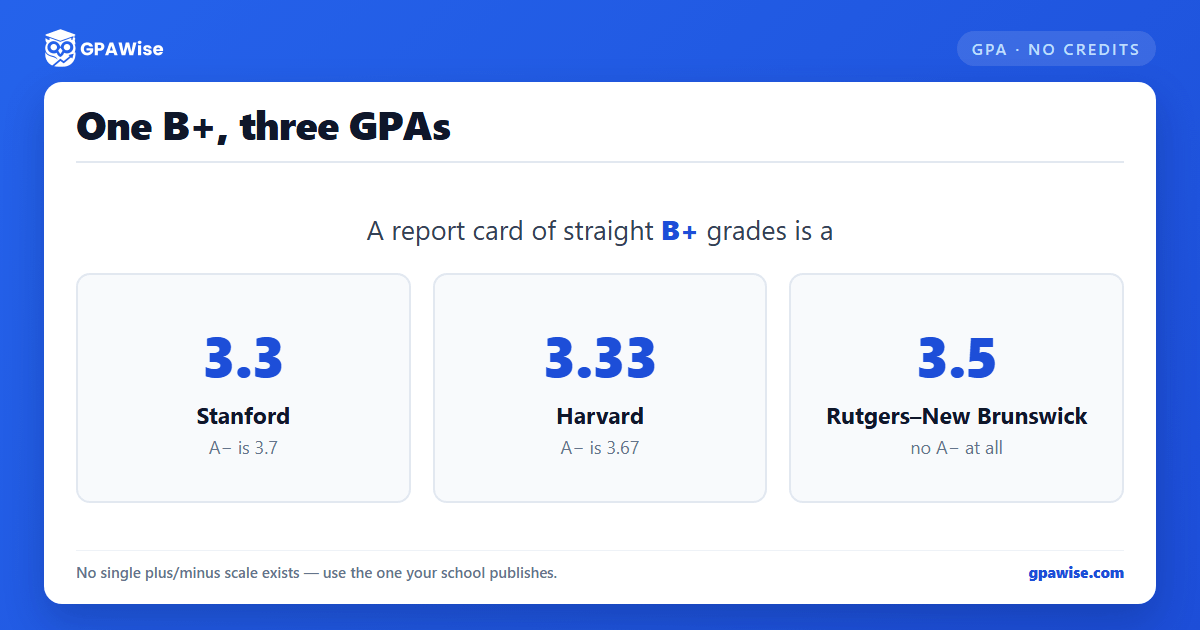
The report card from the first example comes to 3.46 where a B+ is 3.3, 3.47 where it is 3.33 and 3.40 where plus and minus are dropped. A report card of nothing but B+ grades is a 3.0 by the University of California’s admissions method (before any honors points), a 3.3 on Stanford’s scale, a 3.33 on Harvard’s and a 3.5 at Rutgers–New Brunswick.
Among colleges an A+ rarely adds anything: of the 105 scales that include one, 91 count it as 4.0, while 8 make it 4.33 and 6 make it 4.3 (Stanford, Cornell, Columbia and Caltech among those 14). We have no such count for high schools or middle schools, where College Board gives the same warning: “Some schools don’t use pluses and minuses, and others have different grade cutoffs.”
| Scale | B+ (or AB) | A− | Verified US scales | Examples |
|---|---|---|---|---|
| Whole letters only | no plus grades | no minus grades | 458 | Georgia Institute of Technology · University of Arizona · University of Oklahoma |
| Plus/minus in tenths | 3.3 | 3.7 | 296 | University of California, Los Angeles · Duke University · University of Michigan |
| Plus/minus in thirds | 3.33 | 3.67 | 169 | Harvard University · University of Texas at Austin · University of Florida |
| Half steps | 3.5 | usually none | 42 | Rutgers University–New Brunswick · University of South Carolina · University of Wisconsin–Madison |
| Other values | 3.4 at 7, 3.25 at 4, others at 2 | 3.7 or 3.75 | 13 | Brigham Young University · University of Pittsburgh · Florida State University |
Counted from each institution’s own published grading scale, colleges and universities only. Every example links to that school’s calculator, which cites the document. Sources for the two quotations: University of California Admissions, GPA requirement · College Board, How to Calculate Your GPA on a 4.0 Scale.
Every letter’s most common grade points and percentage cut-off across GPAWise’s verified US college scales, with the count behind each, are on the letter grade scale chart.
Using percentages instead of letter grades
With percentages, this calculator turns each grade into a letter first, and schools draw those lines in different places. Among the 93 verified college scales that publish percentage bands, a 90% is an A (4.0) at 47, an A− at 43 and lower still at the other 3. The table lists the most common cut-off for each letter, which is what the calculator applies: the plus/minus column on its two plus/minus scales, the whole-letter column on whole letters. If your syllabus prints other bands, convert each grade yourself and enter the letters. To turn one overall percentage into a GPA, use the percentage to GPA calculator.
| Letter | Lowest % on plus/minus scales | Lowest % on whole-letter scales |
|---|---|---|
| A | 93 | 90 |
| A− | 90 | |
| B+ | 87 | |
| B | 83 | 80 |
| B− | 80 | |
| C+ | 77 | |
| C | 73 | 70 |
| C− | 70 | |
| D+ | 67 | |
| D | 63 | 60 |
| D− | 60 | |
| F | below 60 | below 60 |
Measured across the verified scales counted above; each is linked from its school’s calculator.
College: where the no-credits shortcut goes wrong
In college a no-credits average is not your official GPA, because classes carry different credits and the registrar multiplies by them. The University of Florida states the rule in two sentences: “Multiply grade value by the number of credits for total grade points. Divide the total number of grade points by the number of credits carried.”
The term in the table shows the size of the gap: counted once each, its five grades average 17 ÷ 5 = 3.40, while the credit-weighted figure is 40 ÷ 13 = 3.08. The shortcut runs 0.32 too high because two one-credit A grades count as much as two four-credit classes. For any term like that, use the calculator built on your university’s own scale and credits, from the list of university GPA calculators.
| Class | Credits | Grade | Grade points | Points × credits |
|---|---|---|---|---|
| Calculus | 4 | C | 2 | 8 |
| Chemistry | 4 | B | 3 | 12 |
| Composition | 3 | A | 4 | 12 |
| Chemistry lab | 1 | A | 4 | 4 |
| First-year seminar | 1 | A | 4 | 4 |
| Total | 13 | 17 | 40 |
Source: University of Florida, Grades and Grading Policies.
Cumulative GPA without credits
A cumulative GPA without credits is your total grade points divided by your total classes, across every term. Work from those totals. Averaging the term GPAs themselves treats a short term as though it were as large as a full one.
Suppose a seven-class term ends at 3.60 and a two-class summer term at 2.50. The first holds 25.2 grade points and the second 5.0, so the cumulative GPA is 30.2 ÷ 9 = 3.36. Averaging 3.60 and 2.50 gives 3.05, which is 0.31 too low, because two summer classes were counted as heavily as seven.
The calculator’s By term tab does this from each term’s GPA and its number of classes. Where your terms carry credits, the weights are credits and not class counts; for those, use the cumulative GPA calculator.
(7 × 3.60 + 2 × 2.50) ÷ 9 = 30.2 ÷ 9 = 3.36