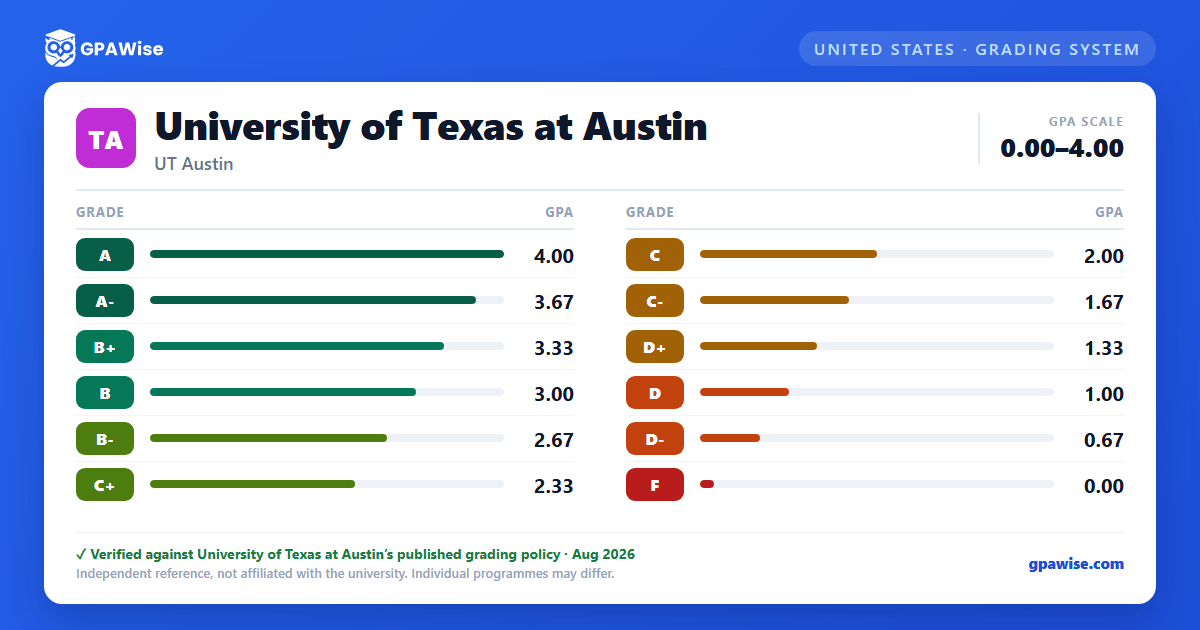

How grading works at UT Austin
UT Austin records your performance in each course as a letter grade, and each letter carries a grade-point value on a 0.00–4.00 scale. The catalog lists the grades UT uses exactly: A, A-, B+, B, B-, C+, C, C-, D+, D, D-, and F. There is no A+ — an A is the highest grade you can earn, and it is worth 4.00.
The same set of numerical equivalents is used for both the cumulative University grade point average for undergraduates and the graduate grade point average, so the scale itself does not change when you move from undergraduate to graduate study. See the Grade Scale Reference above for every letter and its grade points.
Individual instructors decide how they evaluate you — faculty are free to develop their own methods — but they must put those methods in writing by the first class day. UT does not publish a university-wide percentage-to-letter conversion, so how a numeric score in your class becomes a letter is set by your instructor, not by the University.
To receive credit for a course, an undergraduate must earn at least a D-. A graduate student must earn at least a C for a course to count on the Program of Work for a graduate degree.
Source: 2025-2026 General Information Catalog — Academic Policies and Procedures: Evaluation (Overview, Grades) and Computation of the Grade Point Average — verified Aug 2026
How UT Austin calculates your GPA
Your official grade point average is calculated by the registrar and appears on the student academic record the registrar maintains. Undergraduates have a cumulative University grade point average; graduate students have a graduate grade point average. Both are computed from the same table of numerical equivalents.
If you are an undergraduate, your cumulative University GPA includes all work you undertake at UT Austin — including credit by examination, correspondence, and extension — for which a letter grade is recorded. Courses recorded with the symbols I, Q, W, X, S, U, or CR are excluded.
If you are a graduate student, your graduate GPA includes the upper-division undergraduate and graduate courses in which you earn a letter grade while enrolled in the Graduate School. Excluded are: undergraduate courses taken through TEXAS Extended Campus; courses recorded with Q, W, X, I, CR, or NC; courses you took at the University before enrolling in the Graduate School; credit earned by examination; and courses taken at other institutions.
Repeating a course: if you repeat a course and have two or more grades, all grades and all semester hours are used to calculate your University GPA and to determine your eligibility to remain in school. The official grade in the course is the last one assigned — but the earlier attempt still counts toward the average.
Source: 2025-2026 General Information Catalog — Computation of the Grade Point Average (Undergraduate Students, Graduate Students); Evaluation: Repetition of a Course — verified Aug 2026
The GPA you need to stay in good standing
Beyond earning adequate grades in individual courses, you must keep your average above a floor to maintain satisfactory progress toward your degree:
- Undergraduates — a cumulative University grade point average of at least 2.00.
- Graduate students — a graduate grade point average of at least 3.00.
The catalog sets out what happens if you fall below these in its Academic Warning and Dismissal section.
Note that repeated courses affect this directly: because all attempts count toward the University GPA, they also count when the University determines your scholastic eligibility to remain in school.
Source: 2025-2026 General Information Catalog — Evaluation: Grades; Repetition of a Course — verified Aug 2026
How outside and by-exam credit is treated
Your cumulative University grade point average as an undergraduate covers work undertaken at The University of Texas at Austin for which a letter grade is recorded — including credit by examination, correspondence, and extension.
Credit by exam: since September 15, 2006, UT has awarded only the symbol CR for credit earned by exam, rather than a letter grade. Because CR carries no grade points, credit earned by exam and recorded since that date is not included in your cumulative University GPA. Through September 15, 2006, students could choose either a letter grade or CR, and credit by exam that was recorded with a letter grade is included.
For graduate students, the graduate GPA excludes courses taken at other institutions, credit earned by examination, and any graduate or undergraduate courses you took at UT before enrolling in the Graduate School.
Source: 2025-2026 General Information Catalog — Computation of the Grade Point Average (Undergraduate Students, Graduate Students); Evaluation: Credit by examination — verified Aug 2026
Frequently asked questions
Can I save my semesters and track my CGPA at UT Austin?
How do I convert SGPA to CGPA at UT Austin?
Can I add past semester GPAs without entering every course?
Is my CGPA tracker data sent to your servers?
Is this University of Texas at Austin (UT Austin) GPA calculator free?
Does UT Austin give A+ grades?
No. The General Information Catalog lists the grades UT uses exhaustively: "A, A-, B+, B, B-, C+, C, C-, D+, D, D-, and F." A+ is not among them, and it does not appear in the University's grade-point table either.
The highest grade you can earn is an A, worth 4.00 grade points, so the top of UT Austin's scale is a flat 4.00 — not 4.3 or 4.33.
Source: 2025-2026 General Information Catalog — Evaluation: Grades; Computation of the Grade Point Average — verified Aug 2026
What is the lowest passing grade at UT Austin?
It depends on your level. As an undergraduate, you must earn a grade of at least D- (0.67 grade points) to receive credit for a course. As a graduate student, you must earn at least a C (2.00) for a course to be included in the Program of Work for a graduate degree.
F is worth 0.00 grade points and is counted in your grade point average.
Source: 2025-2026 General Information Catalog — Evaluation: Grades; Computation of the Grade Point Average — verified Aug 2026
Is the graduate GPA scale different from the undergraduate one at UT Austin?
The scale is the same. The catalog states that the same numerical equivalents of letter grades are used to calculate both the cumulative University grade point average for undergraduates and the graduate grade point average. An A is 4.00 either way.
What changes is the policy around the scale:
- Minimum grade — D- for undergraduate course credit, C for a graduate Program of Work.
- Standing floor — 2.00 for undergraduates, 3.00 for graduate students.
- Which courses count — the graduate GPA additionally excludes transfer work, credit by exam, TEXAS Extended Campus undergraduate courses, and coursework taken before you enrolled in the Graduate School.
Source: 2025-2026 General Information Catalog — Computation of the Grade Point Average; Evaluation: Grades — verified Aug 2026
Do W, Q, X, I and other symbols count toward your UT Austin GPA?
No. Instead of a letter grade, an instructor may report a symbol. The symbols UT uses are CR (credit), NC (no credit), Q (course was dropped), W (student withdrew from the University), X (temporary delay of course grade), I (permanent incomplete), * (course is continuing), S (satisfactory), U (unsatisfactory), # (grade not submitted in time), and Z (registered on the pass/fail or credit/no credit basis).
None of these carries a grade-point value. Courses recorded with I, Q, W, X, S, U or CR are excluded from an undergraduate's cumulative University GPA, and courses recorded with Q, W, X, I, CR or NC are excluded from the graduate GPA.
X is temporary. While an X stands, the course is left out of your GPA; once the final grade is reported, the course is included under that letter grade. If an undergraduate's X is not resolved by the last grade-reporting date of the next fall or spring semester, an F is recorded as the final grade.
Source: 2025-2026 General Information Catalog — Evaluation: Symbols, Symbol X; Computation of the Grade Point Average — verified Aug 2026
Do pass/fail courses affect your UT Austin GPA?
Mostly no — but a failure does. As an undergraduate registered on the pass/fail basis, if you earn D- or better you are awarded the symbol CR, and that course is not included in your grade point average. If you fail, a grade of F is awarded, and that course is included in your University GPA.
Graduate students register on the credit/no credit basis instead, and need performance at the level of C or above to earn CR. Courses taken on the credit/no credit basis are not included when the grade point average is computed.
The symbols S and U are assigned only in developmental studies (DEV) courses, and those courses are not included in your GPA either.
Source: 2025-2026 General Information Catalog — Evaluation: Symbols CR and NC, Pass/Fail, Credit/No Credit, Symbols S and U — verified Aug 2026
What happens to your GPA if you repeat a course at UT Austin?
Every attempt keeps counting. If you repeat a course and have two or more grades, all grades and all semester hours are used to calculate your University grade point average and to determine your scholastic eligibility to remain in school. The official grade in the course is the last one assigned, but a lower earlier grade is not removed from the average.
Some colleges also restrict repeating in the first place: students in the McCombs School of Business, Moody College of Communication, Cockrell School of Engineering, College of Liberal Arts, College of Natural Sciences, School of Nursing, and College of Pharmacy may not repeat for credit a course in which they earned a grade of C- or better.
Source: 2025-2026 General Information Catalog — Evaluation: Repetition of a Course — verified Aug 2026
Can a UT Austin grade be changed after it is reported?
Only to correct an error. Once a grade has been reported to the registrar, it may not be changed unless the instructor made a mistake.
A college or school may approve an appeal for a change of final grade for a semester earlier than the previous fall or spring semester, but only for the most compelling nonacademic reasons, and the appeal must be signed by the dean or the appropriate associate dean. For graduate students, this is the graduate dean or the associate dean for graduate student services.
Faculty also may not withhold or defer a final grade without the academic dean's approval, other than by using the symbol X.
Source: 2025-2026 General Information Catalog — Evaluation: Grades — verified Aug 2026
Does the UT Austin School of Law use this same grading scale?
No. The School of Law assigns its own letter grades on its own scale, so the Grade Scale Reference on this page does not apply to law courses — the Law School's numerical equivalents are what calculate a student's grade point average in law courses.
The differences are substantial, not cosmetic:
- The School of Law does award an A+, worth 4.30 grade points — the University-wide scale has no A+ at all and tops out at 4.00.
- Its plus and minus grades step by 0.30 rather than the 0.33 and 0.67 steps used University-wide.
- It has no C-, D+ or D- grades.
- Most importantly, an F in a law course is worth 1.30 grade points, not 0.00.
An explanation of the grading scale appears on each law student's transcript. If you are a J.D. student, use the Law School's own scale rather than this calculator's University-wide table.
Source: 2025-2026 General Information Catalog — School of Law, Academic Policies and Procedures: Grades and Minimum Performance Standards (Grading System) — verified Aug 2026