
How to calculate your final grade
A final grade is each part of the course multiplied by its weight, with the results added up. Instructure’s guide to the Canvas gradebook works one through: three assignment groups weighted 20%, 50% and 30%, with scores of 75%, 98% and 87%, come to (.75 × .20) + (.98 × .50) + (.87 × .30) = 90.1%.
With the final exam as one of the parts, everything else folds into a single term: your grade on everything except the final times the rest of the weight, plus your final exam score times the final’s weight, each weight written as a decimal. Take an 82 on the work so far and a final worth 30%. A 70 on the final ends the course at 78.4, and a 95 ends it at 85.9. Each point on the final moves the course grade by the weight, so 25 points on that exam are 7.5 points on the grade.
82 × 0.70 + 70 × 0.30 = 57.4 + 21.0 = 78.4
An instructor may restrict students from viewing the total grade, Instructure’s student guide notes. If yours is hidden, build your grade so far from the syllabus weights and your posted scores with the grade calculator.
Sources: Instructure, Canvas Instructor Guide, How do I weight the final course grade based on assignment groups? · Instructure, Canvas Student Guide, How do I view my grades in a current course?.
What do I need on my final exam?
The final exam score you need is the same equation solved for the final: take what your current grade already contributes away from your target grade for the course, then divide by the final exam weight. With an 88 going in, a final worth 25% and a target of 90, that is (90 − 66) ÷ 0.25 = 96. With an 82, a final worth 30% and a target of 80, it is 22.6 ÷ 0.30 = 75.33.
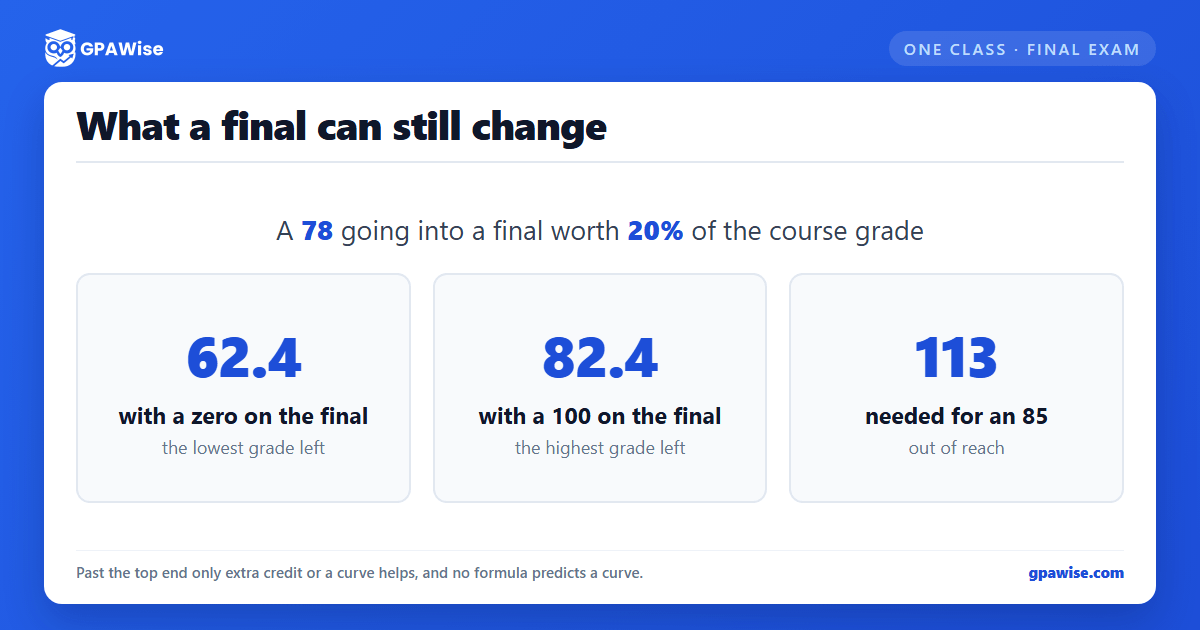
The same numbers fix the range still reachable. A zero on the final leaves your current grade × (1 − final weight), and a perfect score adds the weight to that. With the final scored from 0 to 100, a 78 with a final worth 20% ends somewhere from 62.4 to 82.4 and nowhere else.
The calculator prints both ends exactly and does not round them. An 84.7 with a final worth 15% tops out at 86.995, so a target of 87 needs 100.03 and is out of reach by a hair. Rounded to two places, that top end would read 87, the target itself.
(90 − 88 × 0.75) ÷ 0.25 = (90 − 66) ÷ 0.25 = 24 ÷ 0.25 = 96
Source: arithmetic on the weighted sum in Instructure’s guide; every step is shown so it can be redone by hand.
Current grade or total grade: which one the formula needs
The current grade: your grade on graded work only. By Instructure’s student guide, Canvas shows a student two figures: the current grade, calculated from graded assignments with the “Calculate based only on graded assignments” checkbox selected, and the total grade, which adds ungraded assignments too. Blackboard’s Original course view calls the first a running total; switched off, its help says, an empty cell counts as 0, which “can make grades appear artificially low”.
A figure that counts the final as a zero breaks the formula. Take homework at 90 and quizzes at 80, each worth 20%, a midterm at 70 worth 30% and a final worth 30%, each a weighted category of its own. The 55 percentage points banked over 70% of the course are a current grade of 78.57, which needs 83.33 for an 80 (83.34 from the rounded 78.57). Instructure’s guide gives the same division for Canvas: a group with nothing graded is removed, and the rest are divided by their combined weight. Type the 55 itself, the course with a zero for the final, and it asks for 138.33.
A final that shares a weighted category with graded work needs its current grade worked from the syllabus. Say homework is 40% at 90 and an Exams category worth 60% holds a 70, an 80 and the final, 100 points each. The final is 20% of the course, not 60%, and 36 + 30 = 66 percentage points are banked over the other 80%: a current grade of 82.5, and an 85 takes (85 − 66) ÷ 0.20 = 95. Weighting each category’s average as it stands gives 36 + 45 = 81, and the formula with 81 and 20% says 101. Canvas’s Grades page also takes what-if scores.
55 ÷ 0.70 = 78.57
Sources: Instructure, Canvas Student Guide, How do I view my grades in a current course? · Instructure, Canvas Instructor Guide, How do I weight the final course grade based on assignment groups? · Anthology, Blackboard Help, Calculate Grades (Original course view). The two worked cases are arithmetic on the weights and scores given.
When more than the final is still ungraded
Then the three-number formula quietly assumes the other work will score your current average. Take a course where each piece has a weighted category of its own: homework, quizzes and a midterm at 20% each, scored 90, 80 and 70, with a project worth 10% and a final worth 30% still to come. The 48 percentage points banked over 60% of the course are a current grade of 80. For an 85, the short formula says 96.67 on the final.
In fact the 40% still open must supply 37 points, an average of 92.5 across the project and the final. A perfect project brings the final down to 90, an 80 on it leaves 96.67, and a 70 pushes the final to 100. Enter the project in the calculator’s two optional fields, its share of the whole course grade and the score you expect on it, and the answer is for the final alone.
The same limit applies to this other work. The optional fields cover it where it sits in a weighted category with nothing graded in it yet; where it shares a category with graded work, work the course from the syllabus, as in the second case above.
(85 − 48 − 10) ÷ 0.30 = 27 ÷ 0.30 = 90
Source: arithmetic on the weighted sum; the limit is the one in the section above.
If you need more than 100%, or less than 0%
A required score above 100 means the target is out of reach on an exam scored out of 100. The highest grade left is the top of the range above: the 78 with a final worth 20% tops out at 82.4, so an 85 there would need 113. Only extra credit or a curve gets past that. No formula predicts a curve, and extra credit has no single mechanism: Instructure’s guide says it is not a default option in Canvas, and in its own example the assignment group weights total 110%.
A required score at or below 0 means the target is met even with a zero on the final. A 96 with a final worth 10% comes to 86.4 with a zero on the final, so on the arithmetic a target of 85 is already met. That is arithmetic on a zero and nothing more. What a missed final leads to is your syllabus’s and your institution’s rule.
In both cases the calculator shows the real figure, uncapped, with the highest or lowest grade still reachable beside it.
Source: Instructure, Canvas Instructor Guide, How do I give extra credit in a course?.
Is a 90 an A? The letter scale is your school’s
It depends on the scale. Among US institutions that publish percentages, the letter grades’ ranges start at 90, 80, 70 and 60 at 86 of 94, yet a 90 is a plain A at 47 of the 94 and an A− at 44. That is a common convention among institutions that publish percentages, not a rule. The 94 are about a tenth of the 984 US institutions verified as of October 2026 and lean toward community, technical and junior colleges; for the other 890, the grading document we verified prints no percentage.
George Mason University’s registrar says it does not dictate a grading scale: instructors may determine the cut-offs. Louisiana State University’s policy says there is no university table of numerical equivalents a faculty member must follow. In Canada the A range starts at 80 at 74 of 80 verified institutions that publish percentages, as of October 2026.
Four published high school scales, North Carolina’s, South Carolina’s, Tennessee’s and Howard County’s, start at 90, 80, 70 and 60; South Carolina’s and Tennessee’s replaced others in 2016 and 2022. Tennessee’s is for state financial-aid purposes, and its districts may adopt another.
| Institution | A starts at | A− starts at | D range starts at |
|---|---|---|---|
| Howard University | 90 | none printed | 60 |
| Prairie View A&M University | 90 | none printed | 60 |
| Houston Community College System | 90 | none printed | 60 |
| Fairfield University | 93 | 90 | 60 |
| Queens College (QC), CUNY | 93 | 90 | 60 |
| Berklee College of Music | 93 | 90 | 60 |
| National University | 94 | 90 | 60 |
| Colorado State University Global | 95 | 90 | 60 |
| Queensborough Community College, CUNY | 96 | 90 | 60 |
| Wilmington University | 95 | 92 | 65 |
| Trident Technical College | 91 | none printed | 65 |
| University of Toronto | 85 | 80 | 50 |
| McMaster University | 85 | 80 | 50 |
| York University | 80 | none printed | 50 |
For grade points, use the percentage to GPA calculator.
Sources: GPAWise verified grading schemes, each read from the institution’s own document (see our methodology) · George Mason University, Office of the University Registrar, Grading Scale · Louisiana State University, Policy Statement 44, Student Grading · North Carolina State Board of Education, grading policy · South Carolina Uniform Grading Policy (archived copy) · Tennessee State Board of Education, Uniform Grading Policy (archived copy) · Howard County Public School System, Policy 8020. Not listed here? Find your university’s grading scale.
Points-based classes, and weights that don’t add up to 100
In a points-based class the final’s weight is its points divided by all the points in the course, and the points you need are your target times the total points, minus the points earned. Take 1,000 points in the course, 200 of them the final, with 680 of 800 earned. An 80% takes 120 of the final’s 200 points, an 85% takes 170, and a 90% takes 220, more than the exam holds.
Check which method your syllabus uses: the same scores come out differently. Homework at 450 of 500 points and exams at 240 of 300 are 86.25% by total points and 83% with homework weighted 30% and exams 70%.
Weights that total something other than 100 are the gradebook’s to settle. By their help pages, Canvas allows a total above or below 100%, Blackboard’s Original course view spreads the difference across the columns and its current view rebalances to 100, and Google Classroom will not save until the categories add up to 100%. This calculator takes one weight for the final and one for other ungraded work, so a course whose weights total more than 100, as with an extra-credit category, cannot be entered as three numbers.
850 − 680 = 170 of 200, or 85%
Sources: Google, Classroom Help, Set up grading · Instructure, Canvas Instructor Guide, How do I weight the final course grade based on assignment groups? · Anthology, Blackboard Help, Calculate Grades (Original course view) · Anthology, Blackboard Help, Overall Grade Column.
How much is a final exam worth?
Whatever your syllabus says. Of the four institutions whose published rules are in the table, three require the weight to be stated in the syllabus or the first-day course materials, and one of those also recommends a limit; the fourth caps it. In a points class there may be no stated weight at all: divide the final’s points by all the points in the course.
| Institution | What its rule says about the final’s weight |
|---|---|
| Louisiana State University | Written syllabi in all courses must clearly state the relative weight of the component factors of the final grade |
| Kutztown University | The course materials given out on the first day must include the weight of the final assessment. Where the course structure allows, it recommends that a final assessment count for no more than one-third of the course grade. A final assessment may be a paper, a project or a presentation as well as a written examination |
| Commonwealth University of Pennsylvania | An undergraduate policy: final examinations and final evaluative assessments are worth no more than 40% of the final course grade, unless the course is an independent study, capstone or thesis |
| University of Arkansas Grantham | For every course that requires a final exam, the syllabus states the percentage of the final |
Sources: each name in the table links to that institution’s own document.
Dropped scores, extra credit and rounding
A dropped score is settled only when the category it applies to is fully graded; it then belongs in your grade on the graded work. If that category still has ungraded work (the final, or one more quiz), which score is dropped depends on the score still to come; the course grade is then not a straight line in the final’s score. A drop rule on such a category is a case this calculator does not cover. For example, with a 70 and an 80 in a drop-lowest exams category, any final up to 70 is itself the dropped score, and the course grade does not move.
By Instructure’s guide, Canvas drops the score that helps the group most: in its example the 65%, not the 50%. Extra credit already earned is part of your grade on the graded work too.
Rounding is a separate rule, and the table gives four published ones. This calculator prints its result to two decimals, rounded half up, reads the letter range from the figure shown and never rounds to a whole number, so an 89.999 shows as 90: the opposite of Blackboard’s display rule.
A final that also replaces your lowest test counts twice. With homework at 90 for 20%, tests of 85, 78, 62 and 91 for 40% and a final worth 40%, an 85 needs 88.5 without the replacement and 83.2 with it. A final counted as one test is the shared-category case above.
| Whose rule | What it says about rounding |
|---|---|
| University of Arkansas Grantham | The grade is rounded up if the decimal is 0.50 or above: an 89.50% is recorded as a 90% |
| Howard County Public School System, Policy 8020 | Fractional scores are rounded to the nearest whole number: 89.49% rounds to 89 and 89.50% rounds to 90 |
| University of Washington Bothell, School of Nursing & Health Studies | Rounding raw scores up or down is at the discretion of each faculty member |
| Blackboard, help for its current course view | The display is cut after the second decimal place, and values are never rounded up |
Sources: each name in the table links to the document. For dropped scores: Instructure, Canvas Instructor Guide, How do I create rules for an assignment group?.
Semester grades, quarters and midterms
A semester grade built from two quarters and an exam is the same weighted sum with different labels. Say each quarter counts 40% and the semester exam 20%, with an 88 and an 82 in the quarters. Those bank 68 percentage points, a grade of 85 going into the exam, and an 87 for the semester takes a 95 on it. In the calculator, type 85 as the current grade and 20 as the final’s weight. A course graded over 4 quarters and an exam works the same way, with the quarters’ weighted average as the current grade.
A year grade that is the plain average of semester 1 and 2 needs no weights at all: with an 84 in the first, an 87 for the year takes 2 × 87 − 84 = 90 in the second. These weights are examples. Your school’s or district’s handbook has the real ones.
For a midterm, use the midterm’s weight and your grade on the work graded before it. What comes back is your grade at that point in the course, not the course grade, because more work usually follows.
- Multiply each quarter’s grade by its weight and add the results: 35.2 + 32.8 = 68.
- Divide by the weight graded so far for the grade going into the exam: 68 ÷ 0.80 = 85.
- Take the banked percentage points from the semester grade you want and divide by the exam’s weight: (87 − 68) ÷ 0.20 = 95.
What-if grades: trying a score before the exam
A what-if grade is a score you have not earned yet, entered to see what it does to the course grade. Switch the calculator to Predict my grade, type the score you expect on the final, and it gives the course grade with a table of outcomes for a run of final exam scores.
Canvas has this built in for your course: Instructure’s student guide says you can click any score field on the Grades page and enter a hypothetical grade. A separate calculator is for when the course is not in Canvas, or when you want the target solved for you. This page describes Canvas’s version only.
Source: Instructure, Canvas Student Guide, How do I view my grades in a current course?.