
How to calculate your HS GPA
Your HS GPA starts from one list: each class with a final letter grade, and whether it was regular, honors or AP. That list gives two figures, which the calculator shows side by side. The unweighted one is a plain average, which College Board puts as adding up your GPA points and dividing “by the number of classes you’ve taken.” The weighted one repeats the sum with a bonus added to each honors and AP grade.
Those five letter values are the common ground: College Board’s chart uses them, and so do all but two of the official rules behind this page (South Carolina’s numeric scale and one New York high school’s, below).
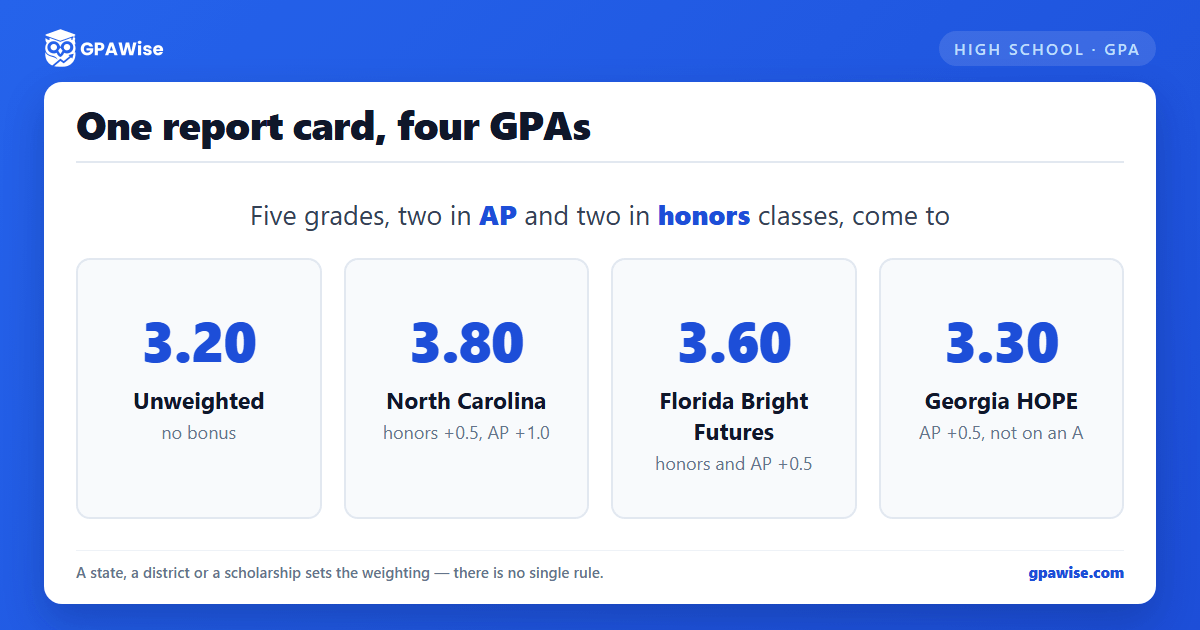
Take five year-long classes: AP Biology, A; AP U.S. History, B; Honors English, A; Honors Algebra II, B; Spanish III, C. Unweighted, those grades are worth 4, 3, 4, 3 and 2, a sum of 16, and 16 ÷ 5 = 3.20. Add half a point to each honors grade and a full point to each AP grade and the sum is 19, a weighted GPA of 3.80. A class graded pass/fail earns no grade points and stays out of both figures.
- List each class that has a final letter grade, and mark it regular, honors or AP.
- Give each grade its grade points.
- Add them and divide by the number of classes. That is the unweighted GPA.
- Add your school’s bonus to each honors and AP grade, then add and divide again. That is the weighted GPA.
(4 + 3 + 4 + 3 + 2) ÷ 5 = 16 ÷ 5 = 3.20
(5.0 + 4.0 + 4.5 + 3.5 + 2.0) ÷ 5 = 19 ÷ 5 = 3.80
Sources: College Board, How to Calculate Your GPA on a 4.0 Scale · NCES, How is Grade Point Average Calculated? (archived copy) (pass/fail classes).
Weighted GPA: there is no single rule for honors and AP classes
No national standard sets the bonus for an honors or AP class. A state board, a district or a single school does. The half point for honors and full point for AP that online calculators apply is a real published rule: North Carolina’s statewide weights “Effective with the freshman class of 2015-16”, before which the same state gave one and two quality points. South Carolina and Howard County, Maryland, add the same amounts and still arrive at different GPAs.
The difference is in what the bonus is added to and which grades earn it. South Carolina adds it to a GPA computed from the numeric grade, on a scale where a regular class reaches 5.0, an honors class 5.5 and an AP class 6.0. Howard County pays it on an A, B or C only. Two other rules add no grade points at all. Tennessee’s uniform grading system adds 3 percentage points to an honors grade and 5 to an AP or IB grade before the letter is decided, and allows no grade point above 4.0. White Plains High School in New York grades on a 4.5 scale and multiplies a weighted class’s points by 1.3.
These are five rules read for this page, each linked below, not a count of schools; we have no such count. The calculator applies North Carolina’s, South Carolina’s and Howard County’s, or a bonus you type. Your own school’s rule is in its handbook or on its transcript key.
| Published by | Honors | AP and IB | Grades that earn it | Most points an AP class can earn |
|---|---|---|---|---|
| North Carolina State Board of Education | +0.5 | +1.0 | Passing grades | 5.0 |
| South Carolina State Board of Education | +0.5 | +1.0 | Numeric averages above 50 | 6.0 |
| Tennessee State Board of Education, for the Tennessee HOPE Scholarship GPA | +3 percentage points | +5 percentage points | Every grade, before the letter is set | 4.0 |
| Howard County Public School System, Maryland | +0.5 | +1.0 | A, B or C only | 5.0 |
| White Plains High School, New York | × 1.3 | × 1.3 | Not stated on the school’s page | 5.85 (an A+ of 4.5 × 1.3) |
Sources: North Carolina Policy GRAD-009 · South Carolina Uniform Grading Policy (archived copy) · Tennessee Policy 3.301 (archived copy) · Howard County Policy 8020 · White Plains High School counseling page. Each name in the table links to the document.
Unweighted GPA and plus or minus grades
An unweighted GPA puts every class on the same scale, so an A in AP Chemistry and an A in PE are worth the same, and on a 4.0 scale the figure cannot pass 4.0. What it leaves open is the plus and the minus. North Carolina, Tennessee and Howard County grade in whole letters. So do three bodies that recalculate GPAs: the University of California’s instructions say pluses and minuses don’t count, Georgia’s HOPE calculation has no separate scale for them, and the NCAA counts a B+, a B and a B− as three points each. The Minnesota Office of Higher Education’s calculator, by contrast, values an A− at 3.7 and a B+ at 3.3. The choice matters only if your report card shows plus or minus grades: on whole letters, this calculator’s three letter scales give the same GPA. If it does show them, pick the values your school’s handbook prints, B+ = 3.3 or the thirds some scales use, B+ = 3.33.
Sources: University of California Admissions, GPA requirement · Georgia Student Finance Commission, Understanding the High School HOPE GPA · NCAA Eligibility Center, How is Core-Course GPA Calculated? · Minnesota Office of Higher Education, GPA calculator.
High school GPA without credits
With no credits entered, each class counts once, which is the right sum whenever every class on your transcript carries the same credit. It goes wrong when year-long and semester classes are mixed. The NCAA counts a full-year course as 1.00 unit and a semester course as 0.50, and Tennessee’s grading policy works its own example the same way: five year-long classes graded B, A, A, B, B and two semester classes graded B and C come to 19.5 grade points over 6 credits, a 3.25. Count those seven grades once each and the result is 22 ÷ 7 = 3.14. Two fixes bring back 3.25: switch credits on and enter 1 and 0.5, or enter a row for each semester’s grade. For a college term, or for the plus/minus scales colleges use in their own grading, use the no-credits GPA calculator.
Sources: NCAA Eligibility Center, How is Core-Course GPA Calculated? · Tennessee State Board of Education, Policy 3.301 (archived copy).
Cumulative high school GPA for all four years
A cumulative high school GPA is every grade point you have earned divided by every credit you have attempted, across all four years. It equals the average of your yearly GPAs only when each year carried the same load. A 3.20 over six credits in 9th grade, a 3.50 over six in 10th, a 3.90 over eight in 11th and a 3.70 over eight in 12th add up to 101 grade points in 28 credits, a 3.61; averaging the four yearly figures gives 3.58. The calculator’s All 4 years tab works from each year’s GPA and its credits.
Which terms belong in it depends on who is counting. The University of California counts courses from the summer after 9th grade to the summer after 11th grade. Georgia HOPE counts 9th through 12th. High school credit earned in middle school counts in South Carolina and not in Howard County; for those earlier grades there is a middle school GPA calculator.
(3.20 × 6 + 3.50 × 6 + 3.90 × 8 + 3.70 × 8) ÷ 28 = 101 ÷ 28 = 3.61
Sources: Howard County Public School System, Policy 8020 · South Carolina Uniform Grading Policy (archived copy).
High school GPA with percentages
Most rules turn a percentage into a letter first. North Carolina, South Carolina, Tennessee and Howard County all print the same cut-offs: 90 for an A, 80 for a B, 70 for a C, 60 for a D. South Carolina then skips the letter and works on the 100 scale directly. Its Uniform Grading Policy gives every point of the average a tenth of a quality point, so a 95 and a 91 in a regular class are worth 4.5 and 4.1 on what is, for that class, a 5.0 scale. Tennessee adds its bonus to the percentage itself: an 88 in an AP class is counted as 93, an A. On its plus/minus scales this calculator uses the cut-offs most common among the college scales we have verified (an A from 93, an A− from 90, a B+ from 87), because no K-12 document behind this page prints any. For one overall percentage, use the percentage to GPA calculator; for the reverse, the GPA to percentage calculator.
| Numerical average | Letter | College Prep (regular) | Honors | AP, IB, dual credit |
|---|---|---|---|---|
| 100 | A | 5.000 | 5.500 | 6.000 |
| 95 | A | 4.500 | 5.000 | 5.500 |
| 90 | A | 4.000 | 4.500 | 5.000 |
| 85 | B | 3.500 | 4.000 | 4.500 |
| 80 | B | 3.000 | 3.500 | 4.000 |
| 70 | C | 2.000 | 2.500 | 3.000 |
| 60 | D | 1.000 | 1.500 | 2.000 |
Sources: South Carolina Uniform Grading Policy, Administrative Procedures (archived copy) · North Carolina Policy GRAD-009 · Tennessee Policy 3.301 (archived copy) · Howard County Policy 8020.
How to convert a weighted GPA to an unweighted GPA
To convert a weighted GPA to an unweighted GPA, subtract the total bonus you earned divided by your number of classes. Both figures divide the same classes by the same number, so the gap between them is only the bonus.
That makes the conversion exact once you know how many classes are in the GPA, how many were honors and how many AP, and what your school adds for each. Ten semester grades with four in AP classes and two in honors carry 4 × 1.0 + 2 × 0.5 = 5.0 bonus points, so a 4.20 weighted GPA is 3.70 unweighted. From the GPA alone no formula can do it; the answer is a range: the same 4.2 could be anything from 3.2, if every class was AP, to 4.0, the ceiling for an unweighted figure.
Dividing by 5 and multiplying by 4 is not a conversion. It rescales the number, taking a straight-A student in regular classes from 4.0 to 3.20. The subtraction needs a bonus that is added to grade points, which rules out Tennessee’s percentage points and a multiplier, and where credits differ it counts credits in place of classes throughout.
4.20 − (0.5 × 2 + 1.0 × 4) ÷ 10 = 4.20 − 0.50 = 3.70
The GPA a college or scholarship calculates
The GPA on your transcript is not always the one that gets used. College Board tells applicants that colleges “may recalculate your GPA based on their own criteria”, dropping non-core courses or replacing a school’s weighting with their own, and that many ask applicants “to report your actual grades” so they can do it. Georgia’s scholarship agency is blunter: a student’s HOPE GPA “is not the same as his or her high school GPA.” A school that ranks reports a class rank beside the GPA, and the class rank calculator turns it into a top percent.
The published methods differ as much as the schools’ rules do. Take the report card from the first example. It is a 3.20 unweighted and a 3.80 on North Carolina’s weights. Florida Bright Futures adds half a point to honors and AP alike, which makes it 3.60. Georgia HOPE removes the school’s weighting, gives honors nothing and adds half a point only to an AP grade below an A, which makes it 3.30. A real Bright Futures or HOPE GPA is taken over all of a student’s qualifying courses, not five. The table sets out four such methods, each with the minimum its own figure has to reach.
| Who calculates it | Courses counted | Weighting | Published minimum |
|---|---|---|---|
| University of California | A-G (college-preparatory) courses, from the summer after 9th grade to the summer after 11th | One honors point per semester of an honors-level course (AP, IB, UC-transferable college courses and UC-certified honors), 8 honors points at most; none for a D or F; plus and minus ignored | 3.0 for California residents, 3.4 for nonresidents |
| NCAA Eligibility Center | NCAA-approved core courses (its core-course GPA) | The school’s own weighting, where the school has notified the NCAA; plus and minus ignored | 2.3 for Division I, 2.2 for Division II |
| Georgia HOPE Scholarship | Core subjects, 9th to 12th grade | School weighting removed; 0.5 added to a B, C, D or F in AP, IB or dual enrollment; nothing for honors | 3.0 for the HOPE Scholarship, 3.7 for the Zell Miller Scholarship |
| Florida Bright Futures | 16 college-preparatory credits | 0.25 per semester course or 0.50 per year course, for honors, AP, IB, AICE and dual enrollment alike | 3.00 for Medallion Scholars, 3.50 for Academic Scholars |
Sources: College Board, How to Calculate Your GPA on a 4.0 Scale · NCAA Eligibility Center, How is Core-Course GPA Calculated? · Georgia Student Finance Commission, HOPE Scholarship initial academic eligibility · Zell Miller Scholarship initial academic eligibility · Florida Department of Education, Bright Futures Student Handbook, Chapter 1 (archived copy). Each name in the table links to that body’s own page.
Is a 3.7 GPA good in high school?
A 3.7 is 0.59 above the national average. No body publishes a line above which a high school GPA counts as good. The average comes from the federal High School Transcript Study: 3.11 for 2019 graduates, up from 3.00 in 2009 and 2.68 in 1990. That study puts every transcript on an unweighted four-point scale, so a weighted 3.7 cannot be set beside it. What bodies do publish are minimums for one purpose, each measured on its own recalculated GPA: 3.0 for California residents applying to the University of California and 3.4 for nonresidents, 2.3 for NCAA Division I, 3.0 for Georgia’s HOPE Scholarship and 3.7 for its Zell Miller Scholarship, 3.00 and 3.50 for Florida’s two Bright Futures awards. Those are floors for eligibility, not a measure of how competitive a GPA is.
Sources: National Assessment Governing Board, release on the 2019 High School Transcript Study · NCES, How is Grade Point Average Calculated? (archived copy).
For what a 3.0 GPA, a 3.5 GPA or a 4.0 GPA means on college grading scales, each value has a page of its own.