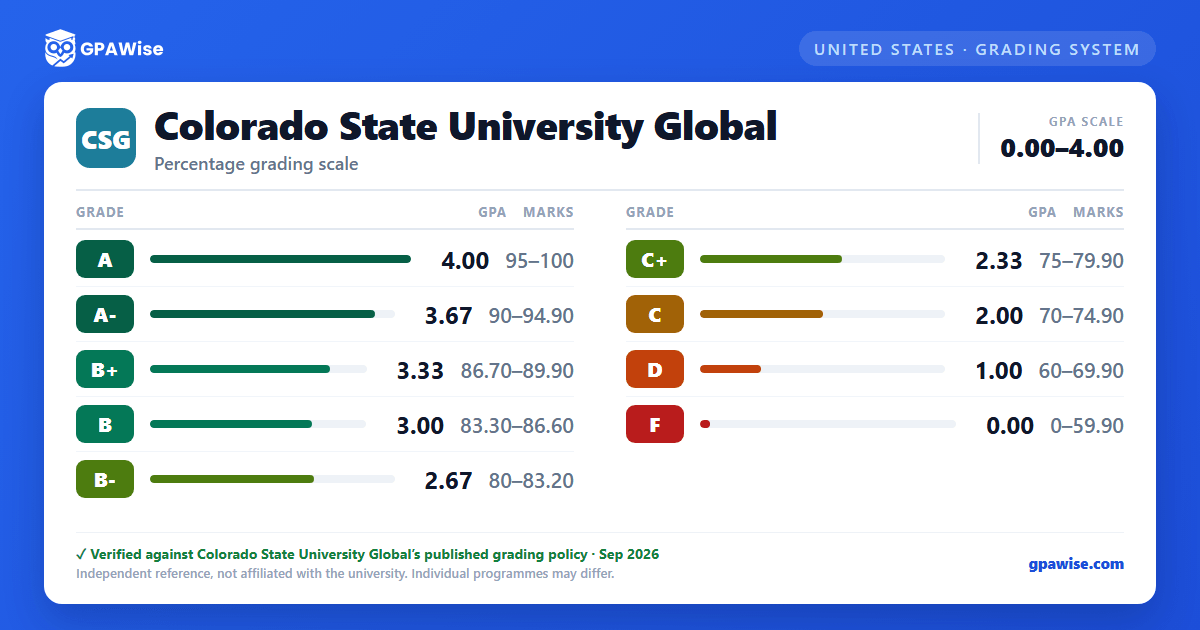
How CSU Global calculates GPA
Cumulative GPA is calculated by dividing total quality points earned by total credit hours attempted; quality points equal a grade's quality-point value multiplied by the course's credit hours. Term GPA is calculated the same way, using only the credits attempted within that term. Final GPA is carried to two decimal places and is not rounded up.
- Grades of S, U, W, and I are not computed in the GPA, and only CSU Global credits are used in the calculation.
- When a course is repeated, only the grade and credit hours from the most recent attempt count toward total hours earned and cumulative GPA. A withdrawal (W) grade does not replace a letter grade (A–F) already earned in the CGPA calculation, and all attempts remain on the transcript.
Source:
Credit & Grading System Policies (accessed 2026-08-25) — verified Aug 2026
Repeat limits and grade requirements toward graduation
A student may repeat a course they did not pass one time per course. A third attempt at the same course requires approval from a Student Success Counselor or a recognized CSU Global committee, and no attempt beyond the third is allowed without an approved Provost Appeal.
Graduate students may apply a maximum of six semester hours of credit graded C+ or C toward graduation, and may be required to repeat a course graded C to maintain the required 3.00 cumulative GPA; no course graded lower than C counts toward graduate program requirements. Undergraduate students may apply D grades earned in general education or elective courses toward graduation only if they meet the university's minimum cumulative GPA required for graduation; D grades do not count toward baccalaureate major or specialization requirements, and no graduate student may apply a D toward program requirements.
Source:
Credit & Grading System Policies (accessed 2026-08-25) — verified Aug 2026
Frequently asked questions
Can I save my semesters and track my CGPA at CSU Global?
Yes. After you calculate a semester's GPA, click "Save as semester" to add it to the built-in CGPA tracker, which then computes your cumulative GPA across every saved semester using the standard weighted formula (Σ SGPA × credits ÷ Σ credits). You can save semesters by course (full breakdown) or quick-add a past semester with just the SGPA and credit hours. Locking, renaming, and deleting saved semesters are all supported, and the tracker shows a running CGPA plus a trend arrow versus your previous semester.
How do I convert SGPA to CGPA at CSU Global?
Your CGPA is the credit-weighted average of every semester's SGPA. The formula is: CGPA = (SGPA₁ × credits₁ + SGPA₂ × credits₂ + … + SGPAₙ × creditsₙ) ÷ (credits₁ + credits₂ + … + creditsₙ). On this page, add each semester to the CGPA tracker (either by course or as a quick SGPA + credit-hours entry) and the calculator runs the conversion for you on every save, edit, and delete — no manual arithmetic required.
Can I add past semester GPAs without entering every course?
Yes. On the My CGPA Tracker tab, click "Add semester" and choose the quick-add option. You enter just the SGPA and the credit hours for that semester — no course-by-course breakdown required. It works as a GPA calculator with previous semesters support, or as a GPA calculator without course details when you only remember the SGPA from your transcript. Quick-added and course-by-course semesters can be mixed freely; both contribute to your CGPA using the same credit-weighted formula.
Is my CGPA tracker data sent to your servers?
No. Your saved semesters are stored locally in your browser only — nothing is transmitted to GPAWise. A "Clear all tracker data" button is always available on the tracker tab to wipe the data on demand.
Is this Colorado State University Global (CSU Global) GPA calculator free?
Yes — GPAWise is completely free to use. There's no signup, no paywall, and your inputs stay in your browser.