
How grading works at UW–Madison
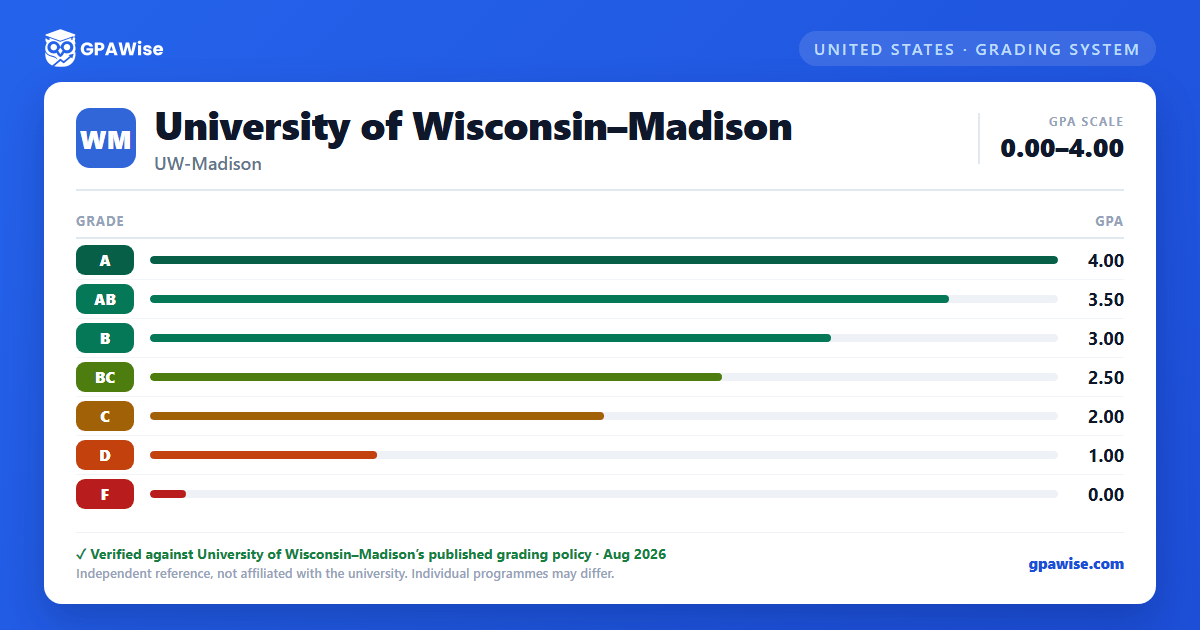
UW–Madison grades on a 0.0–4.0 scale using letters only. The Guide states it plainly: semester grades are reported by letter only, and plus and minus signs are not authorized — so there is no A+, no A−, and no B+ anywhere on your transcript.
Instead of plus/minus, Wisconsin uses two intermediate grades: AB sits between A and B, and BC sits between B and C. There is no equivalent half-step between C and D.
| Grade | Meaning | Grade points per credit |
|---|---|---|
| A | Excellent | 4 |
| AB | Intermediate grade | 3.5 |
| B | Good | 3 |
| BC | Intermediate grade | 2.5 |
| C | Fair | 2 |
| D | Poor | 1 |
| F | Failure | 0 |
The highest possible GPA is 4.0, representing A grades in every course; the lowest possible is 0.0.
Source: Undergraduate Guide › Enrollment and Records › Grading System — introductory paragraph and the table “Grades with Associated Grade Points per Credit” — verified Aug 2026
How UW–Madison calculates your GPA
Your grade point average is based on the total number of credits taken for which grades of A through F are received. Each course contributes its credits multiplied by the grade points for the letter you earned, so a 3-credit AB contributes 3 × 3.5 = 10.5 grade points.
Grades that are excluded from the GPA calculation entirely:
- S or U (Satisfactory / Unsatisfactory) in courses taken on the pass/fail basis
- Cr or N (Credit / No Credit) in courses offered on a credit/no credit basis
- I (Incomplete, or IN for Cr/N courses), EI (Extended Incomplete) and PI (Permanent Incomplete)
- P (Progress), a temporary grade for courses extending beyond one term
- NR (No Report) — a grade the instructor has not submitted; it has no net effect on GPA
- W (Withdrew), DR (Dropped), NW (No Work) and Q (a credit or honors question flagged during grade reporting)
- Audited courses, marked AU in place of a credit count, which are graded S or NR
- SD/UD, the Satisfactory-Disruption option offered in response to the COVID-19 events, and S/M/U, used only in School of Veterinary Medicine courses
Because these carry no grade points at all, a course graded S, CR or P does not raise or lower your average — it simply sits outside it.
Source: Undergraduate Guide › Enrollment and Records › Grading System — the GPA basis sentence and the list “Excluded from the GPA calculation are:” — verified Aug 2026
Good standing, probation, and class standing
UW–Madison does not set one university-wide GPA threshold for good standing. Undergraduates must maintain the minimum academic thresholds, including the minimum grade point average specified by their school, college, or program, to remain in good academic standing. Students whose academic performance drops below those minimum thresholds are placed on academic probation. Check your own school or college for the number that applies to you.
Good academic standing also gates the pass/fail option: you must be in good standing according to your school or college to be eligible to request it.
Class standing is set by credits earned, not by GPA:
- Freshman — fewer than 24 credits
- Sophomore — 24–53 credits
- Junior — 54–85 credits
- Senior — 86 or more credits
Source: Undergraduate Guide › Academic Probation, Pass/Fail Eligibility, and Class Standing — verified Aug 2026
What you need to graduate from UW–Madison
To receive a bachelor's degree from UW–Madison you must earn a minimum of 120 degree credits (this includes AP, IB and other test credit, transfer credit, and retroactive credit). Some programs require more than 120.
At least 30 credits must be earned in residence at UW–Madison — on campus with an undergraduate degree classification, which also covers UW–Madison courses taken in distance or online formats and credits earned in UW–Madison Study Abroad/Study Away programs.
On GPA, the Guide is deliberately open: degree candidates must achieve a minimum cumulative grade point average specified by the school, college or program they are pursuing. There is no single university-wide graduation GPA published — the requirement is set where your degree is.
Source: Undergraduate Guide › Requirements for Undergraduate Study › Requirements for Undergraduate Degrees — Total Degree Credits, Residence Credit, and Quality of Work — verified Aug 2026
Frequently asked questions
Can I save my semesters and track my CGPA at UW-Madison?
How do I convert SGPA to CGPA at UW-Madison?
Can I add past semester GPAs without entering every course?
Is my CGPA tracker data sent to your servers?
Is this University of Wisconsin–Madison (UW-Madison) GPA calculator free?
Does UW–Madison give A+ grades?
No. UW–Madison awards no plus or minus grades at all — the Guide states that semester grades are reported by letter only and that plus and minus signs are not authorized. There is no A+, A−, B+, B−, C+, C−, D+ or D−.
This is why UW–Madison's scale tops out at exactly 4.0: with no A+ row, there is no grade worth more than an A, and the Guide says so directly — the highest possible GPA is 4.0, representing A grades in every course.
Source: Undergraduate Guide › Enrollment and Records › Grading System — opening paragraph — verified Aug 2026
What are AB and BC worth at UW–Madison?
AB is worth 3.5 grade points per credit and BC is worth 2.5. They are UW–Madison's intermediate grades: AB falls between A and B, and BC falls between B and C.
They are the reason Wisconsin has no plus/minus grades — AB and BC do the same job of marking a half-step, but only at the top two intervals. There is no intermediate grade between C and D, or between D and F.
Source: Undergraduate Guide › Enrollment and Records › Grading System — table “Grades with Associated Grade Points per Credit” — verified Aug 2026
Does taking a course pass/fail affect your GPA?
No. Your instructor still enters a letter grade on the grade roster, but it is recorded on your record as a pass or a fail: a letter grade of A through C becomes S (satisfactory), and a letter grade of D or F becomes U (unsatisfactory). Neither the S nor the U is used in computing the grade point average, so a pass/fail course leaves your GPA untouched. Your transcript also shows the symbol # against courses taken pass/fail. Instructors are not told that you elected the option.
The limits: you must be in good academic standing to request it; you may carry one course per term on a pass/fail basis, up to a maximum of 16 credits across your undergraduate career (the summer sessions count collectively as a single term); and required courses cannot be taken pass/fail — a pass/fail course will not count for nonelective requirements even if it normally would. Requests are submitted through your Student Center by midnight on the Friday at the end of the fourth week of fall and spring semesters.
Source: Undergraduate Guide › Pass/Fail Grading Option — policy, eligibility, and request process — verified Aug 2026
What happens to your GPA if you repeat a failed course?
The F stays in your GPA. Every course grade of F counts as 0 grade points and remains permanently on the transcript — and if you repeat the course, the original F remains on the transcript and is still included in computing the GPA.
So repeating a failed course at UW–Madison adds a new grade to your average rather than replacing the old one. When you model a retake in the calculator, keep the original F in the list as well as the new grade.
Source: Undergraduate Guide › Enrollment and Records › Failures — verified Aug 2026
Do Credit/No Credit (CR/N) courses count toward your GPA?
No. Some courses are designated as being offered on a Credit/No Credit basis, and the transcript shows either CR — you earned the credits the course was offered for — or N, meaning you earned no credit even though you were enrolled. Both are excluded from the GPA calculation, so neither carries grade points.
Credit/No Credit is not the same as pass/fail and is not a student option: where a course is designated CR/N, you may not take it on any other basis.
Source: Undergraduate Guide › Enrollment and Records › Credit/No Credit Courses, and the “Excluded from the GPA calculation” list under Grading System — verified Aug 2026
What happens to an Incomplete at UW–Madison?
An Incomplete (I) may be assigned if illness or another unusual and substantiated cause beyond your control stops you finishing the coursework. To be eligible you must be earning a passing grade to date in the course and have only a limited amount of work left, and you must raise the request with your instructor before the end of the term.
An Incomplete carries no grade points, so it sits outside your GPA — but only until the deadline. An Incomplete from spring or summer must be resolved by the Friday of the eighth week of the following fall term; one from fall must be resolved by the Friday of the eighth week of the following spring term. If it is not, the Incomplete lapses to a grade of F (or N for Credit/No Credit courses) — and that F does count, at 0 grade points.
An instructor may grant more time by converting the I to an Extended Incomplete (EI) with a new deadline, normally no later than the last day of instruction for that semester. If the EI is not resolved by that date it also becomes an F or N. A graduating student must complete all coursework before the degree can be awarded; finishing after the intended term means the degree is awarded at the next conferral date.
Source: Undergraduate Guide › Incompletes — eligibility, deadlines, and consequences for non-completion — verified Aug 2026
What GPA do you need to graduate from UW–Madison?
There is no single university-wide number. UW–Madison's Guide states only that degree candidates must achieve a minimum cumulative grade point average specified by the school, college or program they are pursuing — the threshold is set where your degree is, not centrally.
The same is true of good academic standing: the minimum GPA that keeps you off academic probation is specified by your school, college, or program. Check your own school or college's requirements for the figure that applies to you.
Source: Undergraduate Guide › Requirements for Undergraduate Study › Quality of Work and Academic Probation — verified Aug 2026