
How grading works at Harvard College
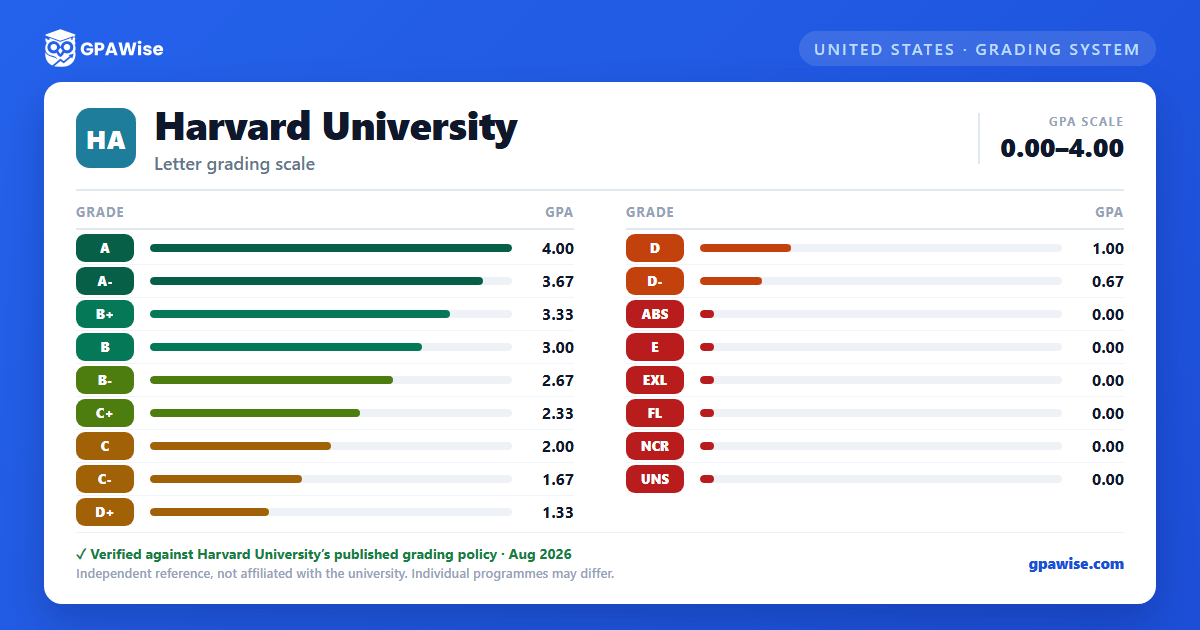
Harvard College grades on a 0.00–4.00 scale using eleven letter grades: A, A- (excellent quality, full mastery of the subject, with extraordinary distinction for A), B+, B, B- (good comprehension and full engagement with the course), C+, C, C- (adequate and satisfactory comprehension), and D+, D, D- (unsatisfactory but still worthy of course credit). Harvard College's failing letter grade is E, not F — F does not appear anywhere in the handbook, and Harvard College does not award an A+.
Alongside the eleven letters, the Faculty of Arts and Sciences also prints six additional grade-point-bearing notations, all valued at 0 and counted as failing grades exactly like E: ABS (Absent, for missing a scheduled exam), NCR (No Credit, the Harvard Summer School equivalent of E), FL (Fail, the pass/fail equivalent of E), UNS (Unsatisfactory, the SAT/UNS equivalent of below-C- work), and EXL (Excluded, when a student is not permitted to continue in a course by vote of the Administrative Board or Honor Council).
Grades of C- or higher are passing and satisfactory grades. Grades of D+ through D- are passing but unsatisfactory. A grade of Credit (CR), Pass (PA), or Satisfactory (SAT) represents an underlying letter grade rather than carrying its own grade points, and the grade of Incomplete (INC) is never given to undergraduates.
Source: GRADING SYSTEM, p. 30 (LETTER GRADES and NON-LETTER GRADES) — verified Aug 2026
How Harvard College calculates your GPA
Your grade point average is the numerical average of all grades received in letter-graded courses you take under the Faculty of Arts and Sciences (FAS) for degree credit. It also includes every failing and unsatisfactory grade — including ones from courses you took pass/fail or SAT/UNS — plus any courses you take for credit at Harvard Summer School and, where applicable, cross-registration courses.
Two categories are left out of your GPA: passing grades from cross-registration courses are never used in computing your grade point average, and neither are grades from course work done out of residence.
Harvard calculates your GPA on a cumulative, term, and annual basis.
Source: Grade Point Averages for Undergraduates, p. 31 — verified Aug 2026
Academic standing and probation at Harvard College
To meet the minimum academic requirements in any term, you may have at most one failing grade (and it can't be paired with another unsatisfactory grade), plus at least two satisfactory grades — one of which must be a letter grade in an FAS course taken for degree credit. Students who don't meet these minimums ordinarily are required to withdraw for two terms.
A satisfactory academic record requires satisfactory grades in all your courses and at least one letter grade in an FAS course taken for degree credit (first-year students in their first term have a partial exception: an all-passing term with at most one unsatisfactory grade still counts as satisfactory). A student whose record is unsatisfactory is ordinarily placed on probation; two consecutive unsatisfactory terms ordinarily mean a two-term withdrawal.
Source: Academic Performance / Minimum Requirements / Satisfactory and Unsatisfactory Academic Records, pp. 32-33 — verified Aug 2026
Latin honors and GPA at Harvard College
To be considered for a degree with Latin honors — cum laude, magna cum laude, or summa cum laude — you need satisfactory letter grades (C- or higher) in a minimum of 96 letter-graded credits (prorated if you're graduating with fewer than 128 total credits). Your GPA for honors purposes includes all your completed letter-graded courses, including any failed courses, Harvard Summer School credit, and applicable cross-registration courses.
There's no fixed GPA cutoff for Latin honors from one year to the next — the minimum grade point average for each level (summa, magna, and cum laude) is set fresh each May based on that year's graduating class, then applied at subsequent degree meetings until the following May. Summa cum laude is limited to the top 5% of the graduating class (drawn from those designated for highest honors in their field); summa and magna combined are capped at 20% of the class; summa, magna, and cum laude in a field combined are capped at 50%.
Source: Requirements for Honors Degrees / Summa, Magna, and Cum Laude criteria, pp. 31-33 — verified Aug 2026
Study abroad, cross-registration, and your GPA
If you study abroad, cross-register, or take courses out of residence, not everything counts toward your Harvard GPA. Passing grades from cross-registration courses are never used in computing your grade point average, and neither are grades from course work done out of residence.
Harvard Summer School credit is treated differently: courses you take for credit at Harvard Summer School are included in your GPA calculation, the same as a regular FAS course.
Source: Grade Point Averages for Undergraduates, p. 31 — verified Aug 2026
Frequently asked questions
What grading scheme does Harvard University use?
Where does this Harvard University grade scale come from?
Does Harvard College award an A+?
No. Harvard College's letter grades top out at a plain A (4.00 grade points) — there is no A+ tier anywhere in the Harvard College Student Handbook.
Source: GRADING SYSTEM / Grade Point Averages for Undergraduates, pp. 30-31 — verified Aug 2026
What is Harvard College's failing grade — E or F?
E, not F. Harvard College's failing letter grade is E (0.00 grade points); the letter F does not appear anywhere in the handbook's grading system.
Source: GRADING SYSTEM, p. 30 — verified Aug 2026
What is Harvard College's lowest passing grade?
D- (0.67 grade points) is the lowest passing grade — D+ through D- are passing but unsatisfactory. C- or higher counts as a passing and satisfactory grade. Below D- is E, Harvard's failing grade.
Source: GRADING SYSTEM, p. 30 — verified Aug 2026
Do study-abroad or cross-registration grades count toward my Harvard GPA?
Passing grades from cross-registration courses are never used in computing your GPA, and grades from course work done out of residence (including most study abroad) are not used either. Harvard Summer School credit is the exception — it is included in your GPA the same as a regular course.
Source: Grade Point Averages for Undergraduates, p. 31 — verified Aug 2026
Is there a fixed GPA you need for Latin honors at Harvard College?
No fixed number carries over year to year. The minimum GPA required for summa cum laude, magna cum laude, and cum laude is recalculated each May from that year's graduating class, then used as the standard until the following May's degree meetings.
Source: Requirements for Honors Degrees, pp. 31-33 — verified Aug 2026