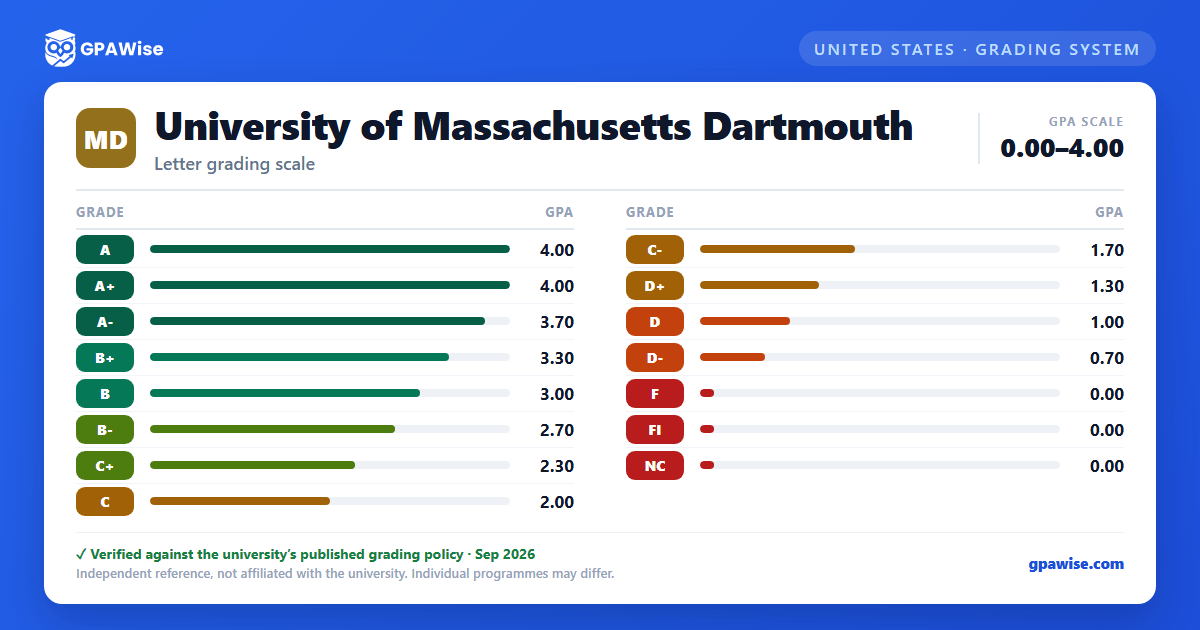

How the GPA Is Calculated
A grade point average (GPA) is computed by multiplying the credit value of each course by the quality points of the grade earned, summing those products, and dividing by the total number of credits attempted. Grades of P, CR, I, W, IP, and AU are not included in the GPA. Grades of F, FI, and NC earn zero quality points and are included in the average.
Students may repeat a course once freely (space or instructor permission permitting); a third or later attempt requires written Dean approval. Only the most recently earned grade for a repeated UMass Dartmouth course counts toward the cumulative GPA, though every attempt remains on the permanent record and a student cannot earn credit twice for the same course.
Transferred credit is recorded on the transcript without a grade and is not calculated into the GPA, except for credit from formally arranged exchange or joint programs, which is graded and does affect the GPA. Grades below C- are not accepted for undergraduate transfer credit.
Source: Academic Regulations and Procedures catalog, Grade Point Average / Course Repeat Policy / Transfer of Course Credit sections — verified Sep 2026
Academic Standing
Good Academic Standing: cumulative and semester GPA both 2.0 or above.
Academic Caution (formerly Academic Warning): cumulative GPA 2.0 or above, but most recent semester GPA below 2.0.
Academic Alert (formerly Academic Probation): cumulative GPA below 2.0.
Extended Academic Alert (formerly Extended Probation): cumulative GPA below 2.0, but most recent semester GPA 2.3 or higher with at least two-thirds of attempted credits passed. Students remain in this status until their cumulative GPA reaches 2.0 or until dismissed.
Academic Dismissal: cumulative GPA below 2.0 for a second consecutive semester without meeting the Extended Academic Alert criteria. Dismissed students may appeal to their college dean and may apply for readmission after one semester.
Source: Academic Regulations and Procedures catalog, Academic Standing section — verified Sep 2026
GPA Requirements for Graduation
To earn an undergraduate degree, a student must have a cumulative grade point average of at least 2.0 across all credits submitted for the degree, and a cumulative GPA of at least 2.0 in all courses taken in the major (departments may set a higher major-GPA floor). A minimum of 120 credits is required, with some programs requiring more.
Source: Academic Regulations and Procedures catalog, Undergraduate Degree Requirements section — verified Sep 2026
Academic Honors
Dean's List: semester GPA of at least 3.200, with at least 12 graded course credits (excluding administrative credits) and no outstanding I or IP grades for that semester.
Chancellor's List: semester GPA of at least 3.800, under the same credit and grade-outstanding conditions as the Dean's List.
Graduation with Distinction, based on cumulative UMass Dartmouth GPA including the final semester: 3.200-3.499 = Cum Laude (Distinction); 3.500-3.799 = Magna Cum Laude (High Distinction); 3.800-4.000 = Summa Cum Laude (Highest Distinction).
Source: Academic Regulations and Procedures catalog, Academic Recognition and Academic Honors section — verified Sep 2026
Frequently asked questions
What grading scheme does University of Massachusetts Dartmouth (UMassD) use?
Where does this UMassD grade scale come from?
What are UMassD's GPA rules?
Source: Academic Regulations and Procedures catalog, Grade Point Average / Course Repeat Policy / Transfer of Course Credit sections — verified Sep 2026
What are UMassD's academic standing rules?
Source: Academic Regulations and Procedures catalog, Academic Standing section — verified Sep 2026
What does UMassD require to graduate?
Source: Academic Regulations and Procedures catalog, Undergraduate Degree Requirements section — verified Sep 2026
How are honors and awards decided at UMassD?
Source: Academic Regulations and Procedures catalog, Academic Recognition and Academic Honors section — verified Sep 2026