
How grading works at the University of Delhi (NEP/UGCF track)
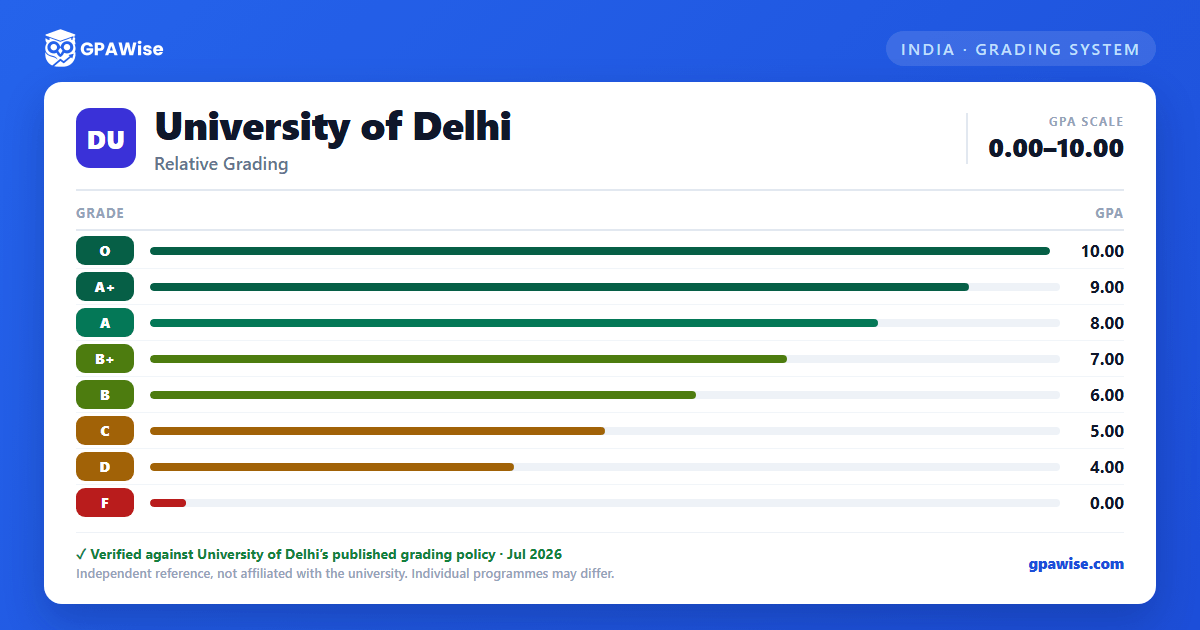
Since the 2022-23 academic year, undergraduates admitted under the National Education Policy / Undergraduate Curriculum Framework (NEP-UGCF-2022) are graded on a 10-point letter-grading system, from O (Outstanding) down to F (Fail).
Letter grades are not assigned from fixed percentage cut-offs. Per the University's own Ordinance IX, each course's grade is set using a relative, cohort-based formula built on the class's mean mark and standard deviation for that paper — so the exact percentage needed for a given grade can shift slightly from one semester or class to the next, capped by a stated ceiling percentage for each grade band. This mechanism is shared with DU's earlier Choice Based Credit System (CBCS); NEP-UGCF changes only how a student's final CGPA converts to a percentage figure (see below), not how individual course grades are computed.
Source: NEP-UGCF 2022-GUIDELINES, clause 12 and clause 15 (cross-referencing Ordinance IX) — verified Jul 2026
How DU calculates SGPA, CGPA, and your final percentage (NEP/UGCF)
Each semester's results are reported as an SGPA (Semester Grade Point Average), and your overall standing as a CGPA (Cumulative Grade Point Average) — both on the University's 0–10 scale, credit-weighted across your courses.
For students on the NEP-UGCF-2022 track, DU converts your overall CGPA to a percentage using its own published formula:
Final Percentage = Grand CGPA (across all semesters) × 10
This is different from the formula DU used for its earlier CBCS track (CGPA × 9.5) — the two are not interchangeable, and which one applies depends on which curriculum framework you were admitted under. The University does not print your percentage on the Grade Certificate, Marksheet, or Transcript itself — only the letter grades, SGPA, and CGPA appear there.
Source: NEP-UGCF 2022-GUIDELINES, clause 14 and clause 15 — verified Jul 2026
Promotion, re-appearance, and repeat rules under NEP-UGCF
Promotion between Parts. You move from Part-1 to Part-2 only after passing at least 50% of the papers across Semester I and II combined; the same 50%-combined threshold applies for Part-2→Part-3 (Semesters III+IV) and Part-3→Part-4 (Semesters V+VI), each assessed independently of your result in the previous Part. Falling short means you're declared fail in that Part, though marks already secured in papers you did pass are retained.
Re-appearing to improve a grade. You may re-appear in a theory paper only in the immediate next semester's examination cycle (a Semester I paper can be retaken alongside Semester III exams, not later), and only by formally foregoing your earlier result in writing — your grade is then based purely on the new attempt. If you've already cleared Part-3 or Part-4, you get only one such re-appearance chance per paper, and taking it disqualifies you from postgraduate admission on that basis.
No supplementary examinations are held under this framework.
Students absent in an odd-semester exam still move on to the next even semester, provided exam forms and fees were submitted for both.
Source: NEP-UGCF 2022-GUIDELINES, clauses 4, 6, 8, 9, 11, 13 — verified Jul 2026
What you need to graduate from DU under NEP-UGCF
To be awarded the UG certificate, UG diploma, or Bachelor's degree, you must pass every paper prescribed for your programme (a minimum numerical grade of 4, i.e. at least a D). Your overall result is then classified into a division, based on your CGPA converted to a percentage (Grand CGPA × 10):
- First Division — 60% or more
- Second Division — 50% up to (but below) 60%
- Third Division — below 50%, provided you've been declared passed
Source: NEP-UGCF 2022-GUIDELINES, clause 16 — verified Jul 2026
Frequently asked questions
Can I save my semesters and track my CGPA at DU?
How do I convert SGPA to CGPA at DU?
Can I add past semester GPAs without entering every course?
Is my CGPA tracker data sent to your servers?
Is this University of Delhi (DU) GPA calculator free?
What is the DU CGPA-to-percentage formula under NEP-UGCF?
For students on the NEP-UGCF-2022 track, DU's own formula is Final Percentage = Grand CGPA (all semesters) × 10. This differs from the ×9.5 formula used for the University's earlier CBCS track — the correct one depends on which curriculum framework you were admitted under.
Source: NEP-UGCF 2022-GUIDELINES, clause 15 — verified Jul 2026
What is the minimum passing grade at DU?
The lowest passing letter grade is D (Pass), worth 4 grade points on DU's 10-point scale. A grade below that is F (Fail), worth 0.
Source: NEP-UGCF 2022-GUIDELINES, clause 12 — verified Jul 2026
Are DU course grades based on fixed percentage cut-offs?
No. DU's Ordinance IX computes course grades using a relative, class-specific formula based on that class's mean mark and standard deviation, with a capped ceiling percentage per grade — not a single fixed percentage band that applies identically to every class or semester.
Source: NEP-UGCF 2022-GUIDELINES, clause 15 (cross-referencing Ordinance IX) — verified Jul 2026