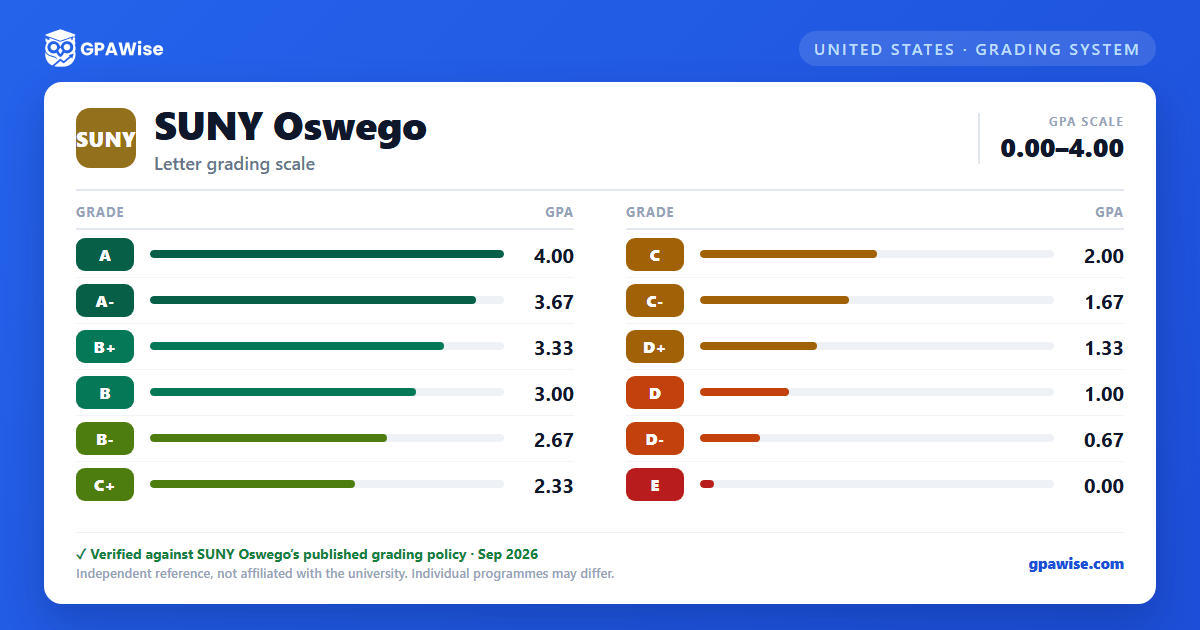
Grading system
The use of plus (+) and minus (-) grades is optional with the instructor. Several additional notations appear on Oswego transcripts that carry no quality-point value and are not part of the numeric grading scale: H (High Honors, used for internships/co-ops), S/U (Satisfactory/Unsatisfactory, used for student teaching and Pass-Fail courses), P/F (Pass-Fail option), I (Incomplete), IP (In Progress, for thesis/research courses), NG (No Grade Transcripted, a disciplinary-suspension notation), W (Withdraw), Z (instructor did not submit a grade), AU (Audit), and NR (case pending/not resolved). No other grades besides the lettered A through E scale carry quality-point value.
Source: University Standards and Policies, Grading System section, 2026-2027 Undergraduate Catalog — verified Sep 2026
How GPA is calculated
The GPA is the total quality points earned divided by the total credit hours carried for all courses in which weighted grades were received. GPA is never rounded up for any purpose. The following grades are not computed in the GPA: AU (Audit), S (Satisfactory), U (Unsatisfactory), P (Passing), F (Failure), H (High Honors), I (Incomplete), IP (In Progress), W (Withdrawal), NR (Not Resolved), and Z (grade not submitted).
Courses in which a C-, C, or C+ or better was earned cannot be repeated for credit; if repeated anyway, the new grade is not used to recompute the GPA. A course in which a D or E was earned may be repeated: if repeated at Oswego, the new grade, credits and quality points replace the old ones in the cumulative average (the earlier grade remains on the transcript, annotated as repeated); if repeated at another institution, only the credit hours transfer and the Oswego GPA no longer reflects the earlier grade. Students changing majors may request one-time conversion of E grades from a prior major into F grades (the "E to F" policy), removing them from the GPA, subject to several conditions. Students admitted to pursue a second undergraduate degree begin with a new 0.00 GPA.
Source: University Standards and Policies, Quality Point System / Repeating Courses / E to F Policy sections — verified Sep 2026
Academic standing and probation
Academic standing is determined only at the end of Fall and Spring semesters (it does not change during Summer or Winter sessions), and is based on overall GPA together with whether the student had a "Successful Semester" (semester GPA of 2.0 or above, plus a minimum course-completion requirement).
- Good Standing: overall GPA of 2.0 or above and a Successful Semester.
- Academic Warning: was in Good Standing, overall GPA still 2.0 or above, but did not have a Successful Semester.
- Academic Probation: overall GPA has fallen below 2.0 (or certain continuing-probation conditions); triggers a mandatory Academic Success Plan with an advisor.
- Academic Disqualification: already on probation, overall GPA remains below 2.0, and did not meet the Academic Success Plan conditions. A dismissed student may appeal, or repair their GPA elsewhere with a minimum of 12 credits and a GPA of at least 2.5 at an accredited institution before seeking reinstatement.
Source: University Standards and Policies, Academic Standing section — verified Sep 2026
GPA requirements for graduation
To graduate, a candidate must complete all prescribed course work for the degree program with a minimum GPA of 2.00 in the major and overall, except for programs in the Curriculum and Instruction, Technology, and Career and Technical Educator Preparation departments, which require a minimum GPA of 2.50. For a minor to be noted on the transcript, a student needs a minimum overall GPA of 2.0 in courses credited to the minor.
Source: University Standards and Policies, Graduation — Requirements section — verified Sep 2026
Dean's List, President's List, and Latin honors
Full-time students completing 12 credit hours of letter-graded coursework qualify for the Deans' List with a semester GPA between 3.30 and 3.79, and for the President's List with a semester GPA of 3.80 or above. A student with fewer than 12 credit hours counted in the GPA for a semester is not eligible for either list.
At commencement, seniors with at least 45 credit hours completed at Oswego qualify for Latin honors based on cumulative index: summa cum laude (3.80 or higher), magna cum laude (3.60 to 3.79), and cum laude (3.30 to 3.59). GPAs are never rounded up for this purpose.
Source: University Standards and Policies, Deans' List and President's List / Senior Honors sections — verified Sep 2026
Transfer credit and D grades
Credits from courses in which a "D" grade was earned transfer directly into Oswego undergraduate programs, though some programs require at least a C- in a transferred course to satisfy a core, cognate, or major-elective requirement — transfer students should check program requirements, since a D-graded course may need to be repeated. At the graduate level, only grades of A or B are transferable. When a course taken elsewhere is repeated at Oswego, only the grade earned at Oswego counts toward the GPA; credit for the same course is given only once.
Source: University Standards and Policies, Transfer Credit: D Grades / Repeating Transfer Courses sections — verified Sep 2026
Frequently asked questions
What grading scheme does SUNY Oswego use?
Where does this SUNY Oswego grade scale come from?
What are SUNY Oswego's GPA rules?
Source: University Standards and Policies, Quality Point System / Repeating Courses / E to F Policy sections — verified Sep 2026
What are SUNY Oswego's academic standing rules?
Source: University Standards and Policies, Academic Standing section — verified Sep 2026
What does SUNY Oswego require to graduate?
Source: University Standards and Policies, Graduation — Requirements section — verified Sep 2026
How are honors and awards decided at SUNY Oswego?
Source: University Standards and Policies, Deans' List and President's List / Senior Honors sections — verified Sep 2026
How does SUNY Oswego treat transfer credit?
Source: University Standards and Policies, Transfer Credit: D Grades / Repeating Transfer Courses sections — verified Sep 2026