
How grading works at Jawaharlal Nehru Technological University Hyderabad (JNTUH)
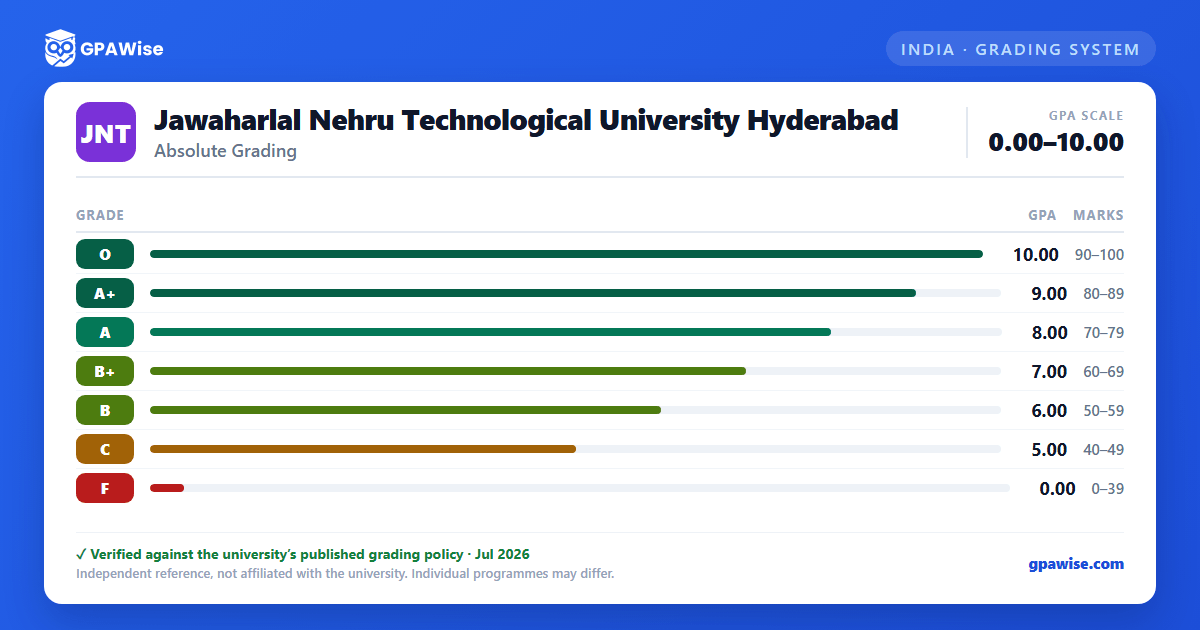
JNTUH uses a 10-point absolute grading system, explicitly described in its own Academic Regulations as following "UGC/AICTE guidelines": your letter grade is set by fixed percentage-of-marks cut-offs, not by how your class performs — there is no curve.
The scale runs from O (Outstanding) down to F (FAIL) across seven graded bands, based on your combined Continuous Internal Evaluation (CIE, out of 40) and Semester End Examination (SEE, out of 60) marks. Because CIE and SEE are both whole-number mark allocations, the combined percentage for any subject is always a whole number, so every band resolves to a clean, non-overlapping integer range with no gaps across 0–100%.
A letter grade "does not indicate any specific percentage of marks secured by the student, but it indicates only the range of percentage of marks" — students within the same band are not distinguished from one another for grading purposes.
Source: Academic Regulations (R22) §9.1-9.2, §9.5 — verified Jul 2026
How JNTUH calculates SGPA and CGPA
JNTUH reports a Semester Grade Point Average (SGPA) and a Cumulative Grade Point Average (CGPA), both credit-weighted and both rounded off to two decimal places:
- SGPA = the sum, across a semester's registered subjects, of (Credits × Grade Point), divided by the total credits registered that semester.
- CGPA = the same sum across every semester registered so far (out of the 160 credits required for the degree), divided by the total credits registered across all semesters.
CGPA computation begins from I Year II Semester onward — after I Year I Semester alone, that semester's SGPA may itself be taken as the CGPA, since there is no cumulative effect yet.
For a final percentage figure equivalent to a student's final CGPA, JNTUH's own regulations state a formula that "may be used": % of Marks = (final CGPA − 0.5) × 10. This is separate from the per-subject grading bands above and is only for expressing an overall CGPA as a percentage.
Source: Academic Regulations (R22) §9.6, §9.8, §9.9, §11.2 — verified Jul 2026
Attendance, year-promotion, and repeat exams at JNTUH
Attendance. You must maintain at least 75% attendance in aggregate across a semester's subjects to be eligible for that semester's end examinations. A shortfall of up to 10 percentage points (i.e. 65%–75%) may be condoned by the college's academic committee for a genuine, evidenced reason and a stipulated fee; a shortfall below 65% can never be condoned. Students whose shortage isn't condoned are detained: that semester's registration (including all internal marks) is cancelled, no grades or SGPA/CGPA are computed for it, and the student isn't promoted — they must seek re-admission into the same semester the next time it's offered.
Year-to-year promotion. Beyond attendance, moving from II semester of one year into I semester of the next requires having earned a minimum share of credits registered so far: 50% of credits (20 of 40) to enter Year 2, and 60% of credits (48 of 80, then 72 of 120) to enter Year 3 and Year 4 respectively — counting every relevant regular and supplementary exam attempt, whether or not the student actually sat it.
Repeating a failed subject. An F grade (or an Ab, automatically treated as failed) requires reappearing as a "supplementary student" in the subject's semester-end exam whenever next offered, with the earlier CIE (internal) marks simply carried over unchanged. However, if a subject was failed specifically because CIE marks fell below 35%, the student must instead fully re-register for that subject — the earlier CIE marks are cancelled outright and a fresh set of CIE marks must be earned alongside a new SEE attempt.
Source: Academic Regulations (R22) §6.1-6.6, §7.3, §7.6-7.8, §8.10, §9.3-9.4 — verified Jul 2026
What you need to graduate from JNTUH
To qualify for the B.Tech. degree, a student must register for and earn all 160 credits specified in their branch's course structure, with a final CGPA of 5.00 or above, within 8 academic years of first admission. A final CGPA below 5.00 makes a student ineligible for the award of the degree altogether.
Degree classification is CGPA-banded: "First Class with Distinction" for a final CGPA above 8.00 (subject to passing every subject on first appearance within the first 4 years/8 sequential semesters, and never having been detained for attendance or any other reason — otherwise a CGPA above 8.00 still places the student in "First Class"); "First Class" for 7.00 up to (but below) 8.00; "Second Class" for 6.00 up to (but below) 7.00; and "pass class" for 5.00 up to (but below) 6.00.
Source: Academic Regulations (R22) §12.1-12.7 — verified Jul 2026
The JNTUH Gold Medal
JNTUH's Gold Medal is awarded only to students who meet every condition for "First Class with Distinction": a final CGPA above 8.00, having passed all subjects/courses on their first appearance within the first 4 academic years (8 sequential semesters) of study, and never having been detained or prevented from sitting a semester-end exam — for attendance shortage or any other reason — at any point in the programme.
Source: Academic Regulations (R22) §12.3, §12.8 — verified Jul 2026
How student transfers work at JNTUH
JNTUH does not permit branch transfers after the admission process is complete, nor transfers between its own constituent colleges/units.
Students transferring in from another university or institution to a JNTUH-affiliated college must pass any subjects they failed at the earlier institution that are equivalent to JNTUH subjects, and must also pass any JNTUH subjects they did not previously study. If a subject the student already passed elsewhere is scheduled in a different semester at JNTUH, the student must study and pass it again at JNTUH regardless of the earlier pass. Transferred students are given one chance to sit the internal (CIE/CBT) assessment for equivalent subjects, per the clearance/equivalence letter issued by the University.
Source: Academic Regulations (R22) §15.1-15.5 — verified Jul 2026
Frequently asked questions
What grading scheme does Jawaharlal Nehru Technological University Hyderabad (JNTUH) use?
Where does this JNTUH grade scale come from?
What CGPA do you need to graduate from JNTUH?
A final CGPA of 5.00 or above is required, alongside earning all 160 credits specified in the course structure within 8 academic years of first admission. A CGPA below 5.00 makes a student ineligible for the degree.
Source: Academic Regulations (R22) §12.1, §12.7 — verified Jul 2026
What is the minimum passing grade at JNTUH?
You pass a subject only with a C grade or above — a Grade Point of 5 or higher, meaning at least 40% combined CIE + SEE marks. Below 40% earns an F, worth 0 grade points.
Source: Academic Regulations (R22) §7.1, §9.7 — verified Jul 2026
Does JNTUH use relative (curved) grading?
No. JNTUH's own regulations describe a 10-point absolute grading system "as per UGC/AICTE guidelines" — fixed percentage cut-offs applied to each student's own marks, with no adjustment for class performance.
Source: Academic Regulations (R22) §9.2 — verified Jul 2026
What happens if I fail a subject at JNTUH?
You reappear as a "supplementary student" in that subject's semester-end exam whenever it's next offered, with your earlier internal (CIE) marks carried over unchanged. The exception: if you failed specifically because your CIE marks were below 35%, you must fully re-register for the subject instead — your earlier CIE marks are cancelled and you earn a fresh set alongside a new exam attempt.
Source: Academic Regulations (R22) §7.6, §8.10, §9.3 — verified Jul 2026
What CGPA do you need for a Gold Medal at JNTUH?
A final CGPA above 8.00 — but the CGPA alone isn't enough. You must also have passed every subject on your first appearance within the first 4 years of study, and never have been detained (for attendance shortage or any other reason) at any point in the programme.
Source: Academic Regulations (R22) §12.3, §12.8 — verified Jul 2026
What happens if my attendance falls short at JNTUH?
You need at least 75% attendance to sit a semester's exams. A shortfall down to 65% can be condoned by the college for a genuine reason and a fee; below 65% is never condoned. If your shortage isn't condoned, you're detained — that semester's registration and internal marks are cancelled, no grades are computed, and you must seek re-admission into the same semester the next time it runs.
Source: Academic Regulations (R22) §6.1-6.6 — verified Jul 2026
Do subjects I already passed elsewhere count if I transfer to JNTUH?
Only if that subject sits in the same semester slot at JNTUH. If a subject you already passed at your previous institution is scheduled in a different semester at JNTUH, you must study and pass it again there regardless of your earlier pass. You must also separately pass any JNTUH subjects you never studied before, and any subjects you failed earlier that are equivalent to JNTUH subjects.
Source: Academic Regulations (R22) §15.3 — verified Jul 2026