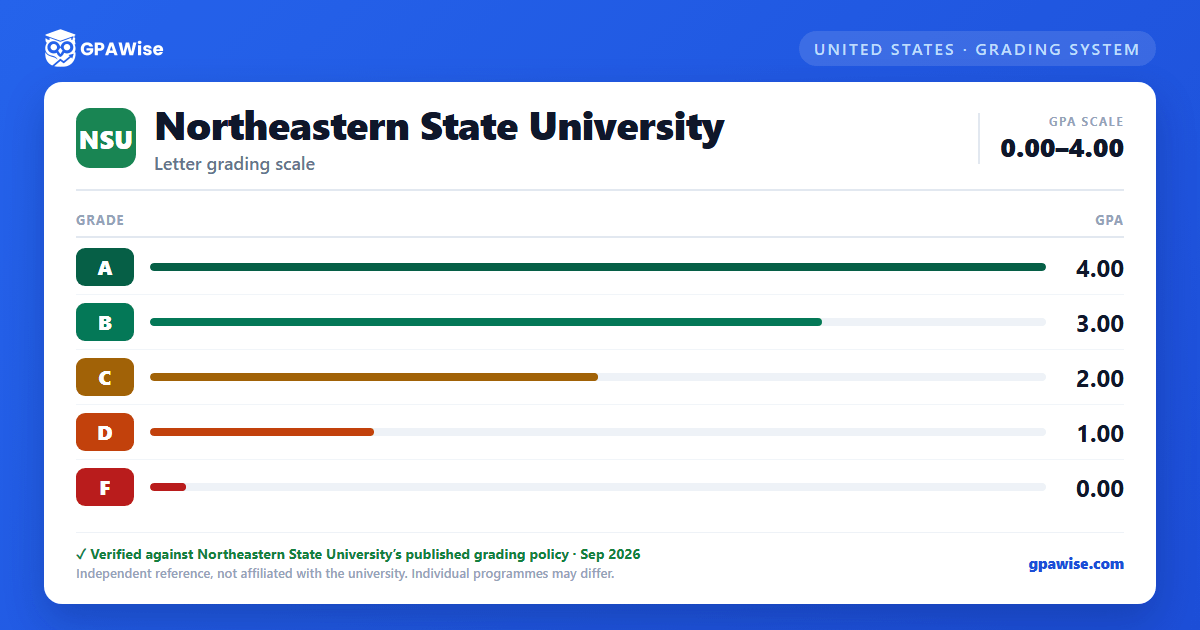

How GPA Is Calculated
To calculate a GPA: convert each grade to its numeric equivalent, multiply each class grade by the number of credit hours earned, add the results together, then divide by the total credits attempted.
Several grade marks carry no grade points and are GPA neutral: I (Incomplete — must be resolved within one calendar year or it becomes a permanent "I" and never contributes to GPA), P/NP (Passing / Not Passing), S/U (Satisfactory / Unsatisfactory), W (Withdrawal), AW (Administrative Withdrawal), and AU (Audit — grade not reported). None of these is counted in the GPA average.
Source: 2026-2027 NSU Undergraduate Catalog, Academic Information: Grading and GPA — verified Sep 2026
Minimum GPA and Grade Forgiveness
Students must maintain a 2.0 cumulative GPA for the duration of their college experience to remain in good academic standing. A freshman with fewer than 30 credit hours and a GPA between 1.7 and 2.0 is placed on academic notice rather than probation.
| Credit Hours Attempted | Minimum Cumulative GPA |
|---|---|
| Fewer than 30 semester credit hours | 1.7 |
| 30 or more semester credit hours | 2.0 |
Repeated courses: students may attempt the identical course up to four times to improve a grade; only the highest grade earned counts toward the GPA (attempts beyond the fourth are also included in the GPA).
Academic reprieve or renewal: a student may use one — but only one — of these in their academic career. Both require the student to have already earned a GPA of 2.0 or higher with no grade below a "C" in at least 12 hours of regularly graded coursework. Renewal additionally requires at least three years to have elapsed since the last semester being renewed, and excludes the renewed coursework from the GPA entirely.
Source: 2026-2027 NSU Undergraduate Catalog, Academic Information: Retention Standards, Academic Forgiveness — verified Sep 2026
Academic Probation and Suspension
A student not maintaining satisfactory progress is placed on probation for one semester. By the end of that semester the student must reach a 2.0 semester GPA (or meet the cumulative GPA standard for their credit-hour level) to continue; otherwise the student is suspended and may not return until one regular (fall or spring) semester has elapsed.
A suspended student may petition the Admission Appeals Committee for readmission once a regular semester has elapsed (application deadlines: July 15 for Fall, November 15 for Spring, April 15 for Summer), or petition the Office of the Registrar for an immediate-return appeal in extraordinary circumstances.
Suspension of seniors: a student with 90 or more earned hours who has failed to reach a 2.0 overall GPA is granted a one-time extension of up to 15 additional semester hours to reach the required GPA, while maintaining at least a 2.0 GPA each semester during the extension.
Source: 2026-2027 NSU Undergraduate Catalog, Academic Information: Academic Probation and Suspension, Suspension Appeals — verified Sep 2026
President's and Dean's Honor Roll
Each semester, undergraduates who have not yet earned a degree may be named to an honor roll based on at least 12 hours of regularly graded NSU undergraduate coursework (1000-4999 level; Pass-Fail and remedial "0"-level hours do not count):
- President's Honor Roll — a semester GPA of 4.00 with no grade below an "A".
- Dean's Honor Roll — a semester GPA of 3.50 with no grade below a "B".
Source: 2026-2027 NSU Undergraduate Catalog, Academic Information: Honor Roll — verified Sep 2026
Transfer Credit Policy
Students transferring from an Oklahoma community college must complete at least 60 hours from a four-year college or university to meet baccalaureate degree requirements.
Credit from other colleges and universities is accepted toward an NSU undergraduate degree when: the prior institution is accredited by an organization recognized by the U.S. Department of Education; a grade was assigned that is measurable and comparable to NSU's grading system; the course is comparable in credit hours, content, level, and instructional time to an NSU course; lower-division (1000-2000 level) credit cannot satisfy upper-division (3000-4000 level) requirements; the student was in good standing (not on academic or disciplinary suspension) at the prior institution; and coursework already applied toward a previously earned degree cannot be reapplied toward the same degree type at NSU.
Prior-learning and correspondence/extension credit combined may not exceed one-fourth of the total semester hours required for graduation, or 30 hours, whichever is less. International transfer students need a minimum of 24 semester hours earned with passing grades and a TOEFL score of 500/61 (or IELTS 5.5); credit earned outside the United States, Canada, or the U.K. additionally requires a course-by-course credential evaluation (e.g. WES or ECE). Final determination of transfer credit rests with the Registrar under the authority of the Vice President of Academic Affairs.
Source: 2026-2027 NSU Undergraduate Catalog, Academic Information: Transferring to NSU — verified Sep 2026
Frequently asked questions
What grading scheme does Northeastern State University (NSU) use?
Where does this NSU grade scale come from?
What are NSU's GPA rules?
Source: 2026-2027 NSU Undergraduate Catalog, Academic Information: Retention Standards, Academic Forgiveness — verified Sep 2026
What are NSU's academic standing rules?
Source: 2026-2027 NSU Undergraduate Catalog, Academic Information: Academic Probation and Suspension, Suspension Appeals — verified Sep 2026
How are honors and awards decided at NSU?
Source: 2026-2027 NSU Undergraduate Catalog, Academic Information: Honor Roll — verified Sep 2026
How does NSU treat transfer credit?
Source: 2026-2027 NSU Undergraduate Catalog, Academic Information: Transferring to NSU — verified Sep 2026