
How grading works at Essex County College
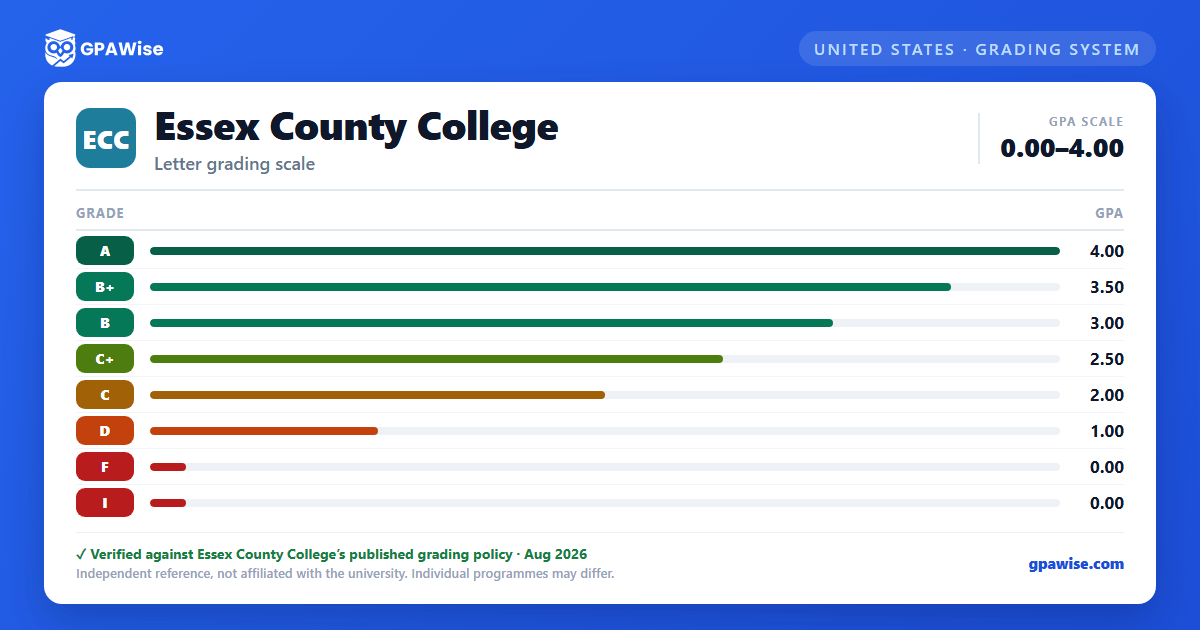
ECC records your performance in each course as a letter grade, and each letter carries a grade-point value on a 0.0–4.0 scale. The catalog's full set of grade-bearing letters is A, B+, B, C+, C, D, and F — note there is no A+ and no minus grades (no A-, B-, C-, or D-); A is the highest grade you can earn, worth 4.0.
A grade of D is passing, but the catalog warns it "may not fulfill certain course prerequisites and major course requirements and may not transfer to other institutions."
An Incomplete (I) is recorded when you've finished at least 75% of a course's work with a grade of C or better but haven't completed everything. You have six months to finish the work with your instructor's sign-off; after that, the catalog states the "I" converts automatically to an F.
A separate group of symbols — AU, CR, M, N, NC, NG, P, R, S, T, U, W, and WU — are used for things like audits, withdrawals, and pass/fail-style outcomes. The catalog explicitly states these are not calculated in the GPA.
Source: 2026-2027 Catalog — Grading System (Quality Points Per Letter Grade) — verified Aug 2026
How ECC calculates your GPA
Your semester GPA is built course by course: multiply each course's grade-point value by its number of semester hours to get the grade points earned for that course, add those up across the semester, then divide the total by the total semester hours attempted.
Your cumulative GPA (CGPA) is calculated the same way, but across all the work you've completed at ECC rather than just one semester.
Repeating a course: if you retake a course after an earlier D or F, the lower grade stays on your transcript, but only the higher of the two grades is used in your CGPA.
Grades that are excluded from the GPA calculation altogether (see the Grading System section) simply don't enter into either formula above.
Source: 2026-2027 Catalog — Grade Point Average; Repeating a Course — verified Aug 2026
Good standing, probation, and suspension at ECC
Good academic standing requires a cumulative GPA of 2.0 or above.
- Probation — your cumulative GPA falls below 2.0.
- Conditional probation — you were below 2.0 cumulative, then earn 2.0 or higher in a term, but your resulting new cumulative GPA is still under 2.0.
- Suspension (one academic period) — you're already below 2.0 cumulative and then earn below 2.0 again in the next term. You may appeal for reinstatement or sit out the suspension period.
- Dismissal (2 years) — after a suspension, you either earn below 2.0 again in a term, or your cumulative GPA is still below 2.0.
Students on probation, suspension, or dismissal must get counselor approval before registering for classes.
Source: 2026-2027 Catalog — Academic Progress (Good Standing, Probation, Suspension, Dismissal) — verified Aug 2026
GPA and other requirements to graduate from ECC
To graduate from an ECC degree or certificate program, you need a cumulative GPA of 2.0 or higher, plus:
- Completion of the required coursework for your program, including the FYE 097 First Year Experience course (2 credits).
- At least half of your total required credits, and at least half of your major's required course credits, completed at ECC itself.
- A grade of C or better in the required courses within your major course category.
- All money owed to the college paid in full.
Source: 2026-2027 Catalog — Graduation Requirements for Degree Students — verified Aug 2026
Dean's List and graduation honors at ECC
ECC publishes a Dean's List every semester. To qualify as a full-time student you need a semester GPA of 3.5 or higher, no "I" grade, and no grade below C for that semester (only college-level courses count). Part-time students qualify the same way, plus at least 12 college-level credits within the academic year.
At graduation, ECC recognizes academic achievement with three cumulative-GPA-based honor levels — using descriptive English titles rather than Latin ones:
- Highest Honors — CGPA 3.85 to 4.00
- High Honors — CGPA 3.65 to 3.84
- Honors — CGPA 3.50 to 3.64
Source: 2026-2027 Catalog — Dean's List; Graduation with Honors — verified Aug 2026
How transfer credit works at ECC
Credit from another institution generally transfers to ECC only for courses you passed with a C or better. An exception: grades of D from New Jersey public colleges may be accepted for non-major courses, as long as a C isn't a prerequisite for something later in your program.
You can transfer in up to half of your degree or certificate's required credits — typically up to 30 credits toward an Associate degree or 15 toward a certificate — and you must still complete at least half of your major requirements and half of your overall degree or certificate requirements at ECC itself.
Transfer credits appear on your transcript, but the catalog is explicit that they are not calculated into your ECC grade point average.
Source: 2026-2027 Catalog — Transfer Credit — verified Aug 2026
Frequently asked questions
What grading scheme does Essex County College (ECC) use?
Where does this ECC grade scale come from?
What are ECC's GPA rules?
Source: 2026-2027 Catalog — Grade Point Average; Repeating a Course — verified Aug 2026
What are ECC's academic standing rules?
Source: 2026-2027 Catalog — Academic Progress (Good Standing, Probation, Suspension, Dismissal) — verified Aug 2026
What does ECC require to graduate?
Source: 2026-2027 Catalog — Graduation Requirements for Degree Students — verified Aug 2026
How are honors and awards decided at ECC?
Source: 2026-2027 Catalog — Dean's List; Graduation with Honors — verified Aug 2026
How does ECC treat transfer credit?
Source: 2026-2027 Catalog — Transfer Credit — verified Aug 2026