
How grading works at ANU
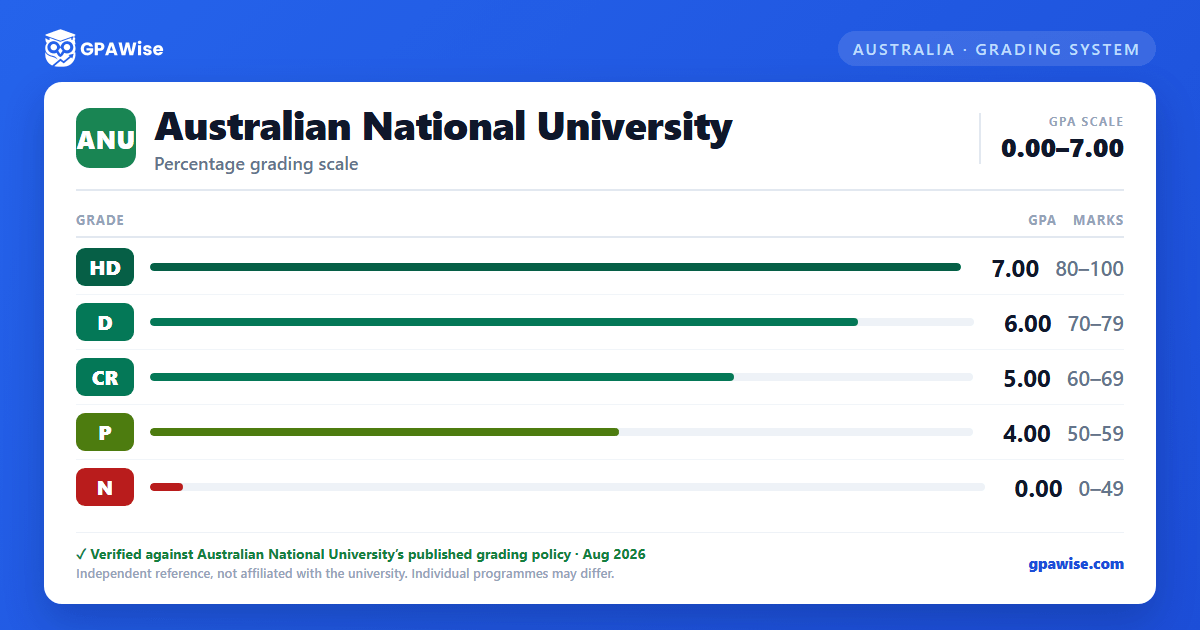
ANU has used the same five-grade scale for all coursework courses since first semester 1994: High Distinction (HD), Distinction (D), Credit (CR), Pass (P), and Fail (N) — see the Grade Scale Reference above for the full mark bands and grade points. Each course result is recorded as a numerical mark from 0–100%, which determines your letter grade.
If you fail a course but are offered and pass a supplementary examination, you receive a Pass at a Supplementary Examination (PS) result, capped at a mark of 50 and worth the same 4 grade points as an ordinary Pass. Some administrative outcomes — Course Requirement Satisfied (CRS), deferred or pending results, and withdrawal codes — carry no grade point and are excluded from your GPA entirely.
Source: Student assessment (coursework) Policy, ANUP_004603, Table 1 & Table 4; Grading scale student page — verified Aug 2026
How ANU calculates your Grade Point Average (GPA)
ANU calculates your Grade Point Average (GPA) on a 7-point scale, published on your academic transcript: GPA = ∑(grade point value × units) / ∑(units). Each course's grade point is multiplied by its unit value, summed across your whole academic career, then divided by your total units attempted.
- You receive one GPA covering all units in one academic career (undergraduate or postgraduate coursework) — if you've completed both, you'll have a separate GPA for each.
- Courses graded on a straight pass/fail basis are not included in your GPA.
- Courses with interim or unresolved grades (deferred, pending, withheld) are excluded until resolved.
- A KU (continuing course) or IP (in progress) grade is folded into the GPA only once the final course in that series receives a final grade.
GPA is not calculated at all for students in a research program, the Doctor of Medicine and Surgery (MChD), or a non-award program. ANU also publishes a separate Weighted Average Mark (WAM), ∑(mark × units) / ∑(units), used where a raw mark-based average is required — courses with a Not Completed/Fail (NCN) or Withdrawn-with-failure (WN) result count toward the WAM with a nominal mark of zero.
Source: Student assessment (coursework) Policy, ANUP_004603, Table 3 & GPA formula clauses; Grade Point Average (GPA) student page — verified Aug 2026
Academic probation and exclusion at ANU
ANU tracks your academic progress by counting course failures (a fail is any N, NCN, or WN result) across your academic career, under the Academic Progress Rule:
- Undergraduate: early intervention advice on your 1st fail, academic probation on your 4th fail, considered for exclusion on your 8th fail.
- Postgraduate coursework: early intervention advice on your 1st fail, academic probation on your 3rd fail, considered for exclusion on your 5th fail.
You've also failed to maintain satisfactory progress if you fail the same course a second time (placing you on probation for that course) or a third time (considered for exclusion), or if you don't achieve the results a specific program requires. If you're considered for exclusion, you can appeal by submitting a formal 'Show Cause' response.
You can reset your fail-count and restore good standing by passing 8 or more courses (undergraduate) or 6 or more courses (postgraduate) in consecutive teaching periods after your last fail, with no further fails in that period.
Source: Expected academic performance for coursework students (Academic Progress Rule fail-count thresholds) — verified Aug 2026
Honours classification and graduate exit standards at ANU
Alongside its course-grade scale, ANU uses a separate honours classification scale for honours-classified courses and final degree outcomes, based on the same 0–100% mark bands:
- 80–100 — First Class Honours (H1)
- 70–79 — Second Class Honours, Division A (H2A)
- 60–69 — Second Class Honours, Division B (H2B)
- 59 and below — Third Class Honours (H3)
For students who commenced before 1 January 2016, the same four mark bands determine Graduate Diploma and Masters (Coursework) exit standards — awarded “with Distinction” (80–100), “with Merit” (70–79), or the plain award (60% and below). Students who commenced on or after 1 January 2016 are classified instead under the Coursework Awards Rule.
Source: Student assessment (coursework) Policy, ANUP_004603, Table 2: Honours grades and graded graduate coursework exit standards — verified Aug 2026
Frequently asked questions
What grading scheme does Australian National University (ANU) use?
Where does this ANU grade scale come from?
What GPA scale does ANU use?
ANU calculates your Grade Point Average on a 7-point scale: High Distinction is worth 7 points, Distinction 6, Credit 5, Pass 4, and Fail 0.
Source: Student assessment (coursework) Policy, ANUP_004603, Table 3: Grade Point Values — verified Aug 2026
What is a passing grade at ANU?
The lowest passing grade at ANU is Pass (P), awarded for a mark of 50–59% and worth 4 grade points. A mark of 0–49% is a Fail (N), worth 0 grade points. If you fail a course but pass an offered supplementary examination, you receive a Pass at Supplementary Examination (PS), also worth 4 points.
Source: Student assessment (coursework) Policy, ANUP_004603, Table 1 & Table 3 — verified Aug 2026
What happens if I fail too many courses at ANU?
ANU tracks a running fail-count across your academic career. Undergraduates are placed on academic probation after their 4th fail and considered for exclusion after their 8th; postgraduate coursework students are placed on probation after their 3rd fail and considered for exclusion after their 5th. Failing the same course three times is also grounds for exclusion. You can appeal an exclusion decision by submitting a 'Show Cause' response.
Source: Expected academic performance for coursework students (Academic Progress Rule fail-count thresholds) — verified Aug 2026
Does ANU use a WAM as well as a GPA?
Yes. Alongside your GPA, ANU can calculate a Weighted Average Mark (WAM) — the credit-weighted average of your raw numerical marks, rather than grade points. Courses with a Not Completed/Fail (NCN) or Withdrawn-with-failure (WN) result count toward your WAM with a nominal mark of zero; pass/fail-only and unresolved-grade courses are excluded from both.
Source: Student assessment (coursework) Policy, ANUP_004603, WAM formula clause — verified Aug 2026
Is a Pass at Supplementary Exam (PS) included in my ANU GPA?
Yes. A Pass at Supplementary Examination (PS) — awarded when you fail a course but subsequently pass an offered supplementary exam — is capped at a mark of 50 and carries 4 grade points, the same as an ordinary Pass, and is included in your GPA calculation.
Source: Student assessment (coursework) Policy, ANUP_004603, Table 1 & Table 3 — verified Aug 2026