
How grading works at La Trobe University
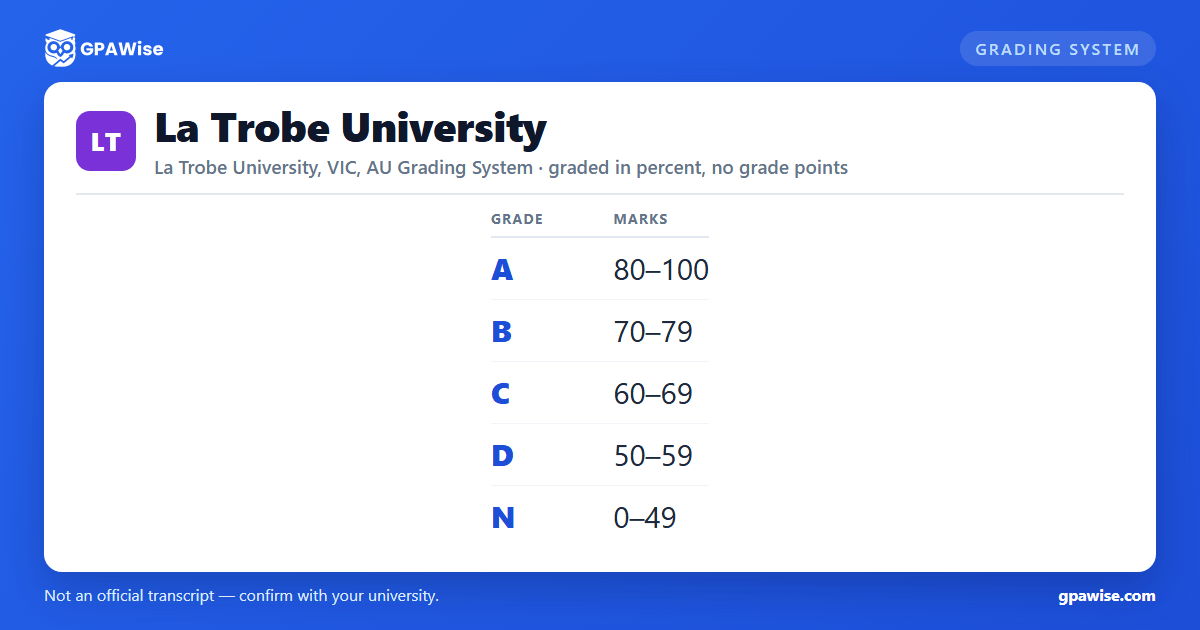
La Trobe grades most Higher Education coursework on a fixed, university-wide percentage-to-grade table for undergraduate and postgraduate subjects: A (80-100%), B (70-79%), C (60-69%), D (50-59%), and N, Fail (0-49%). Some subjects are assessed as pass/fail only, recorded as P (Ungraded Pass) or F (Ungraded Fail) with no percentage attached.
La Trobe does not publish a grade-point value for any of these results anywhere in its grading policy — there is no numeric points column. In courses run in association with particular partners, an alternative label set is used for the same percentage bands instead: HD (High Distinction, 80-100%), DI (Distinction, 70-79%), CR (Credit, 60-69%), P (Pass, 50-59%) and N (Fail, 0-49%). The university's own procedure states this alternative set is used only "in specific circumstances (eg, in courses run in association with particular partners)" — the general undergraduate/postgraduate scheme is the A-D table above.
Source: Assessment Procedure - Grades and Administrative Codes, clauses 4, 7 (Section 6, Part A) — verified Aug 2026
How La Trobe calculates the Weighted Average Mark (WAM)
La Trobe does not calculate a GPA. Its overall academic-performance indicator is a Weighted Average Mark (WAM), on the same 0-100 scale as an individual subject mark:
WAM = the sum of (Numeric Mark for a subject × Credit Points for that subject), for every subject attempted in a Progression Period, divided by the Total Credit Points.
If a subject has no numeric mark (for example, one assessed entirely as competent/not-yet-competent), it is excluded from the WAM calculation altogether — except for an NS (Nothing Submitted) or KN (Late Withdrawal with Academic Penalty) result, which is counted using a default numeric mark of zero. A WAM cannot be calculated at all while a student holds one or more incomplete grades (such as XC or W) within the Progression Period.
Source: Assessment Procedure - Grades and Administrative Codes, clauses 2, 8-10 (Section 6, Weighted Average Mark) — verified Aug 2026
Academic progression monitoring at La Trobe
La Trobe monitors academic progression by counting subject failures within each enrolment period (a "Progression Period"), not by a minimum WAM threshold. Students who pass everything they're enrolled in receive no intervention.
- Academic Progression Stage One (AP1) – Recovery: triggered by a first failure of a subject other than a workplace-based one. Students receive a support communication and access to an Academic Recovery Module.
- Academic Progression Stage Two (AP2) – Support and Sanction: triggered by failing a workplace-based subject for the first time, failing 50% or more of enrolled credit points for the first time, failing the same subject a second time, or triggering AP1 more than three times. Requires attendance at an academic recovery workshop and caps enrolment at 45 credit points in the next Progression Period.
- Academic Progression Stage Three (AP3) – Show Cause and Course Exclusion: triggered by a second workplace-based subject failure, failing 50%+ of credit points a second time, failing the same subject a third time, exceeding the course's maximum completion date, or reaching AP3 twice. The student has 10 business days to make a written show-cause submission; the outcome is either a credit-point enrolment restriction (45 credit points or less) or exclusion from the course for nine months.
A student excluded from a course may reapply to the same course once any conditions are met, or apply to a different La Trobe course at any time.
Source: Academic Progression Review Policy (00220), clauses 7-22, Table One — verified Aug 2026
Honours classifications at La Trobe
For Honours units and courses, results are classified rather than graded on the standard A-D scale, using the same percentage cut points:
- H1 – First Class Honours (80-100%)
- H2A – Second Class Honours, Division A (70-79%)
- H2B – Second Class Honours, Division B (60-69%)
- H3 – Third Class Honours (50-59%)
An Ungraded Pass (P) or Fail/Ungraded Fail (N/F) may also apply, as in the general scheme. These classifications apply to Honours-specific units and courses, not to La Trobe's general Bachelor's or Postgraduate coursework grading.
Source: Assessment Procedure - Grades and Administrative Codes, Section 6, Part A, Honours table — verified Aug 2026
Cross-institutional study at La Trobe
Where a student undertakes a subject at another institution under an approved external-studies arrangement, the result appears on the La Trobe record as EXTP (External Pass) or EXTF (External Fail) rather than as a graded mark. Separately, an EX (Exemption) administrative code is used when a student is granted credit towards a coursework course from previous study or activity.
Source: Assessment Procedure - Grades and Administrative Codes, Section 6, Part A, External Studies table — verified Aug 2026
Frequently asked questions
Can I save my semesters and track my average at La Trobe University?
Can I add past semesters without entering every course?
Is my tracker data sent to your servers?
Is this La Trobe University GPA calculator free?
Does La Trobe University use a GPA?
No. La Trobe uses a Weighted Average Mark (WAM) instead of a GPA — a credit-point-weighted average of your percentage marks, on the same 0-100 scale as individual subject results. No grade-point value is published for any La Trobe grade.
Source: Assessment Procedure - Grades and Administrative Codes, clauses 2, 8 — verified Aug 2026
What mark do you need for an A, B, C or D grade at La Trobe?
For standard undergraduate and postgraduate coursework: A is 80-100%, B is 70-79%, C is 60-69%, D is 50-59%, and N (Fail) is 0-49%. Some partner-delivered courses instead label the same bands HD/DI/CR/P/N (High Distinction/Distinction/Credit/Pass/Fail).
Source: Assessment Procedure - Grades and Administrative Codes, Section 6, Part A — verified Aug 2026
How does La Trobe monitor academic progress?
By counting subject failures within each enrolment period, not by a minimum WAM. A first failure triggers a support-focused "Recovery" stage; repeated or more serious failures escalate through an enrolment-restricted "Support and Sanction" stage to a "Show Cause and Course Exclusion" stage, where a student must argue in writing why they shouldn't be excluded from their course.
Source: Academic Progression Review Policy (00220), Table One — verified Aug 2026