
How grading works at ACU
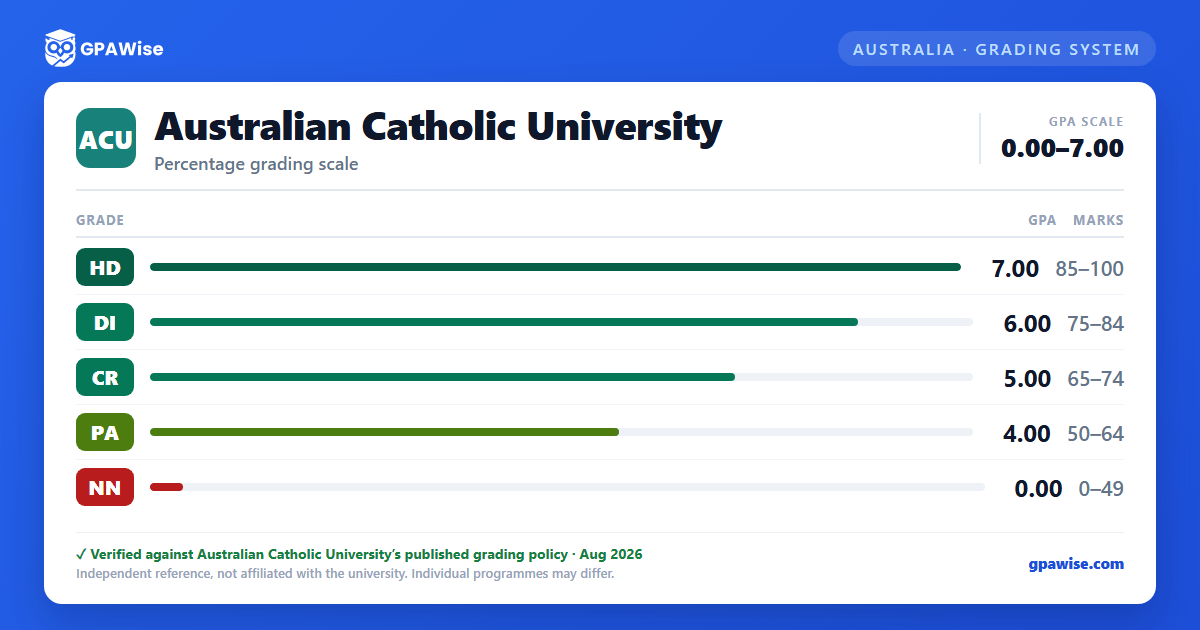
ACU records your performance in most units as a mark out of 100, which converts to a letter grade on a 0–7 grade-point scale: High Distinction (HD) 85–100 = 7, Distinction (DI) 75–84 = 6, Credit (CR) 65–74 = 5, Pass (PA) 50–64 = 4, and Fail (NN) 0–49 = 0. This one table applies university-wide, across every ACU campus.
Note the Australian sense of the letters: at ACU, D means Distinction — the second-highest grade — and C (CR) means Credit, not a near-fail. See the Grade Scale Reference above for every grade and its grade points.
A sixth outcome, Fail Hurdle (NH), is also worth 0 grade points. It is used specifically when you are withdrawn from a professional-experience placement for unsatisfactory performance, rather than for ordinary coursework underperformance.
Some units are ungraded — assessed only as Pass Ungraded (PS) or Fail Ungraded (NU), with no percentage mark recorded at all.
Source: Academic Regulations — Grading and Results: Unit Results, Table 1, Table 2 (clause 97) — verified Aug 2026
How ACU calculates your GPA
Your grade point average is the average of your unit grades, weighted by each unit's credit points:
GPA = SUM (grade point value × unit credit points) / SUM unit credit points
Three grades are excluded from your GPA calculation: Pass Ungraded (PS), Credit Granted (CG), and Withdrawn Without Academic Penalty (WW). Every graded unit — including a Fail (NN) or Fail Hurdle (NH), both worth 0 — counts toward your average.
Repeating a unit: if the Course Adviser requires you to repeat a previously completed unit (for example after an interruption to your studies), each attempt is recorded on your transcript and does contribute to your GPA. If you choose to repeat a unit voluntarily on a non-award, full fee-paying basis, that attempt is recorded on your transcript but does not contribute to your GPA.
Source: Academic Regulations — Grading and Results: Grade Point Average (clauses 106-108); Enrolment: Repeating a Previously Completed Unit (clauses 52-53) — verified Aug 2026
Staying in satisfactory academic progress at ACU
ACU does not set a single minimum cumulative GPA to remain enrolled. Instead, your academic progress is formally reviewed after each semester's results are released, based on how many of your enrolled units or credit points you failed in that review period.
- At risk: you are warned if you fail 50% or more of your enrolled units/credit points in a review period (the first time, or again in a later non-consecutive period), or if you fail the same unit twice.
- Unsatisfactory progress: triggered by failing 50%+ of your units in two consecutive review periods (or three non-consecutive ones), failing the same unit three times, or failing any professional-experience unit. You will be required to show cause in writing why your enrolment should not be terminated.
- Termination: can follow failing to show cause, failing 50%+ of your units in three consecutive (or four total) review periods, failing the same unit a fourth time, or exceeding the maximum time allowed to complete your program.
If your enrolment is terminated, you may be offered an approved exit qualification if you've met its requirements, and you generally cannot apply for readmission until two standard study periods have passed.
Source: Academic Regulations — Section 11, Academic Progress (clauses 109-131) — verified Aug 2026
What ACU requires for your award
To be eligible for conferral of any ACU award, you must comply with all applicable University statutes, policies, procedures, regulations and rules; pay all relevant fees and charges; and complete all requirements prescribed for your program.
Minimum ACU-based study: normally, you must complete at least one-quarter of the units required for your program — and at least one-quarter of the units required for any major, double major or specialisation — through study undertaken at ACU itself, in units not already credited toward another completed award.
Time limits to complete your program (excluding approved interruptions): Bachelor and Sub-Bachelor programs follow the formula 2n+1 (twice the full-time-equivalent course length, plus one year); Graduate Certificate 2 years; Graduate Diploma 4 years; Masters Degree 6 years.
Source: Academic Regulations — Section 13, Conferral of Awards (clauses 133-137); Minimum Level of Studies for an Award (clause 24); Academic Progress (clause 110) — verified Aug 2026
How ACU classifies Honours
If you're in a Bachelor Honours program, your overall Honours classification is a separate calculation from your regular unit GPA. It is based on the marks you achieve in all units required for the Honours course, weighted by each unit's credit points:
Honours mark range = SUM (Honours unit marks × unit credit points) / SUM Honours unit credit points
| Classification | Mark range | Code |
|---|---|---|
| First Class Honours | 85–100 | HI |
| Second Class Honours – Division A | 75–84 | HIIA |
| Second Class Honours – Division B | 65–74 | HIIB |
| Third Class Honours | 50–64 | HIII |
| Fail | 0–49 | NN |
These mark bands mirror the HD/DI/CR/PA/NN bands used for ordinary unit grading, but the classification is computed across your whole Honours course, not unit by unit.
Source: Academic Regulations — Grading and Results: Honours Course Grading Codes, Table 5 (clauses 104-106) — verified Aug 2026
Credit for previous study at ACU
ACU can grant credit toward your program for formal, non-formal or informal prior learning, in three forms: Specified Credit (for units substantially the same as ones you've already passed elsewhere), Block Credit (a complete section of a program via an articulation pathway), and Unspecified Credit (for elective components, where your prior study doesn't correspond precisely to program components).
Maximum credit varies by award: up to one-half of a non-award course or Sub-Bachelor program, two-thirds of a 3-year Bachelor degree, three-quarters of a 4-year Bachelor degree, or one-half of a postgraduate coursework degree (excluding theses/dissertations/research projects).
Limits: credit is only granted for prior learning within the last 10 years (exceptions possible with Head of School approval), only once per completed award, and never for a failed unit unless you've since passed equivalent study. Regardless of credit granted, you must still complete at least one-quarter of your program's units through study at ACU.
Source: Academic Regulations — Section 5, Credit for Previous Study or Learning (clauses 19-32) — verified Aug 2026
Frequently asked questions
Can I save my semesters and track my CGPA at ACU?
How do I convert SGPA to CGPA at ACU?
Can I add past semester GPAs without entering every course?
Is my CGPA tracker data sent to your servers?
Is this Australian Catholic University (ACU) GPA calculator free?
Does D mean a near-fail at ACU, like in the US system?
No. At ACU, D stands for Distinction — the second-highest grade on the scale, worth 6 grade points, awarded for marks of 75–84%. Distinction sits above Credit (CR) and below High Distinction (HD). This is the standard Australian grading convention and is the opposite of the near-fail 'D' used in some other countries.
Source: Academic Regulations — Grading and Results, Table 1 (clause 97) — verified Aug 2026
What is Fail Hurdle (NH) at ACU?
Fail Hurdle (NH) is worth 0 grade points, the same as an ordinary Fail (NN). It's awarded specifically when you're withdrawn from a professional-experience placement (for example, a practicum or clinical placement) because of unsatisfactory performance — it flags that the failure relates to a placement 'hurdle' requirement rather than to your coursework marks generally. Both NN and NH count the same way (0) in your GPA calculation.
Source: Academic Regulations — Grading and Results, Table 1; Withdrawal from a Professional Experience Placement for Unsatisfactory Performance (clauses 66-70) — verified Aug 2026
What is the ACU GPA scale, and what's the highest possible GPA?
ACU uses a 0.00 to 7.00 scale. The highest grade is High Distinction (HD), worth 7 grade points for marks of 85–100%. A Fail (NN or NH) is worth 0.
Source: Academic Regulations — Grading and Results, Table 1 (clause 97) — verified Aug 2026
Does the ACU grading scale differ between campuses?
No. ACU is one national university, and the Academic Regulations' grading table applies to all units, university-wide — there is no separate scale for the North Sydney, Strathfield, Blacktown, Melbourne, Brisbane or Canberra campuses. The same High Distinction–to–Fail scale and the same GPA formula apply no matter which campus you study at.
Source: Academic Regulations — Grading and Results: Unit Results (clause 97) — verified Aug 2026
What is the minimum passing mark at ACU?
You need a mark of at least 50% to pass a graded unit — the Pass (PA) band runs 50–64% and is worth 4 grade points. Marks of 49% and below fall into Fail (NN), worth 0.
Source: Academic Regulations — Grading and Results, Table 1 (clause 97) — verified Aug 2026
Does Pass Ungraded (PS) count toward your ACU GPA?
No. Some units at ACU are assessed only as Pass Ungraded (PS) or Fail Ungraded (NU), with no percentage mark recorded. Pass Ungraded (PS) is explicitly excluded from your grade point average calculation, along with Credit Granted (CG) and Withdrawn Without Academic Penalty (WW).
Source: Academic Regulations — Grading and Results: Grade Point Average (clause 108); Table 2 — verified Aug 2026
If I repeat a unit at ACU, does it affect my GPA?
It depends on why you're repeating. If your Course Adviser requires you to repeat a previously completed unit — for example after a study interruption of two or more standard study periods, or to maintain professional registration recency — that attempt is recorded on your transcript and does count toward your GPA. If you choose to repeat a unit yourself on a non-award, full fee-paying basis, that attempt is recorded but does not count toward your GPA.
Source: Academic Regulations — Enrolment: Repeating a Previously Completed Unit (clauses 52-53) — verified Aug 2026
Is my Honours classification the same as my GPA at ACU?
No, they're calculated separately. Your regular GPA averages grade points across all your graded units. Your Honours classification (First Class, Second Class Division A or B, or Third Class) is a distinct calculation based only on the marks in the units required for your Honours course, weighted by credit points, and expressed as a mark range rather than a grade-point average.
Source: Academic Regulations — Honours Course Grading Codes, Table 5 (clauses 104-106) — verified Aug 2026