
How repeats and resits affect your GPA at Sunway University
If you fail a course, Sunway University's Academic Regulations (Section J2) give undergraduate students up to two reassessment opportunities, unless a professional body's own rules prohibit it. Reassessment takes one of two forms:
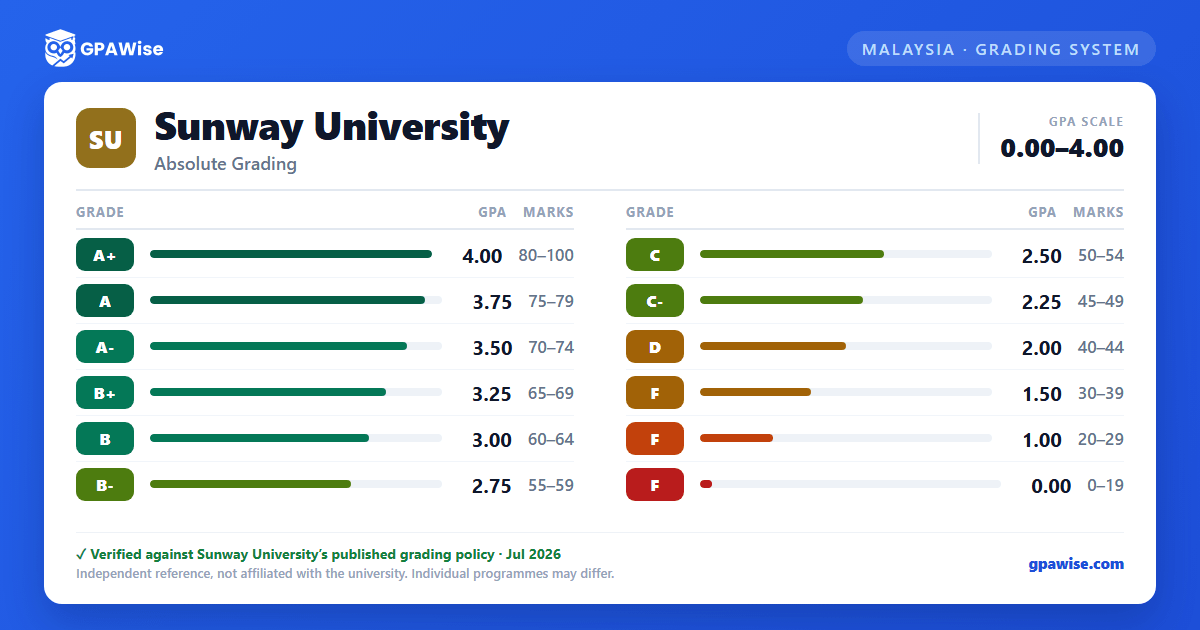
- Re-sit - retaking only the failed assessment component(s) (for example, sitting another exam or resubmitting coursework), available after a marginal failure (30%-39%) or the failure of just one required component.
- Repeat - retaking all assessment components of the course again, including attending classes.
If you waive the re-sit, you have two remaining attempts to repeat the course; failing the re-sit at the second attempt means the course must be repeated as your final attempt.
For students from the August 2019 intake onwards, marks from a reassessment attempt are not capped - you are awarded the actual marks you achieve. However, marks from every failed attempt still appear on your transcript, and if you have to repeat a course in a later semester, that earlier failed attempt still contributes to your GPA for the semester it was taken in. Your CGPA, though, is calculated only from your latest reassessment attempt for each course.
Source: Academic Regulations 2024(ii) Section J2.1-J2.3, J2.7 — verified Jul 2026
Academic standing and probation at Sunway University
Sunway University tracks your academic standing every semester based on your GPA and CGPA:
- Good Standing - your CGPA is 2.00 or above.
- Warning - your GPA for the semester drops below 2.00, but your CGPA is still 2.00 or above.
- Probation - your CGPA itself falls below 2.00.
- Extended Probation - your CGPA is still below 2.00 after a semester on probation, even if that semester's own GPA was 2.00 or higher; you may register a maximum of 12 credits.
- Final Probation - your CGPA remains below 2.00 after a semester on Extended Probation; registration is again capped at 12 credits.
- Dismissal - you fail to bring your GPA/CGPA back to 2.00 during Extended or Final Probation.
Separately, a student is dismissed outright after four consecutive semesters with a CGPA below 2.00, regardless of the probation stage reached.
Source: Academic Regulations 2024(ii) Section J6.10-J6.11 — verified Jul 2026
Minimum CGPA to graduate from Sunway University
Sunway University's "Good Standing" floor is a CGPA of 2.00 - the same floor that anchors its lowest award classification. For the Diploma/Bachelor's scheme, the lowest classification band recognised at graduation is 2.00-2.49 ("Pass" for a Diploma, "Class III" for a Bachelor's degree - see the Award Classification section). A CGPA that never recovers to 2.00 does not lead to graduation at all: instead it moves a student through Probation, Extended Probation, and Final Probation toward Dismissal, or triggers automatic dismissal after four consecutive semesters below a 2.00 CGPA.
Source: Academic Regulations 2024(ii) Section J6.6, J6.10 — verified Jul 2026
Award classification at Sunway University (Distinction, Merit, Class I/II/III)
Sunway University classifies Diploma and Bachelor's degree awards from your final CGPA, for the August 2019 intake onwards. Diploma and Bachelor's awards use different labels for the same four CGPA bands:
| CGPA range | Diploma classification | Bachelor's classification |
|---|---|---|
| 3.50 - 4.00 | Distinction | Class I |
| 3.00 - 3.49 | High Merit | Class II (I) |
| 2.50 - 2.99 | Merit | Class II (II) |
| 2.00 - 2.49 | Pass | Class III |
A Programme Assessment Board may recommend a higher classification to the Senate when a student's CGPA is no more than 0.05 points below the next band and at least half of their counting credits fall in that higher band.
Source: Academic Regulations 2024(ii) Section J6.6, J6.8 — verified Jul 2026
Credit transfer and exemption at Sunway University
Sunway University distinguishes two types of prior-learning credit: ungraded credit exemption (counts toward your graduation credit total but is excluded from your award classification) and graded credit transfer (the transferred mark or grade counts toward your classification, and only applies if you have not yet completed a programme and are transferring within the same level).
Vertical transfer (moving up a qualification level) is capped: up to 30% of a diploma's total credits can be exempted from a prior certificate, up to 50% of a bachelor's degree's credits can be exempted from a prior diploma (for intakes from August 2020 onward, subject to a minimum-grade requirement), and up to 2 years of a bachelor's degree can be exempted for holders of an advanced diploma (not applicable to programmes validated by Lancaster University). Credit exemption is never given from undergraduate to postgraduate study, or from a higher-level award down to a lower one.
Exempted courses appear on the transcript marked EX; credit-transferred courses keep their transferred grade with a ^ suffix (e.g. A^, B^).
Source: Academic Regulations 2024(ii) Section C3.2-C3.14 — verified Jul 2026
Frequently asked questions
What grading scheme does Sunway University use?
Where does this Sunway University grade scale come from?
What are Sunway University's GPA rules?
Source: Academic Regulations 2024(ii) Section J2.1-J2.3, J2.7 — verified Jul 2026
What are Sunway University's academic standing rules?
Source: Academic Regulations 2024(ii) Section J6.10-J6.11 — verified Jul 2026
What does Sunway University require to graduate?
Source: Academic Regulations 2024(ii) Section J6.6, J6.10 — verified Jul 2026
How are honours and awards decided at Sunway University?
Source: Academic Regulations 2024(ii) Section J6.6, J6.8 — verified Jul 2026
How does Sunway University treat transfer credit?
Source: Academic Regulations 2024(ii) Section C3.2-C3.14 — verified Jul 2026