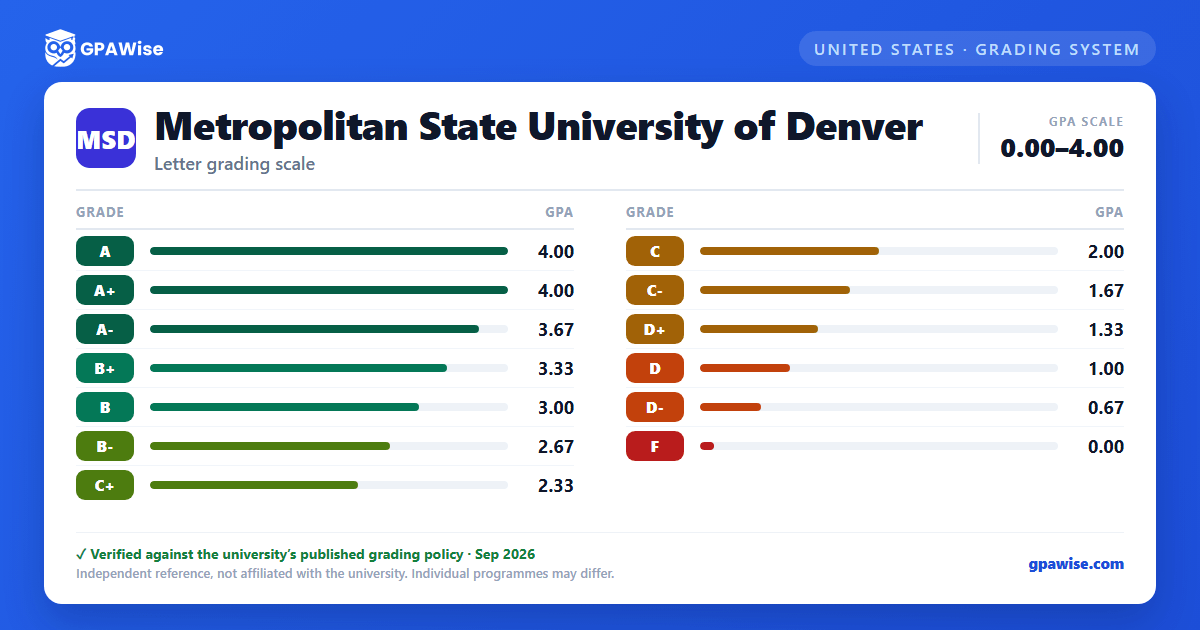

How grades are assigned
Faculty must assign a grade or notation for each student enrolled in a particular course. Faculty may, at their discretion, use the plus/minus grading system but are not required to do so, and are required to notify students of the grading system used for an individual course via the course syllabus.
Source: Grades and Notations, 2026-2027 Undergraduate Catalog — verified Sep 2026
Computing the GPA
The number of quality points awarded for a course is determined by multiplying the number of semester hours for that course by the quality point value of the grade received. The cumulative GPA is calculated by dividing the total number of quality points by the number of semester hours attempted.
Under the Best Grade Stands policy, a repeated course (same title, course number and semester hours as the original) has only its best grade and associated credit counted in the GPA and earned-hours totals; other attempts remain on the record but are annotated as not counting for academic credit or GPA. A grade is not removed from GPA calculations once a degree has been conferred if the course was required for that degree, and a permanent "F" assigned for academic dishonesty is never removed.
Source: Computing Grade Point Average/Quality Points; Best Grade Stands — Undergraduate Catalog Academic Policies — verified Sep 2026
Academic standing
A student is in Good Academic Standing with a cumulative GPA of 2.0 or higher. A student whose cumulative GPA falls below 2.0 is placed on Academic Notice, then Academic Recovery standing, and must achieve a semester GPA of 2.2 or higher each semester while on Academic Recovery to work back toward good standing. A student on Academic Recovery who is not making the required progress is placed on Academic Suspension and is prohibited from registering for three consecutive semesters.
Source: Academic Standing Policy — Undergraduate Catalog Academic Policies — verified Sep 2026
Graduation GPA requirement
To earn a degree, a student must achieve a cumulative GPA of 2.0 or higher in all MSU Denver courses that satisfy the requirements for the major, and in all MSU Denver courses that satisfy requirements for a minor. Some programs apply additional or alternative GPA standards.
Source: Degree and Certificate Requirements — Undergraduate Catalog — verified Sep 2026
Graduation honors and honor lists
Graduation honors (Summa Cum Laude, Magna Cum Laude, and Cum Laude) require a specified cumulative GPA that varies by college or school, generally in the high 3.7-3.9 range; grades from the graduating term count and GPAs are not rounded up. The President's Honor List recognizes students with a cumulative GPA of 3.85 or higher, and the Provost's Honor List recognizes a cumulative GPA between 3.50 and 3.84 inclusive, computed at three checkpoints during a student's academic career.
Source: Honors and Awards — Undergraduate Catalog — verified Sep 2026
Transfer credit policy
Transfer credit is accepted only from institutions holding full regional accreditation (or under a current articulation agreement/MOU with MSU Denver), and only for grades of "C-" or better; courses graded "D," "F," or similar are not transferable. Transfer course grades and previous grade point averages are not indicated on the MSU Denver record and do not affect the MSU Denver cumulative GPA.
Source: Transfer Credit Evaluation — Undergraduate Catalog — verified Sep 2026
Frequently asked questions
What grading scheme does Metropolitan State University of Denver (MSU Denver) use?
Where does this MSU Denver grade scale come from?
What are MSU Denver's GPA rules?
Source: Computing Grade Point Average/Quality Points; Best Grade Stands — Undergraduate Catalog Academic Policies — verified Sep 2026
What are MSU Denver's academic standing rules?
Source: Academic Standing Policy — Undergraduate Catalog Academic Policies — verified Sep 2026
What does MSU Denver require to graduate?
Source: Degree and Certificate Requirements — Undergraduate Catalog — verified Sep 2026
How are honors and awards decided at MSU Denver?
Source: Honors and Awards — Undergraduate Catalog — verified Sep 2026
How does MSU Denver treat transfer credit?
Source: Transfer Credit Evaluation — Undergraduate Catalog — verified Sep 2026