
Grading system
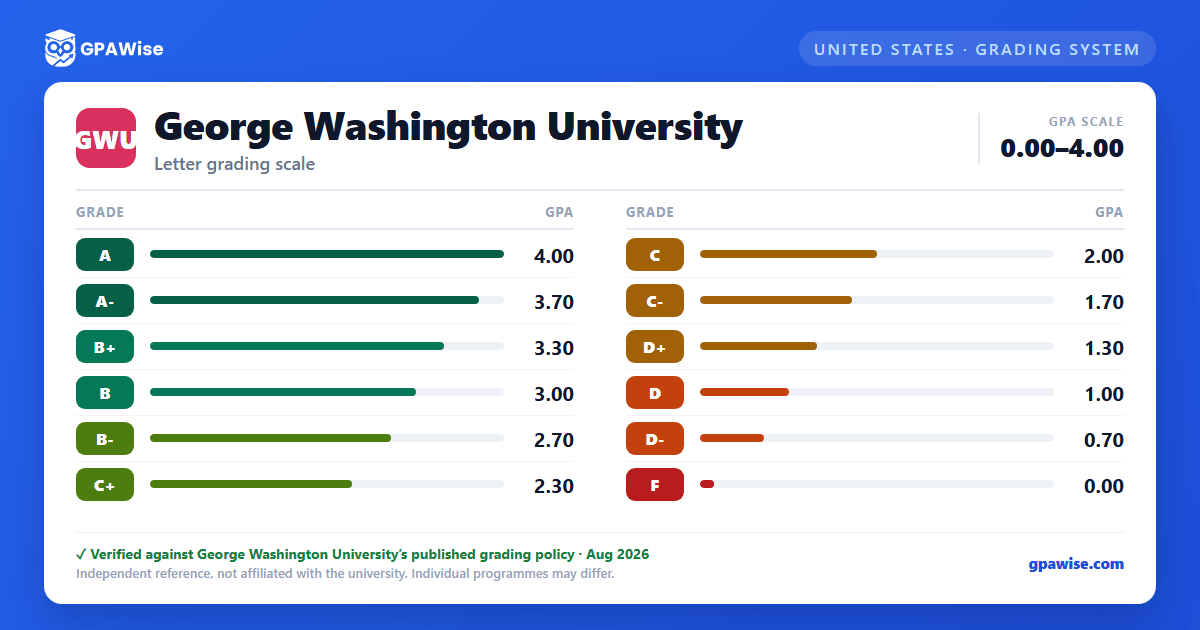
GW's undergraduate letter grades are A, A-, B+, B, B-, C+, C, C-, D+, D, D-, and F, described as Excellent (A), Good (B), Satisfactory (C), Low Pass (D), and Fail (F). No A+ grade exists at GW.
Other transcript notations carry no grade-point value and are not letter grades: P (Pass), NP (No Pass), AU (Audit), I (Incomplete), IPG (In Progress), NE (Never Engaged), R (Need to Repeat Course), RP (Repeated Under Academic Forgiveness), W (Authorized Withdrawal), and Z (Unauthorized Withdrawal).
Source: GW Bulletin 2026-2027, University Regulations — Undergraduate Grading System
How GPA is calculated
GPA is total quality points earned divided by total letter-graded credits undertaken; quality points are each course's grade-point value multiplied by its credits. Courses marked AU, I, IPG, NE, NP, P, R, RP, W, or Z are excluded from the GPA — once an Incomplete (I) receives a final grade, that grade is included. Grades from other institutions (except Consortium courses) are not counted.
With instructor permission, a student may repeat a course graded B- or below; the repeat grade counts in the cumulative GPA, though the credit does not recount toward degree requirements. Under the Undergraduate Academic Forgiveness Policy, eligible students in Columbian College of Arts and Sciences, the GW School of Business, the School of Engineering and Applied Science, the Elliott School of International Affairs, and the Milken Institute School of Public Health may repeat up to three courses graded D+ or below; only the repeat grade counts toward the cumulative GPA.
Source: GW Bulletin 2026-2027, University Regulations — Grade-Point Average / Repeating Courses for Credit
Academic standing
Undergraduates are in good academic standing when both their semester and cumulative GPA are 2.0 or above; a GPA below 2.0 in either measure places a student on academic probation.
Suspension for poor scholarship applies to undergraduates who have attempted at least 24 credits and meet any of: a current semester GPA below 1.0; two successive semesters without both semester and cumulative GPA at 2.0 or above; or a semester or cumulative GPA below 2.0 in any three semesters. Students suspended for poor scholarship may apply for readmission after one semester and must earn at least 12 credits elsewhere; a second suspension for poor scholarship bars readmission.
Source: GW Bulletin 2026-2027, University Regulations — Academic Standing
Graduation requirements
A bachelor's degree requires a minimum of 120 academic credits, the University General Education Requirement, school and major requirements, and a cumulative GPA of at least 2.0.
The residence requirement is at least 60 credits earned at or through GW (including approved study abroad/away), with at least 30 of those credits in upper-level courses (numbered 2000 or above) — including at least 12 upper-level credits in the major and, if a minor is sought, at least 6 upper-level credits in the minor.
Source: GW Bulletin 2026-2027, University Regulations — Undergraduate Degree Requirements / Residence Requirement
Honors and Dean's List
Dean's List: undergraduates who earn 12 or more credits in a semester with a semester GPA of at least 3.75 in letter-graded coursework, pass all non-graded courses, and have no Unauthorized Withdrawal (Z) or Incomplete (I) grades.
Latin honors on the bachelor's degree are based on cumulative GPA: cum laude, 3.40-3.59; magna cum laude, 3.60-3.79; summa cum laude, 3.80-4.00; eligibility requires at least 60 letter-graded credits completed at GW.
Source: GW Bulletin 2026-2027, University Regulations — Dean's List / Latin Honors
Transfer credit
After matriculation, undergraduates may transfer no more than 9 credits (up to 3 courses, 12 credits total) from other accredited institutions toward GW degree requirements, subject to department and advising-office approval — except credits earned through GW study-abroad or GW domestic study-away programs, which are not subject to this cap.
Source: GW Bulletin 2026-2027, University Regulations — Earning Transfer Credit after Matriculation
Frequently asked questions
What grading scheme does George Washington University (GWU) use?
Where does this GWU grade scale come from?
What are GWU's GPA rules?
Source: GW Bulletin 2026-2027, University Regulations — Grade-Point Average / Repeating Courses for Credit
What are GWU's academic standing rules?
Source: GW Bulletin 2026-2027, University Regulations — Academic Standing
What does GWU require to graduate?
Source: GW Bulletin 2026-2027, University Regulations — Undergraduate Degree Requirements / Residence Requirement
How are honors and awards decided at GWU?
Source: GW Bulletin 2026-2027, University Regulations — Dean's List / Latin Honors
How does GWU treat transfer credit?
Source: GW Bulletin 2026-2027, University Regulations — Earning Transfer Credit after Matriculation