
How grading works at MIT
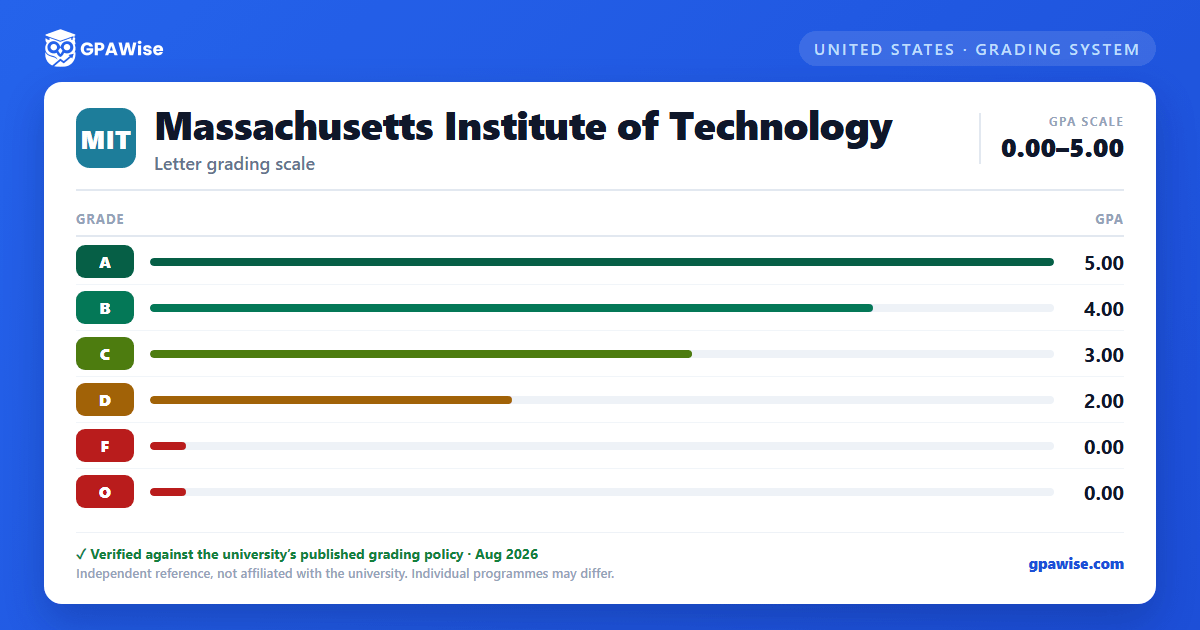
The MIT grade point average is calculated on a 5.0 scale — not the 4.0 scale you may be expecting. An A is worth 5 grade points at MIT, and each step down the scale is worth one point less, until F reaches zero. The O notation also carries zero. See the Grade Scale Reference above for the exact value attached to each grade.
If you need to report your results on the more familiar 4.0 scale, MIT publishes an official conversion — see the question on converting your GPA below.
Your cumulative GPA appears on both your grade report (your internal record) and your transcript (your external record). Your term GPA appears on your grade report only. If you are enrolled in both an undergraduate and a graduate degree at MIT, you will have a separate GPA for each.
Source: Calculating GPA — "What you need to know" and "How to calculate your GPA" sections — verified Aug 2026
How MIT calculates your GPA
MIT weights every grade by the number of units the subject carries:
- Total all the units of A-level work and multiply by 5.
- Total all the units of B-level work and multiply by 4, and so on down the scale.
- Add the results together and divide by the total number of units.
Rounding. Your GPA is rounded to the first place after the decimal point. If the hundredth place is 5 or above, the tenth place rounds up (4.75 becomes 4.8); if it is 4 or below, the tenth place rounds down (4.74 becomes 4.7).
Repeated subjects. A repeated subject counts in your GPA each time you take it — the earlier attempt is not replaced.
Ongoing subjects. When you complete an ongoing subject other than a thesis, take the sum of the units of J grade you received in prior terms and apply the final grade to that total.
Thesis units. For a master's-level thesis, a maximum of 24 units is used in your GPA calculation. Doctoral-level thesis units, which receive the grade of SA, are not included at all.
Source: Calculating GPA — "How to calculate your GPA" section — verified Aug 2026
Frequently asked questions
Can I save my semesters and track my CGPA at MIT?
How do I convert SGPA to CGPA at MIT?
Can I add past semester GPAs without entering every course?
Is my CGPA tracker data sent to your servers?
Is this Massachusetts Institute of Technology (MIT) GPA calculator free?
Does MIT use a 4.0 or a 5.0 GPA scale?
5.0. MIT's Registrar states plainly that "the MIT grade point average (GPA) is calculated on a 5.0 scale." An A is worth 5 grade points at MIT, a B is worth 4, a C is worth 3 and a D is worth 2. MIT does publish a conversion to the 4.0 scale for external use, but 5.0 is the scale your MIT GPA is actually calculated on.
Source: Calculating GPA — "What you need to know" and "GPA conversions" sections — verified Aug 2026
How do you convert an MIT GPA to a 4.0 scale?
Run the same calculation, but substitute these values: A=4, B=3, C=2, D=1, F=0, O=0. In other words, total the units at each grade level, multiply by the 4.0-scale value, add the results and divide by the total number of units.
One limit to be aware of: conversion to a 4.0 scale is not valid for students who attended MIT prior to 1970.
Source: Calculating GPA — "GPA conversions" section — verified Aug 2026
Why don't first-year students at MIT have a GPA?
Because P grades are not used in calculating the GPA, first-year students will not have a GPA until the spring semester concludes. Until then there are no graded units to average, so there is nothing for the calculation to work on.
Source: Calculating GPA — "What you need to know" section — verified Aug 2026
Which grades are left out of your MIT GPA?
The following are not included in the calculation:
- Subjects with a grade of P, S, URN, SA or T
- Subjects that are not completed, with a grade of I, OX, J or U
- Grades earned from Advanced Standing Exams (ASEs)
- ROTC subjects
Everything else is weighted on the 5.0 scale. Note that O is not on this list — it counts in your GPA at 0 grade points.
Source: Calculating GPA — "What you need to know" section, exclusion list — verified Aug 2026
What happens to your GPA if you repeat a subject at MIT?
Both attempts stay in. A repeated subject counts in your GPA each time you take it — passing it the second time does not remove the first grade from the average.
Source: Calculating GPA — "What you need to know" section — verified Aug 2026
How does MIT round your GPA?
To one decimal place, rounding half up. If the hundredth place is 5 or above, the tenth place rounds up — 4.75 becomes 4.8. If the hundredth place is 4 or below, the tenth place rounds down — 4.74 becomes 4.7.
Source: Calculating GPA — "How to calculate your GPA" section — verified Aug 2026
How many MIT units equal one semester hour?
Three MIT credit units are equal to one semester hour. This matters when you are reporting MIT coursework to an institution that counts in semester hours rather than MIT units.
Source: Calculating GPA — "GPA conversions" section — verified Aug 2026