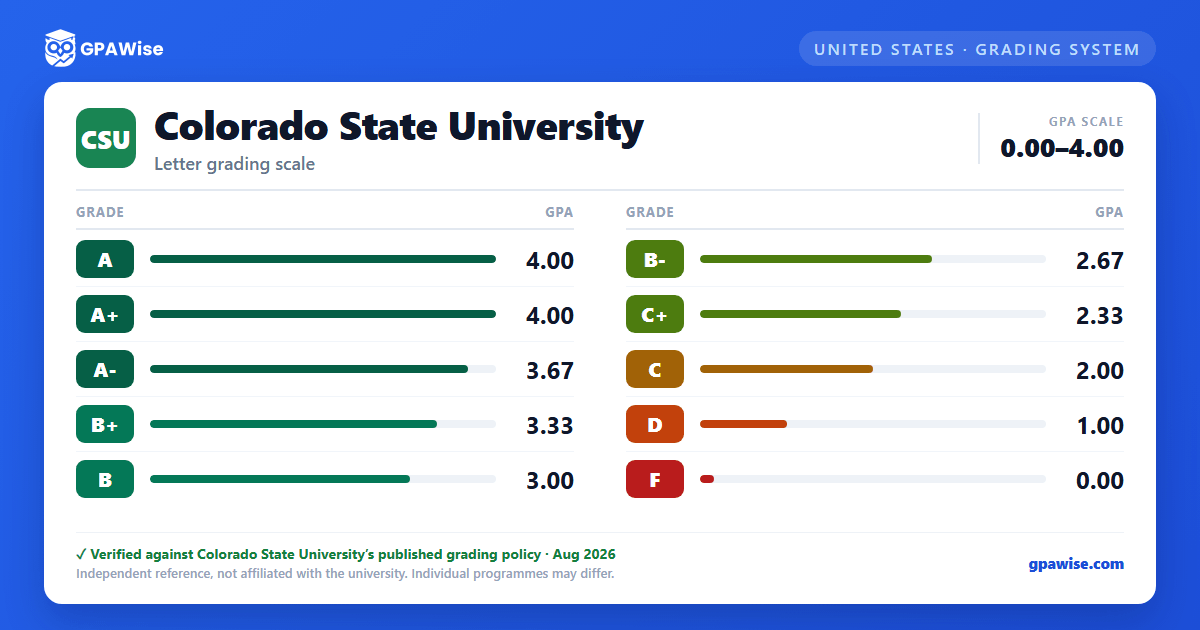

How grading works at Colorado State University
CSU uses letter grades on a 0.000–4.000 grade-point scale. The catalog publishes grade points to three decimal places — A+ and A are both worth 4.000 points per credit, A- is 3.667, B+ is 3.334, B is 3.000, B- is 2.667, C+ is 2.334, C is 2.000, D is 1.000 and F is 0.000. CSU describes A as “Excellent”, B as “Good”, C as “Satisfactory”, D as “Poor, but passing” and F as “Failure”.
CSU does not assign C-, D+ or D- grades. Those grades were discontinued effective Fall 2008 and are not part of the scale.
Not every course uses the full plus/minus range. CSU's policy is that faculty use of +/- grading is optional, and instructors should state the grading system they are using on the course syllabus or policy statement — so check your syllabus before assuming a B+ is available.
Courses are offered under one of five grade modes, and the approved mode for each course is shown with the course listing in the General Catalog: Traditional (the A–F letter grades above), Student Option Satisfactory/Unsatisfactory, Instructor Option, Satisfactory/Unsatisfactory, and Audit.
The same grading scale applies across the university — CSU's Graduate and Professional Bulletin points back to this table rather than publishing one of its own.
Source: Grading — CSU General Catalog 2026-2027, Academic Standards and Policies: "Grading Scale" / "Grade points" table, the notes printed beneath it, and the "Traditional" grade-mode section — verified Aug 2026
Which CSU grades count toward your GPA
Only the lettered grades carry grade points, and those are the grades that build your CSU grade point average: A+, A, A-, B+, B, B-, C+, C, D and F.
An F counts. CSU states plainly that credits for courses graded F are used to compute your GPA — they simply don't count toward graduation. A failed course pulls your GPA down and earns you nothing toward your degree.
These notations appear on your record but are not used in the GPA calculation at all:
- S (Satisfactory) and U (Unsatisfactory)
- I (Incomplete)
- W (Withdrawal)
- H (Honors)
- AU (Audit)
- NG (No Grade Reported) and NGC (Non Graded Component)
Some prefixed grades are excluded too. A grade beginning with X (for example XA or XB) means you were granted an Academic Fresh Start, and those grades are not calculated into your GPA. A grade beginning with R marks a course you repeated under the Repeat/Repair policy, and the original grade is not calculated into your GPA. Grades with a leading zero (0A, 0B) come from an educational partnership where CSU was the School of Record, and are not included in your cumulative GPA.
If you want to take a course Satisfactory/Unsatisfactory to keep it out of your GPA, note the limits: undergraduates may elect Student Option S/U in one course per term, you need a cumulative CSU GPA of 2.000 or better and your advisor's consent, first-term freshmen and transfers are not eligible, and the course must be a free elective — not something required for your major, minor, teacher licensure, or the All-University Core Curriculum. You must register for the course first and then submit the S/U grading form, and changes can only be made during the add/drop period. Graduate students have their own S/U registration rules, set out in CSU's Graduate and Professional Bulletin.
Source: Grading — CSU General Catalog 2026-2027: "Grade points" footnotes 1-2, the F/GPA note, the grade-prefix notes, and the "Student Option Satisfactory/Unsatisfactory" section — verified Aug 2026
Which CSU credits count toward your degree
Passing a course and having it count toward graduation are two different things at CSU.
- F — the credits are used to compute your GPA, but they do not count toward graduation.
- U, I, W, AU and NG — these credits are neither used to compute your GPA nor counted toward graduation.
- S — not used in your GPA, but courses graded S may apply to graduation requirements.
An Incomplete must be resolved before you graduate. CSU requires the temporary grade of “I” to be changed to an actual grade (A, B, C, D, F, S or U) before you can be awarded a diploma.
One practical warning: CSU places a financial hold preventing the release of transcripts and diplomas on the record of any student who owes the university money for unpaid tuition, room and board, or returned financial aid — any amount at all. The hold lifts once that balance reaches zero. Under Colorado House Bill 22-1049, students who owe other kinds of balances may still request official transcripts and diplomas. Setting up a payment plan while you're enrolled exempts you from receiving financial transcript holds.
Source: Grading — CSU General Catalog 2026-2027: "Grade points" footnote 1, the F/graduation note, and the "Satisfactory/Unsatisfactory Grades", "Incomplete Grades" and "Transcripts" sections — verified Aug 2026
Frequently asked questions
What grading scheme does Colorado State University (CSU) use?
Where does this CSU grade scale come from?
Does CSU award an A+, and is it worth more than an A?
CSU does award an A+, but it is worth exactly the same as an A: 4.000 grade points per credit. Unlike some universities, CSU does not run its scale above 4.000, so an A+ cannot lift your GPA past a 4.000 — it is recognition on your transcript rather than extra grade points.
Source: Grading — CSU General Catalog 2026-2027: "Grade points" table, first two rows — verified Aug 2026
Why is there no C-, D+ or D- grade at CSU?
CSU discontinued them. The catalog states that effective Fall 2008, C-, D+ and D- grades are not assigned at CSU. The scale runs A+, A, A-, B+, B, B-, C+, C, then straight to D and F — there is nothing between C (2.000) and D (1.000), and nothing between D and F.
Source: Grading — CSU General Catalog 2026-2027: note printed beneath the "Grade points" table — verified Aug 2026
What is the lowest passing grade at CSU?
D, which CSU describes as “Poor, but passing” and values at 1.000 grade points per credit. Below that is F (“Failure”) at 0.000 points — and while an F earns you no credit toward graduation, its credits are still used to compute your GPA.
If you are taking a course Satisfactory/Unsatisfactory instead, the line falls higher: performance equivalent to a C or better is recorded as S, and performance equivalent to a D or F is recorded as U. So a D that would pass under traditional grading becomes an Unsatisfactory under S/U.
Source: Grading — CSU General Catalog 2026-2027: "Grade points" table, the F/GPA note, and the "Satisfactory/Unsatisfactory Grades" section — verified Aug 2026
How does CSU's Repeat/Repair option affect your GPA?
Repeat/Repair is a one-time-per-course option for undergraduates who repeat a course. When you apply it, the grade from the repeat is the one used in your GPA — even if it is the same as, or lower than, the original. The original grade stays visible on your transcript but drops out of the GPA calculation.
The limits are strict:
- You must request it through RAMweb before the course withdrawal deadline of the semester in which you first repeat the course.
- Maximum twelve (12) credit hours and no more than three courses across your degree.
- It can only be used the first time you repeat a course. Repeat it again after that and every grade except the initial one counts in your GPA.
- It cannot be applied to a course where the final grade was a penalty for academic dishonesty.
- It will not retroactively change academic standing already recorded for a previous term, even though it may change your cumulative GPA.
- Once you have graduated from CSU, you cannot Repeat/Repair any course taken before your graduation date.
CSU adds its own caution: other institutions and employers may not honor the exclusion. Medical schools, many law schools and other graduate programs may recalculate your cumulative GPA using every grade on the transcript — including the one CSU set aside.
Source: Grading — CSU General Catalog 2026-2027: "Repeat/Repair Policy" section, including the closing note — verified Aug 2026
What happens to an Incomplete (I) grade at CSU?
An I is a temporary grade, given at the instructor's discretion when you show that circumstances beyond your control — and not reasonably foreseeable — make it impossible to finish the course. You normally have to be passing the course when you request it, unless the instructor finds extenuating circumstances. The instructor must put in writing what you have to do to complete the course.
You have one year. After that, an Incomplete is automatically changed to an F in a traditionally graded class, or to a U in a Satisfactory/Unsatisfactory-only class, unless the work was completed and a grade change submitted. For instructor-option courses, it rolls to a U if S/U grades exist and to an F if only traditional grades do.
Do not register for the course again to finish the work — the instructor of record, or the department head in their absence, changes the grade once you complete the makeup requirements. You will be prompted to deal with outstanding Incompletes at the start of your anticipated graduation term, and every I must be converted to a real grade before CSU awards your diploma.
Source: Grading — CSU General Catalog 2026-2027: "Incomplete Grades" section (Faculty Council approved minutes March 6, 2018) — verified Aug 2026
Do S and U grades affect your CSU GPA?
No. Neither S nor U is used in calculating your CSU grade point average. Courses graded S may still apply to graduation requirements; a U gives you neither GPA impact nor credit toward graduation.
The trade-off is that it is one-way. A grade taken as Satisfactory/Unsatisfactory cannot later be converted to a traditional grade in order to improve your GPA to meet graduation or scholastic requirements. If you change your major or minor so that an S-graded course becomes required, the major department decides whether it can count.
Source: Grading — CSU General Catalog 2026-2027: "Grade points" table footnotes 1 and 2, and the "Student Option Satisfactory/Unsatisfactory" and "Satisfactory/Unsatisfactory Grades" sections — verified Aug 2026
What do the X, R, AM and GT markings mean on a CSU transcript?
CSU uses letter prefixes and markers alongside the grade itself:
- X before a grade (XA, XB…) — you were granted an Academic Fresh Start. These grades are not calculated into your GPA.
- R before a grade — you elected to repeat the course under the Repeat/Repair policy. The original course grade is not calculated into your GPA.
- AM before a grade — a finding of academic misconduct in that course.
- GT — the course is approved for the statewide general education transfer program used among Colorado public institutions.
- A leading zero (0A, 0B) — the course was completed through an educational partnership in which CSU served as the School of Record. These grades are not included in your cumulative GPA.
Source: Grading — CSU General Catalog 2026-2027: the grade-prefix notes printed beneath the "Grade points" table — verified Aug 2026
What happens if you stop attending a CSU class without dropping it?
You get an F. CSU's rule is direct: if you discontinue attending a class and have not officially dropped or withdrawn through RAMweb or the Office of the Registrar, the grade of F (failure) is recorded. Because F credits are used to compute your GPA, simply walking away from a course is the most damaging way to leave it.
Source: Grading — CSU General Catalog 2026-2027: "Discontinuing a Class (Student Non-Attendance)" section — verified Aug 2026
Can you appeal a grade at CSU?
Yes, but the burden of proof is on you, and only three grounds are accepted. You must show that the grading decision was made on some basis other than performance (and other than as a penalty for academic misconduct); that it applied standards unreasonably different from those applied to other students in the same course and section; or that it was a substantial, unreasonable or unannounced departure from previously articulated standards.
Deadlines are firm. For a fall grade, you must submit the appeal within 30 calendar days after the first day of classes of the following spring semester; for a spring or summer grade, within 30 calendar days after the first day of classes of the following fall. Miss the window and the grade is final.
Talk to the instructor first, then submit a written request to the department head stating which of the three grounds you are relying on. An appeal committee is formed — two faculty members, two students from within the department, and one faculty member from outside the department as chair, all five voting. It either upholds the original grade or has the department chair reevaluate your work and assign a grade. The committee's decision is the final decision of the University.
Source: Grading — CSU General Catalog 2026-2027: "Grade Appeals" section (Faculty Council approved minutes May 4, 2010) — verified Aug 2026