
Using CUA's Grading Scheme

Catholic University of America (CUA) Grading System

Verified against CUA’s official grading policy policies.catholic.edu — the grade table below is the one the institution publishes. Verified Sep 2026.

Grade Scale Reference

See grade values & mark ranges
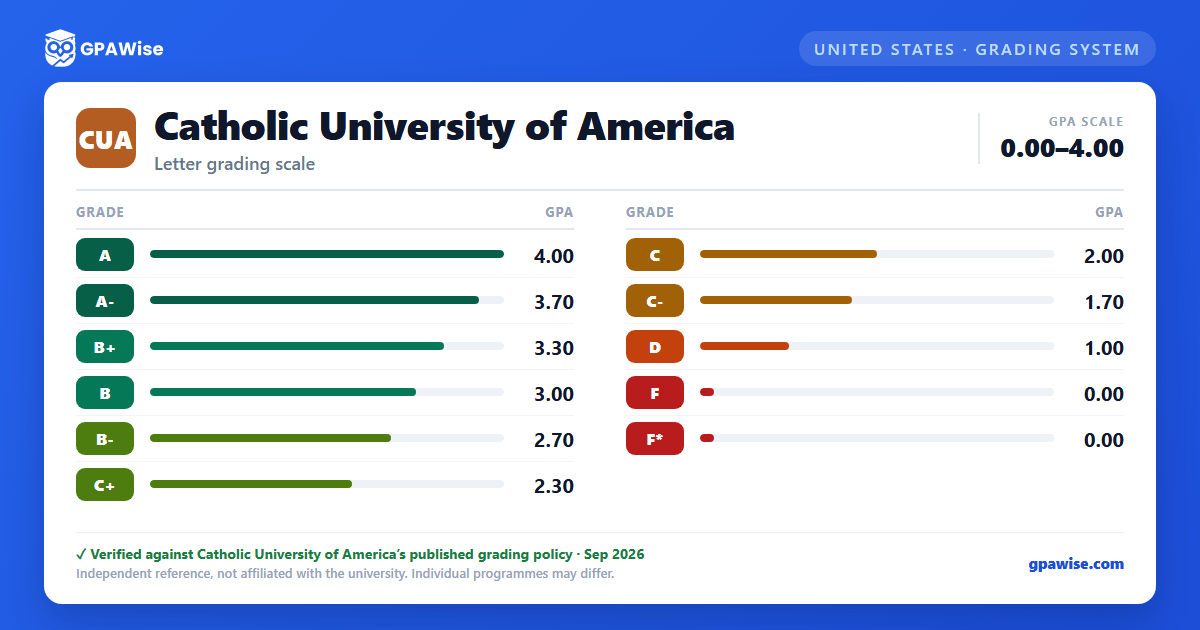
Grade GPA Value
A 4.00
A- 3.70
B+ 3.30
B 3.00
B- 2.70
C+ 2.30
C 2.00
C- 1.70
D 1.00
F 0.00
F* 0.00

Report an error in this scheme

Catholic University of America grading scheme — grade and GPA value
The grade scale as an image — handy for saving or sharing.
Your GPA updates as you type — no submit button needed.

GPA Results

Semester GPA
on a 0.00 - 4.00 scale
0.00 4.00
0 credits

Performance Summary

Course Details

Course Credits Grade Grade Value Points
Total Credits: 0 Total Points: 0.00
Aiming for a specific CGPA? Try the Catholic University of America (CUA) Target GPA Calculator Work out the average GPA you'll need next semester to reach your goal.

How the GPA Is Calculated

Quality points for a course are computed by multiplying the point value of the grade earned by the number of credits for that course. The grade point average (GPA) is calculated by dividing the total quality points earned by the total credits attempted; pass/fail credits are not included. The GPA is computed only for coursework registered through The Catholic University of America.

Grades of P (pass/fail elective) do not affect the cumulative GPA; a failing grade in a pass/fail course earns no degree credit but does not lower the average.

When a course graded D, F, or F* is repeated, both attempts are recorded on the transcript, but only the credit and grade of the repeated attempt count toward the GPA and degree requirements — the original attempt's credit and grade no longer count.

Source: Undergraduate Grades and Academic Standing policy, Sec. III-IV — verified Aug 2026

Academic Probation, Warning, and Dismissal

A student with a cumulative GPA below 2.00 is placed on academic probation until the cumulative average returns to 2.00 or above, and may be required to take a reduced course load; students on probation may not participate in extracurricular or intercollegiate activities.

A freshman whose first full-time semester GPA falls below 2.00 is placed on academic warning for one semester instead of probation. Academic warning may not be extended or repeated in consecutive semesters.

An undergraduate is subject to dismissal by the dean of a school for: receiving a failing grade (F or F*) in three or more credit-bearing courses in a semester; ending an academic year with a cumulative GPA below 1.50; failing to satisfy additional school-specific requirements; or failing to gain acceptance into a program of concentration after a fourth semester of full-time study.

Source: Undergraduate Grades and Academic Standing policy, Sec. VI-VIII — verified Aug 2026

Dean's List

The Dean's List is published each semester for degree students who achieve at least a 3.50 grade point average in a full-time course load for that semester. Individual schools may set additional criteria for their own Dean's List.

Source: Undergraduate Grades and Academic Standing policy, Sec. V — verified Aug 2026

Frequently asked questions

Can I save my semesters and track my CGPA at CUA?
Yes. After you calculate a semester's GPA, click "Save as semester" to add it to the built-in CGPA tracker, which then computes your cumulative GPA across every saved semester using the standard weighted formula (Σ SGPA × credits ÷ Σ credits). You can save semesters by course (full breakdown) or quick-add a past semester with just the SGPA and credit hours. Locking, renaming, and deleting saved semesters are all supported, and the tracker shows a running CGPA plus a trend arrow versus your previous semester.
How do I convert SGPA to CGPA at CUA?
Your CGPA is the credit-weighted average of every semester's SGPA. The formula is: CGPA = (SGPA₁ × credits₁ + SGPA₂ × credits₂ + … + SGPAₙ × creditsₙ) ÷ (credits₁ + credits₂ + … + creditsₙ). On this page, add each semester to the CGPA tracker (either by course or as a quick SGPA + credit-hours entry) and the calculator runs the conversion for you on every save, edit, and delete — no manual arithmetic required.
Can I add past semester GPAs without entering every course?
Yes. On the My CGPA Tracker tab, click "Add semester" and choose the quick-add option. You enter just the SGPA and the credit hours for that semester — no course-by-course breakdown required. It works as a GPA calculator with previous semesters support, or as a GPA calculator without course details when you only remember the SGPA from your transcript. Quick-added and course-by-course semesters can be mixed freely; both contribute to your CGPA using the same credit-weighted formula.
Is my CGPA tracker data sent to your servers?
No. Your saved semesters are stored locally in your browser only — nothing is transmitted to GPAWise. A "Clear all tracker data" button is always available on the tracker tab to wipe the data on demand.
Is this Catholic University of America (CUA) GPA calculator free?
Yes — GPAWise is completely free to use. There's no signup, no paywall, and your inputs stay in your browser.

GPAWise is an independent tool and is not affiliated with, endorsed by, or sponsored by Catholic University of America. University names and trademarks are the property of their respective owners. Grading data is reproduced for reference — always verify with your institution.

Other feedback or bug reports

Calculator not working right? UI confusing? Missing a feature? Tell us here.

Found an error in CUA's grading scheme (wrong GPA value, mark range, missing grade)? Use Suggest a correction instead — admins can review and apply those directly.