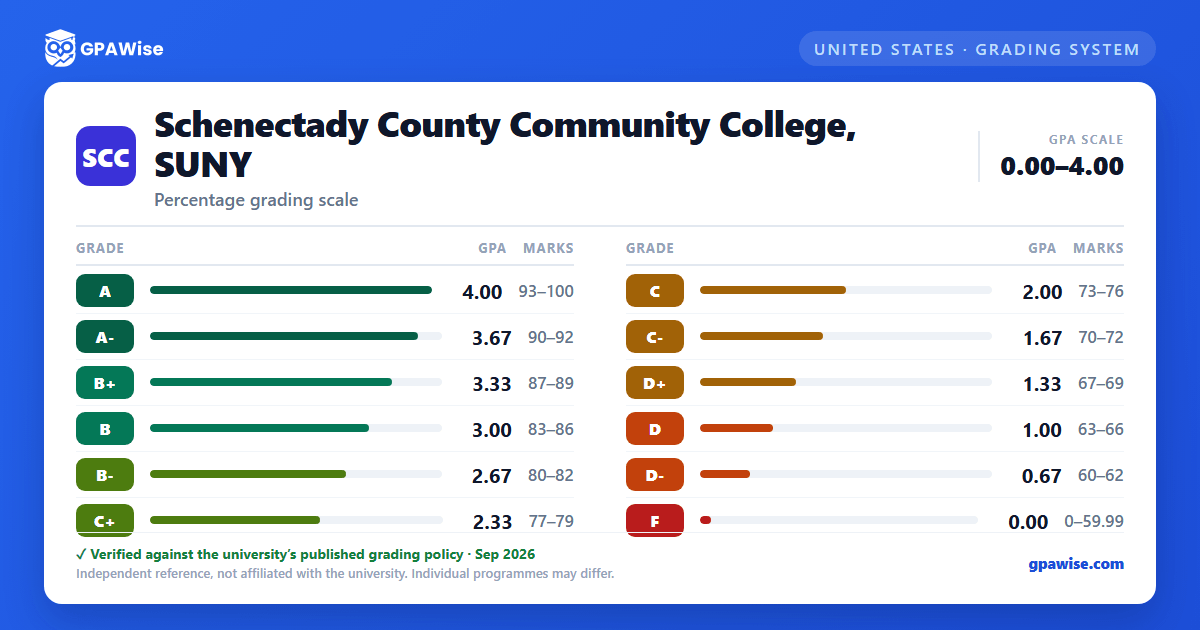

How the GPA is Calculated
A student's grade-point average is determined by dividing the total grade-points earned in residence credit-bearing courses by the corresponding total credit hours attempted. Pass/fail grades are not calculated in the G.P.A.
Repeating a course: with the exception of special-topics courses whose focus changes each term, a student may repeat a course twice with no additional credit earned. Only the highest grade is used in all future cumulative GPA computations, though every grade attempt remains on the transcript. Withdrawn courses (grade "W") count as attempted credits but are not included in the GPA calculation.
Fresh Start: a student who returns to the College after an absence of two or more years and completes 12 credits with a GPA of at least 2.00 may petition to have up to 30 hours of prior credit (grade "C" or higher) carried forward as if transfer credit; the cumulative GPA is then based only on credits earned after re-entry. Fresh Start can be applied only once in a student's career.
Source: 26-27 Catalog, Academic Code SS7.2 / SS3.9 / SS7.5.1, Fresh Start Policy — verified Sep 2026
Satisfactory Academic Progress and Dismissal
Academic standing is reviewed at the end of each semester against a cumulative-GPA floor that rises with total credit hours attempted:
| Total Credit Hours Attempted | Dismissal if Cumulative GPA Below |
|---|---|
| 0-11 | N/A |
| 12-23 | 1.00 |
| 24-35 | 1.50 |
| 36-47 | 1.80 |
| 48 and above | 2.00 |
A student who falls below Satisfactory Academic Progress is placed on Academic Warning for one term (limited to 13 credits); failing to meet the standard by the end of that term results in dismissal from the program. A dismissed student may apply for readmission and, if approved, is placed on Academic Probation for one semester.
Source: 26-27 Catalog, Academic Code SS7.6, Satisfactory Academic Progress table — verified Sep 2026
Qualifying for a Degree or Certificate
To be eligible for an Associate degree or certificate, a candidate must meet the program requirements in effect at matriculation and earn a cumulative GPA of at least 2.00, be matriculated in the program at least one semester prior to graduation, and be recommended for graduation by the Academic Senate (or approved by the Board of Trustees/Vice President of Academic Affairs).
Residency requirement: at least 30 semester credit hours in residence for an Associate degree, or at least 15 semester credit hours in residence for a certificate.
Source: 26-27 Catalog, Academic Code SS8.2 / SS4.1 — verified Sep 2026
Semester and Graduation Honors
President's List: awarded each semester a matriculated student earns a GPA of 3.70 or higher while completing at least 12 credit hours (6-11 credit hours for part-time students meeting the same GPA, with a cumulative earned total of at least 12 credit hours).
Dean's List: awarded each semester a matriculated student earns a GPA from 3.20 up to less than 3.70, under the same credit-hour terms as the President's List.
Students who receive a grade of F or AW in the semester are not eligible for semester honors.
Graduation Honors: degree recipients with a cumulative GPA of 3.70 or higher graduate with High Honors; those from 3.20 up to 3.69 graduate with Honors.
Source: 26-27 Catalog, Academic Code SS7.3-7.4 — verified Sep 2026
Transfer Credit Policy
Coursework taken at other regionally-accredited institutions (or approved non-accredited/non-collegiate sources) is accepted for transfer if passed with a grade of C (2.00) or better and applicable to the student's degree program, subject to Division Dean approval; a C-, D+, D, or D- from a regionally-accredited institution may be approved at the Division Dean's discretion. Coursework older than 10 years transfers only at the Division Dean's discretion.
Transfer credits count as credits attempted (for program-pursuit and maximum-timeframe purposes) but are not included in the cumulative GPA calculation.
Source: 26-27 Catalog, Academic Code SS5.1, External Transfer — verified Sep 2026
Frequently asked questions
What grading scheme does Schenectady County Community College, SUNY use?
Where does this Schenectady County Community College, SUNY grade scale come from?
What are Schenectady County Community College, SUNY's GPA rules?
Source: 26-27 Catalog, Academic Code SS7.2 / SS3.9 / SS7.5.1, Fresh Start Policy — verified Sep 2026
What are Schenectady County Community College, SUNY's academic standing rules?
Source: 26-27 Catalog, Academic Code SS7.6, Satisfactory Academic Progress table — verified Sep 2026
What does Schenectady County Community College, SUNY require to graduate?
Source: 26-27 Catalog, Academic Code SS8.2 / SS4.1 — verified Sep 2026
How are honors and awards decided at Schenectady County Community College, SUNY?
Source: 26-27 Catalog, Academic Code SS7.3-7.4 — verified Sep 2026
How does Schenectady County Community College, SUNY treat transfer credit?
Source: 26-27 Catalog, Academic Code SS5.1, External Transfer — verified Sep 2026