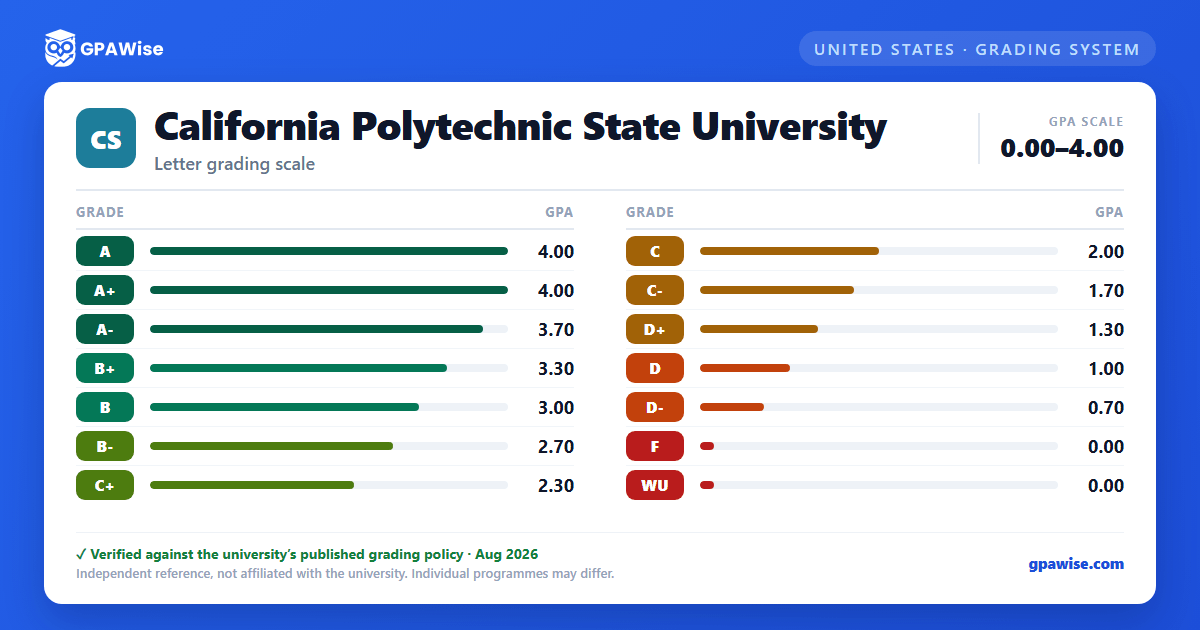
Cal Poly computes grade point average (GPA) by dividing total grade points earned by units graded. Higher Education GPA includes all college-level work, both Cal Poly coursework and any transfer work.
Students may elect Credit/No Credit (CR/NC) grading for eligible courses in place of a letter grade; CR/NC has no effect on GPA. Undergraduates need at least a 2.0 cumulative Cal Poly GPA to elect CR/NC (waived for first-term students). Undergraduate CR requires C- or better, with NC given for D+ or lower; graduate students need B- or higher for CR, with NC for C+ or lower. Undergraduates may take a maximum of 12 units CR/NC toward degree requirements, limited to one CR/NC course in the major and one in General Education.
The symbols AU (Audit), I (Incomplete), RD (Report Delayed), RP (Report in Progress), and W (Withdrawn) carry no grade-point value and do not affect GPA. WU (Withdrawal Unauthorized) is the exception: it is scored equivalent to an F and does count toward GPA. An Incomplete not resolved within the instructor's deadline (maximum one year) converts to an F-equivalent for GPA purposes.
Undergraduates may repeat a course for grade forgiveness on up to 16 units: if the second Cal Poly grade is equal to or higher, it replaces the first grade in the GPA (both remain on the transcript). A further 12 units of repeats (28 total) are averaged into the GPA rather than replacing the original grade; after 28 repeated units, no further repeats are permitted. Grade forgiveness does not apply where the original grade followed a finding of academic dishonesty.
Can I save my semesters and track my CGPA at Cal Poly?
Yes. After you calculate a semester's GPA, click "Save as semester" to add it to the built-in CGPA tracker, which then computes your cumulative GPA across every saved semester using the standard weighted formula (Σ SGPA × credits ÷ Σ credits). You can save semesters by course (full breakdown) or quick-add a past semester with just the SGPA and credit hours. Locking, renaming, and deleting saved semesters are all supported, and the tracker shows a running CGPA plus a trend arrow versus your previous semester.
How do I convert SGPA to CGPA at Cal Poly?
Your CGPA is the credit-weighted average of every semester's SGPA. The formula is: CGPA = (SGPA₁ × credits₁ + SGPA₂ × credits₂ + … + SGPAₙ × creditsₙ) ÷ (credits₁ + credits₂ + … + creditsₙ). On this page, add each semester to the CGPA tracker (either by course or as a quick SGPA + credit-hours entry) and the calculator runs the conversion for you on every save, edit, and delete — no manual arithmetic required.
Can I add past semester GPAs without entering every course?
Yes. On the My CGPA Tracker tab, click "Add semester" and choose the quick-add option. You enter just the SGPA and the credit hours for that semester — no course-by-course breakdown required. It works as a GPA calculator with previous semesters support, or as a GPA calculator without course details when you only remember the SGPA from your transcript. Quick-added and course-by-course semesters can be mixed freely; both contribute to your CGPA using the same credit-weighted formula.
Is my CGPA tracker data sent to your servers?
No. Your saved semesters are stored locally in your browser only — nothing is transmitted to GPAWise. A "Clear all tracker data" button is always available on the tracker tab to wipe the data on demand.
Is this California Polytechnic State University (Cal Poly) GPA calculator free?
Yes — GPAWise is completely free to use. There's no signup, no paywall, and your inputs stay in your browser.