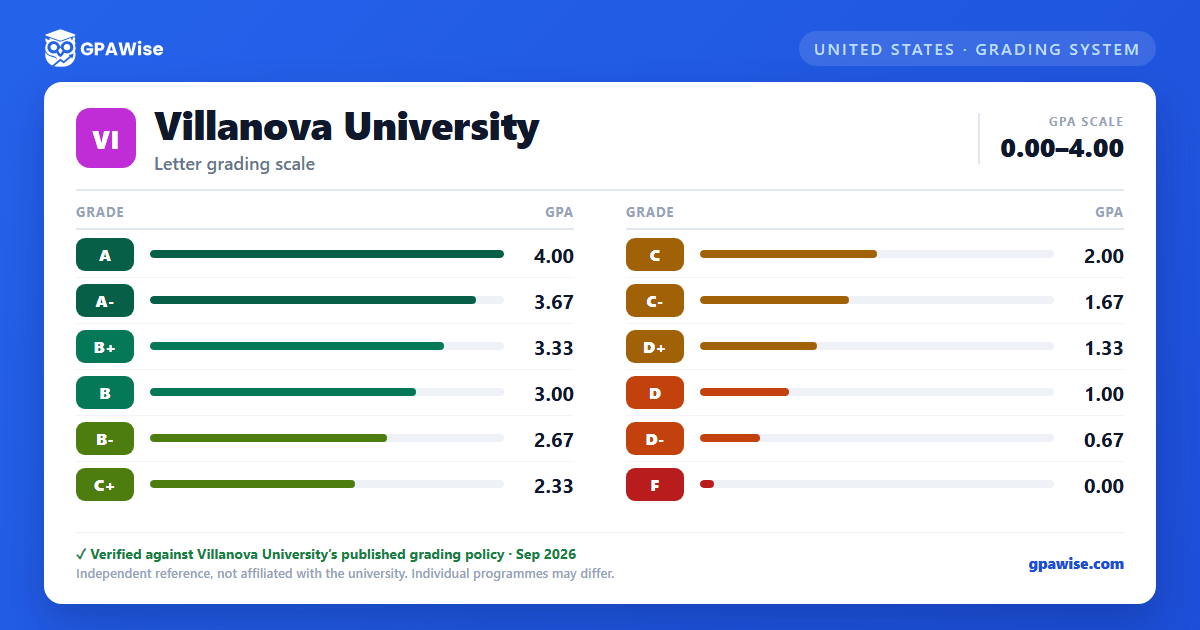

How the GPA is calculated
Grades for all courses taken at Villanova University are calculated in the GPA, with the exception of Satisfactory/Unsatisfactory grades and approved withdrawals without penalty ("WX"). If a course is repeated, both the original and the repeat grade are included in the GPA computation.
GPA is calculated as total quality points divided by total attempted credits, where a course's quality points equal its grade points multiplied by its credit hours.
Source: Grade Point Average (GPA) page, Undergraduate Catalog 2026-2027 — verified Sep 2026
Academic standing and probation
Villanova defines academic standing through three related policies: Grade Point Average, Academic Progress and Academic Probation. A student whose cumulative or semester quality-point average falls below 2.00 has their record reviewed by their college's Academic Standing Committee; students in business, science or engineering whose technical course quality-point average falls below 2.00 are also reviewed. The outcome is typically academic probation or dismissal, and a student on probation is normally allowed one semester to restore the required average.
The Academic Standing Committee may allow a freshman to declare academic bankruptcy and repeat a semester or year with a new start on the cumulative average, though the original year's work remains on the transcript; once bankrupted, the action cannot be reversed.
Source: Academic Standing policy, Office of the Provost (approved Nov. 8, 2016; rev. 2019) — verified Sep 2026
Graduation GPA requirement
To qualify for a Bachelor's degree, a student must earn a cumulative quality-point average of at least 2.00 in addition to completing all required coursework. Science students must also maintain a Technical GPA of at least 2.00, and some Arts majors require a minimum GPA within major-requirement coursework.
Most full-time students complete the degree in four years; full-time students who have not finished within six years, and part-time students who have not finished within twelve years, may need additional coursework, and after twelve years must complete the degree through the College of Professional Studies.
Source: Academic Standing (Provost) and Grade Point Average (GPA) pages, Undergraduate Catalog — verified Sep 2026
Latin honors
Graduating students may receive summa cum laude, magna cum laude or cum laude honors, requiring a minimum cumulative quality-point average of 3.90, 3.75 and 3.50 respectively. At least sixty credits counted toward these averages (not including Satisfactory/Unsatisfactory courses) must have been taken at Villanova University.
Source: Academic Standing policy, Office of the Provost — verified Sep 2026
Transfer credit and failed courses
If a transfer course is accepted to fulfill a requirement in place of a failed Villanova University course, the failed Villanova grade remains in the GPA computation — it is not removed or replaced by the transfer credit.
Source: Grade Point Average (GPA) page, Undergraduate Catalog 2026-2027 — verified Sep 2026
Frequently asked questions
What grading scheme does Villanova University use?
Where does this Villanova University grade scale come from?
What are Villanova University's GPA rules?
Source: Grade Point Average (GPA) page, Undergraduate Catalog 2026-2027 — verified Sep 2026
What are Villanova University's academic standing rules?
Source: Academic Standing policy, Office of the Provost (approved Nov. 8, 2016; rev. 2019) — verified Sep 2026
What does Villanova University require to graduate?
Source: Academic Standing (Provost) and Grade Point Average (GPA) pages, Undergraduate Catalog — verified Sep 2026
How are honors and awards decided at Villanova University?
Source: Academic Standing policy, Office of the Provost — verified Sep 2026
How does Villanova University treat transfer credit?
Source: Grade Point Average (GPA) page, Undergraduate Catalog 2026-2027 — verified Sep 2026