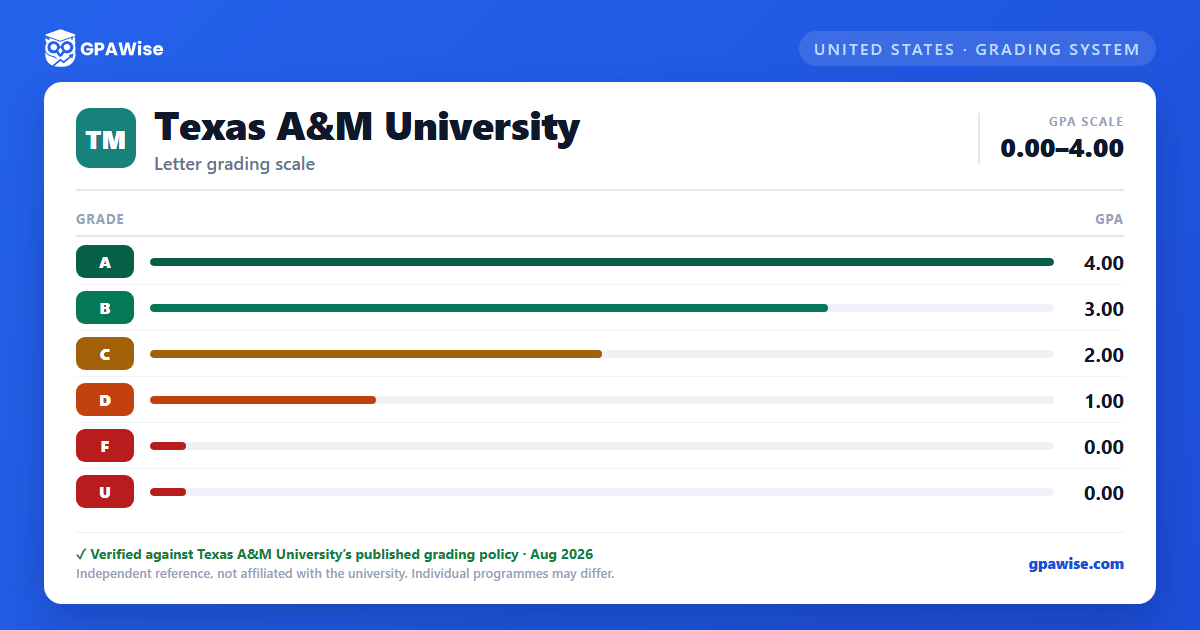

Grade notations beyond the point scale
Texas A&M's Student Rules define twelve total grade notations, not just the five point-bearing passing grades (A, B, C, D, S). Alongside the standard letter grades, students may see:
- I (Incomplete) — no grade points, hours not included in GPA.
- S / U (Satisfactory / Unsatisfactory) — an alternate grading option for eligible undergraduate courses; S is C-or-above and excluded from the GPA, U is D-or-F range and computed the same as an F.
- W (Withdrawal) — dropped with no penalty, hours not included in GPA, requires Dean or designee approval.
- Q (Q-drop) — dropped with no penalty, requires Dean or designee approval.
- X — no grade submitted by the instructor.
- NG (No Grade) — administrative removal of a posted grade.
Graduate students' passing grades are limited to A, B, C, and S; only these are acceptable for graduate credit.
Source: Texas A&M University Student Rules, Rule 10 – Grading, §10.3–10.4 — verified Aug 2026
How Texas A&M calculates your GPA
Texas A&M computes cumulative GPA by dividing the total grade points earned by the total semester hours for which a grade was received. Hours graded F or U count toward the denominator; hours graded W, Q, S, X, I, or NG are excluded entirely.
Repeating a course: when an undergraduate repeats a course to earn a grade higher than C, D, F, or U, only the highest grade is used for the degree audit — though every attempt stays on the transcript. A course may be attempted no more than three times without Dean approval. If a grade of B or better has already been earned, repeating the course earns no additional grade points unless the catalog specifically allows it to be repeated for credit.
Students may take eligible undergraduate courses on a Satisfactory/Unsatisfactory (S/U) basis: a Satisfactory grade (C or above) does not affect the GPA at all, while an Unsatisfactory grade (D or F range) is computed into the GPA exactly as an F would be.
Source: Rule 10 – Grading, §10.11 (GPA formula), §10.21–10.22 (repeat rule), §10.13.2 (S/U mechanics) — verified Aug 2026
GPA floors: graduate students and professional programs
Graduate students and post-baccalaureate non-degree students must maintain a cumulative GPA of at least 3.00 (on the 4.00 scale), both overall and on all coursework listed on their degree plan; departments and colleges may set higher requirements.
Several professional-practice degree programs publish their own scholastic-deficiency GPA floors, distinct from the general undergraduate/graduate scale: Doctor of Dental Surgery students fall below satisfactory standing under a 2.00 GPA, Doctor of Pharmacy students under 2.30, and Juris Doctor students under 2.33 (a 2.33 cumulative GPA is also required to be granted the J.D. degree).
Source: Rule 10 – Grading, §10.4.3 & §10.19 (graduate floor), §10.5.1.7 / §10.5.3.4 / §10.5.5.5–10.5.5.6 (professional-program floors) — verified Aug 2026
Only Texas A&M coursework counts toward your GPA
Only coursework for which a student was registered at Texas A&M University itself is used in determining that student's grade point average — credit accepted from another institution is not factored into the Texas A&M GPA.
Source: Rule 10 – Grading, §10.10 — verified Aug 2026
Frequently asked questions
What grading scheme does Texas A&M University use?
Where does this Texas A&M University grade scale come from?
Does Texas A&M use plus/minus grading (A-, B+) for undergraduates?
No. Undergraduate and graduate courses are graded on a straight A, B, C, D, F scale worth 4, 3, 2, 1, and 0 grade points. Plus/minus grades are not used for the general student population — they appear only in the separately governed Doctor of Jurisprudence (J.D.) program in the School of Law.
Source: Rule 10 – Grading, §10.3 (twelve-grade list), §10.5.5.1 (Law-only plus/minus scale) — verified Aug 2026
Does an Unsatisfactory (U) grade affect my GPA at Texas A&M?
Yes. A grade of Satisfactory (S) does not affect the GPA, but a grade of Unsatisfactory (U) is included in the computation of grade points per credit hour exactly as an F would be — it is not a neutral or excluded outcome.
Source: Rule 10 – Grading, §10.3, §10.13.2 — verified Aug 2026
What GPA do graduate students need to maintain at Texas A&M?
Graduate students and post-baccalaureate non-degree students must maintain a cumulative GPA of at least 3.00 on the 4.00 scale — both overall and on the courses listed on their official degree plan.
Source: Rule 10 – Grading, §10.4.3, §10.19 — verified Aug 2026