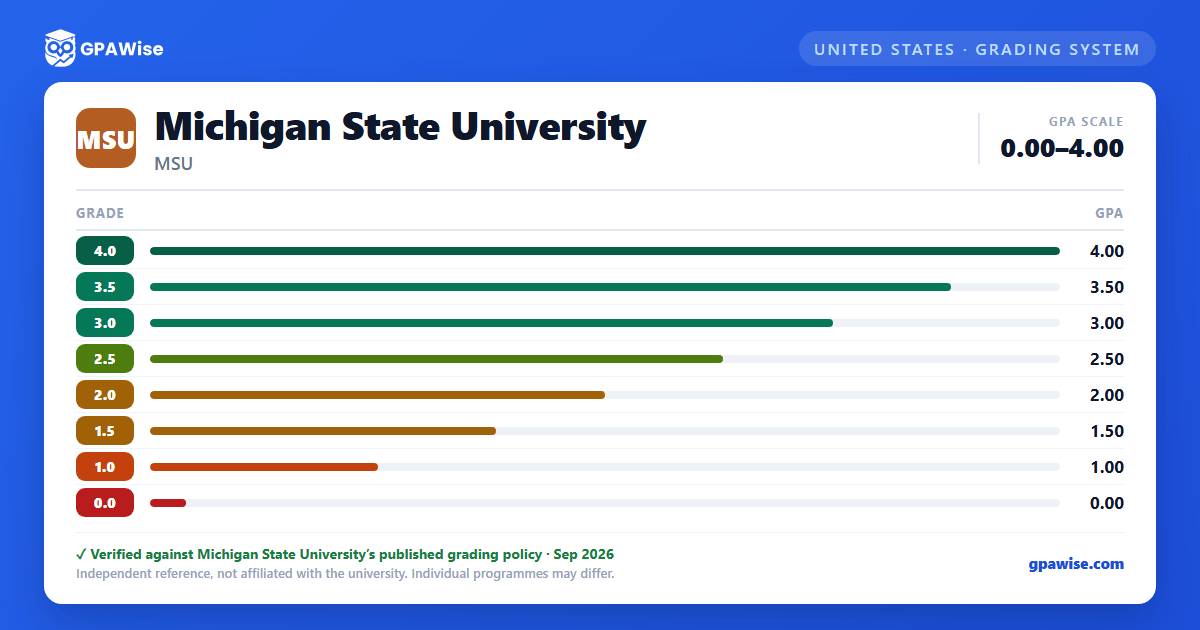

How MSU Grades Are Recorded
Michigan State University uses three systems of grading: a numerical system, a supplemental Credit-No Credit system, and a limited Pass-No Grade system.
The numerical system is the primary, GPA-bearing system: grades are recorded and averaged as the point values themselves, university-wide -- there are no letter grades in this system.
Source: MSU Registrar, Grading Systems (Academic Programs Catalog) — verified Sep 2026
GPA Computation Rules
All grades earned on the numerical system are counted in the calculation of the grade-point average (GPA).
- Minimum credit level: 1.0 for undergraduate students, 2.0 for graduate students.
- Credit-No Credit (CR/NC) grades are not included in computing the semester or cumulative GPA.
- A grade earned on the numerical system cannot later be converted to Credit/No Credit.
- A repeated course must be graded under the same system it was originally completed under, except where standard degree requirements require otherwise.
- All grades are final and may not be changed by re-examination or the submission of additional work.
Source: MSU Registrar, Grading Systems (Academic Programs Catalog) — verified Sep 2026
Minimum GPA for Graduation
The minimum cumulative grade-point average required for graduation is 2.0 for undergraduate students and 3.0 for graduate students.
Individual graduate programs may restrict the number of 2.0-level grades accepted for credit and/or set a higher minimum than 2.0 for degree requirements.
Source: MSU Registrar, Grading Systems (Academic Programs Catalog) — verified Sep 2026
Frequently asked questions
What grading scheme does Michigan State University (MSU) use?
Where does this MSU grade scale come from?
What are MSU's GPA rules?
Source: MSU Registrar, Grading Systems (Academic Programs Catalog) — verified Sep 2026
What does MSU require to graduate?
Source: MSU Registrar, Grading Systems (Academic Programs Catalog) — verified Sep 2026