
How grading works at Douglas College
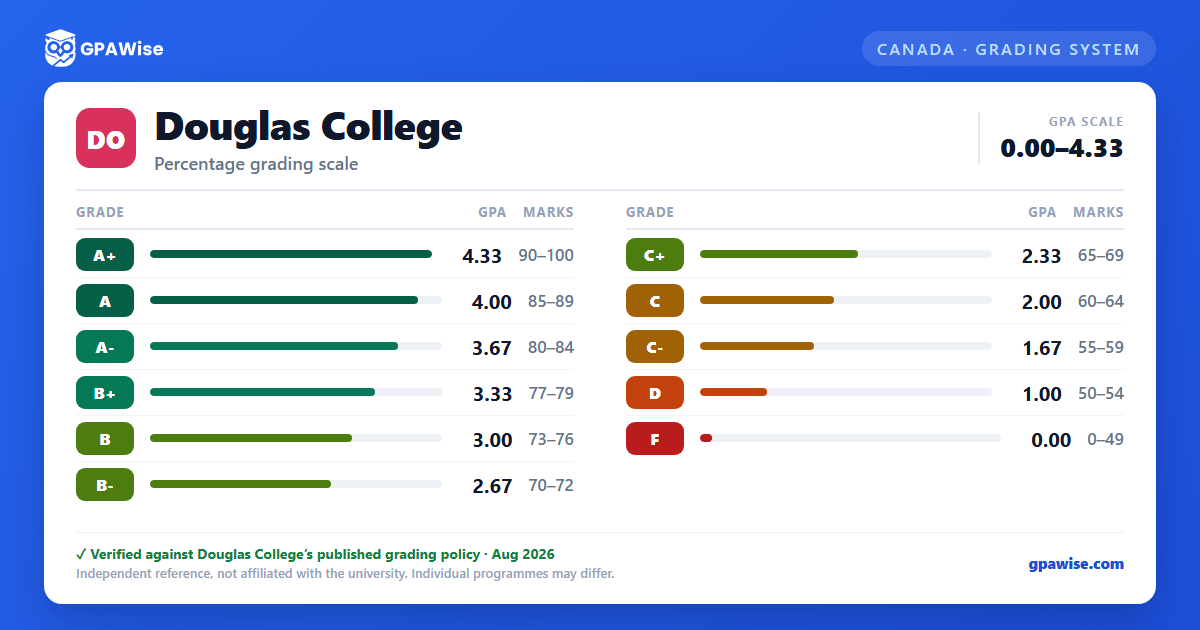
For credit courses, Douglas College uses a standard letter grade and percentage-value equivalent system: a percentage mark maps to a letter grade and a grade point on a 0–4.33 scale (not the more common 4.0 scale). The scale runs from A+ (90–100%, 4.33 points, Outstanding Achievement) down to F (49% and below, 0.00 points, Unsatisfactory Achievement). A grade of D (50–54%, 1.00 points, Minimal Achievement) is a passing, credit-bearing grade, but a course graded D cannot be used to satisfy a prerequisite requirement for another course.
An asterisk before a grade (e.g. *B) indicates the grade was achieved by Challenge Credit — a challenge examination — and such grades are not calculated in GPA.
Douglas College's Mastery-based grading system
Alongside the standard percentage/grade-point scale, Douglas College offers an alternative Mastery-based Assessment system for areas of study where it is desirable to evaluate students on the basis of successfully or unsuccessfully meeting a defined standard, rather than on a scale of performance or values. A department must obtain Education Council approval, stipulated in the course's official curriculum guideline, before using Mastery-based assessment; once approved, it applies to all sections of that course (used, for example, in ELLA and Upgrading courses).
Mastery-based results are not included in GPA calculations and use four outcomes instead of a percentage or grade point:
- MAS (Mastery) — met and mastered the goals, criteria, or competencies established for the course, practicum, or field placement.
- EXP (Experience) — participated in course activities and is progressing, but has not yet mastered those goals, criteria, or competencies.
- NM (Non-mastery) — participated in course activities but did not meet those goals, criteria, or competencies.
- UNW (Unofficial Withdrawal) — completed less than 70% of the total evaluation of the course, or missed more than 30% of the classes where attendance is a stated course requirement.
Non-credit grading at Douglas College
Courses taken through Continuing Education and/or The Training Group use a separate, simpler grading system (used since January 2002) that is not counted toward the credit-program GPA at all: letter grades A+ through F, plus P (Pass), each carrying only a descriptive achievement level (e.g., Outstanding, Good, Satisfactory, Marginal, or Minimal Achievement) with no published percentage ranges.
Source: Grading Policy, Section D "Policy Statements" — "GRADING SYSTEM: CREDIT COURSES", Letter Grades table — verified Jul 2026
How Douglas College calculates GPA
Douglas College's Grade Point Average (GPA) is calculated from the total grade points and credits for all courses represented, on a term or cumulative basis. For repeated courses, the highest grade achieved is used in the cumulative GPA calculation. A student's transcript displays both the term and cumulative GPA alongside academic performance for each semester.
Grades and notations that don't affect GPA
Beyond the standard scale, Douglas College's transcript carries a number of notations that are not calculated in GPA:
- UN (Unofficial Withdrawal, standard scale) — assigned when a student completed less than 70% of the total course evaluation, or missed more than 30% of classes where attendance is a stated course requirement. Carries a numerical value of 0.00 but no percentage band of its own.
- I (Incomplete) — a temporary grade for coursework unresolved by the grade-submission deadline; governed by an Incomplete Grade Contract with a maximum four-month extension. There is no limit to the number of I grades a student may carry, but an I grade does not satisfy prerequisite requirements.
- IP (In Progress) — a temporary grade for courses requiring further enrollment (e.g., an extended practicum or internship); converts to a final grade once submitted.
- AUD (Audit), DEF (Deferred), GNR (Grade Not Reported), and W (Withdrawal before the official deadline) — none carry a numerical equivalent or affect GPA.
How academic dishonesty affects a grade at Douglas College
Two grade notations apply specifically when a student has breached the Academic Integrity Policy:
- FD (Failure due to academic dishonesty) — counts as 0.00 in GPA, unlike other non-numeric dishonesty notations.
- NMD (Non-mastery due to academic dishonesty) — sits outside GPA, like an ordinary Non-mastery (NM) grade.
Both notations remain on a student's transcript for two years following the student's graduation or last semester attended, after which the student becomes eligible to apply to have the grade converted to an ordinary "F" (for FD) or "NM" (for NMD).
Source: Grading Policy, Section C "Definitions" — "Grade Point Average (GPA)" — verified Jul 2026
Transfer credit and challenge credit are excluded from GPA
Douglas College distinguishes two ways credit can be earned without a standard letter grade, and excludes both from GPA:
- Challenge Credit — a grade achieved by means of a challenge examination; not calculated in term or cumulative GPA (marked with an asterisk on the transcript, e.g. *B).
- Transfer Credit (TRF) — credit granted for a post-secondary course taken elsewhere whose content is substantially similar to a Douglas College course; criteria for granting it rest with the instructional department offering the equivalent course. Transfer credit grades are not included in Douglas College's term or cumulative GPA.
Advanced Credit (ADV) — granted for an equivalent course completed at another recognized educational institution — is likewise not calculated in GPA.
Source: Grading Policy, Section C "Definitions" (Challenge Credit, GPA); "GRADING SYSTEM: OTHER GRADES" table (TRF, ADV) — verified Jul 2026
Frequently asked questions
What grading scheme does Douglas College use?
Where does this Douglas College grade scale come from?
What GPA scale does Douglas College use?
Douglas College's standard grading system for credit courses runs on a 0–4.33 grade-point scale, derived from percentage marks: A+ (90–100%) equals 4.33 points, down to F (49% and below) at 0.00 points.
Source: Grading Policy, Letter Grades table — verified Jul 2026
What is the minimum passing grade at Douglas College?
A grade of D (50–54%, 1.00 grade points) is a passing, credit-bearing grade at Douglas College. However, a course graded D cannot be used as a prerequisite for another course. Below 50% (F, 0.00 points), the achievement level is unsatisfactory.
Source: Grading Policy, Letter Grades table — verified Jul 2026
If I repeat a course at Douglas College, which grade counts toward my GPA?
For repeated courses, the highest grade achieved is used in the cumulative GPA calculation, though all attempts remain on the transcript.
Source: Grading Policy, Section C "Definitions" — "Grade Point Average (GPA)" — verified Jul 2026
Do transfer credit or challenge credit grades count toward my GPA at Douglas College?
No. Both Transfer Credit grades (from an equivalent course completed elsewhere) and Challenge Credit grades (earned via challenge examination) are excluded from Douglas College's term and cumulative GPA calculations.
Source: Grading Policy, Section C "Definitions"; "GRADING SYSTEM: OTHER GRADES" table (TRF) — verified Jul 2026
Does Douglas College use a different grading system for some courses?
Yes. Certain courses (e.g., in ELLA and Upgrading) may use Mastery-based Assessment instead of the standard percentage scale, evaluating students as MAS (Mastery), EXP (Experience), NM (Non-mastery), or UNW (Unofficial Withdrawal) rather than a percentage or grade point. Mastery-based results are not included in GPA. Continuing Education and Training Group (non-credit) courses use a further separate scale that also does not count toward GPA.
Source: Grading Policy, "Mastery-based Grades" table; "GRADING SYSTEM: NON-CREDIT COURSES" — verified Jul 2026