
How grading works at Cambria College
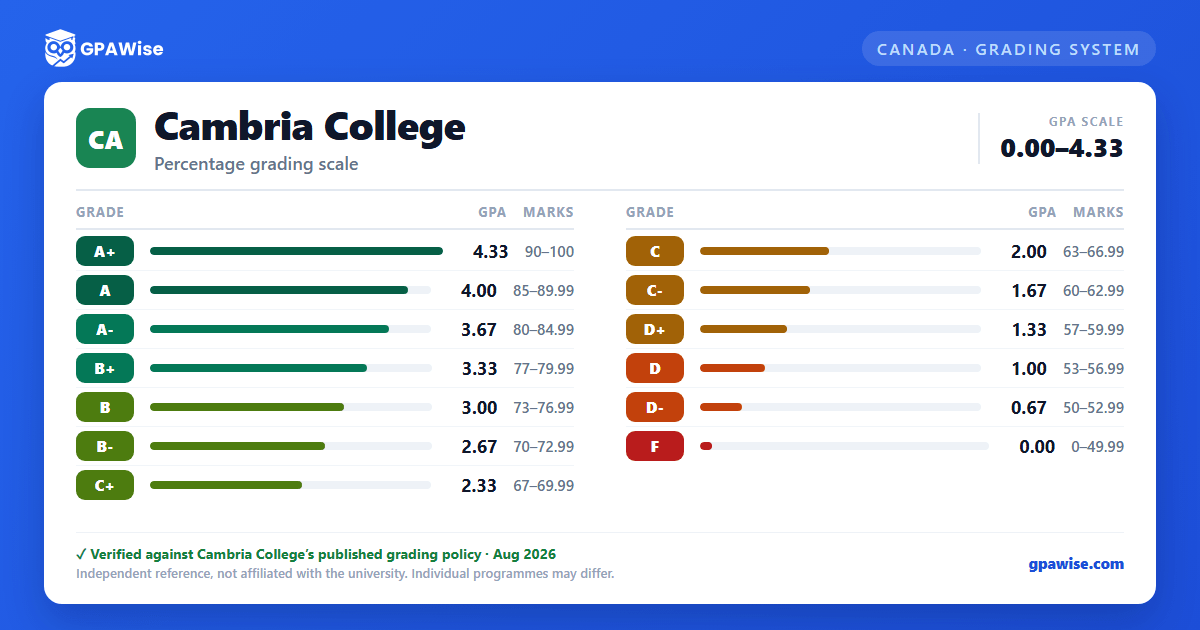
Cambria College evaluates student performance through a variety of methods — group and individual projects, presentations, quizzes, homework, assignments, participation, tests, midterms, and final exams — formalizing a student's success within a course and/or program. Each percentage mark maps to a letter grade and a grade point on a 0–4.33 scale, from A+ (90–100%, 4.33 points) down to F (0–49.99%, 0 points).
Passing marks are specific to the program — the handbook does not print a single college-wide numeric floor. All weighted courses must be passed to earn a credential; students should refer to their program outline and Campus Director for the exact passing threshold in their program.
Source: "Competency Assessment" and "Cambria College Grading System", p.26; "Cambria GPA Scale" table, p.27 — verified Jul 2026
Honours status at Cambria College
To achieve honours status, a student must achieve an overall aggregate of 90% or above for the entire program and maintain a 90% or higher attendance rate. This is a program-wide aggregate-and-attendance threshold rather than a per-course letter grade.
Source: "Competency Assessment", p.26 — verified Jul 2026
Maintaining satisfactory academic progress
Students must achieve the minimum passing mark for all courses and micro-credential modules (First Aid, FoodSafe, Serving It Right, etc.). Late coursework is penalized 10% once the deadline passes, and must still be submitted within 2 days of the due date or it is marked as a rewrite.
A student who misses a scheduled exam needs a doctor's note to write it without penalty; without one, the maximum achievable mark is the minimum passing mark, though the attempt isn't treated as a rewrite. Students may attempt a maximum of one rewrite/retake per weighted assignment, project, quiz, or exam in a course, and a rewrite/retake mark cannot exceed the minimum passing mark.
If a student still doesn't achieve the minimum passing mark after exhausting rewrites/retakes, the entire course must be retaken (affecting student loan status and incurring additional tuition/supply fees). Unsuccessful completion of a course or micro-credential module may lead to an academic warning or academic probation; unsuccessfully attempting three or more courses/micro-credentials may result in dismissal from the College.
Academic Probation Policy
A student may be placed on Academic Probation for: failing to achieve the minimum passing grade in two or more modules at any point in the program; failing to maintain 70% or greater cumulative attendance during the study period (extenuating circumstances, e.g. temporary medical leave, may be exempted by the Campus Director); or failing to uphold the Academic Policy, Code of Professionalism, Ethical Conduct Policy, or Respectful and Fair Treatment of Students Policy.
When probation is imposed, the institution reviews the student's progress, prepares a formal probation letter with an action plan and any applicable deadlines or fees, and may meet with the student to discuss it. A follow-up review within 30 days of the probation notice results in one of three outcomes: the student is removed from probation, the probation period is extended, or the student is dismissed from the program.
Source: "Academic Policy", p.36 — verified Jul 2026
Earning a credential: course retakes and micro-credentials
To earn a credential, students must attempt all assessments and meet the minimum passing grade for every course in their program (the exact grade required varies by program and is set out in the program outline).
A student who fails to achieve the minimum passing mark in any course must retake the entire course and pay a course retake fee, calculated as $10 per hour of course duration (e.g. a 20-hour course costs $200 to retake, a 60-hour course $600). A retaken course can earn full marks, but all coursework must be newly completed — previously submitted work cannot be resubmitted. Retaking a course is not guaranteed and depends on factors such as the student's overall academic standing, course availability within the study period, funding source, and study-permit expiration.
Many diploma programs also require completing mandatory micro-credentials (e.g. Standard First Aid with CPR-C, FoodSafe, WHMIS, N95 Mask Fitting, POPARD, Non-Violent Crisis Intervention) as a graduation requirement; failing or missing one requires paying additional retake fees and may require finding an outside training source.
Source: "Course Retake" and "Micro-Credential Retakes", pp.30-31; "Assessment and Credential Requirements", p.38 — verified Jul 2026
Transfer Credit Policy
Cambria College recognizes transferability of courses on a case-by-case basis. To have prior coursework evaluated, a student pays a $50 Credit Evaluation fee and submits transcripts to the Campus Director or Director of Education, who assesses equivalency against Cambria's own course offerings. A transfer course must carry a minimum passing mark of 65% to be considered for transferability, and a student may receive a maximum credit of 50% of the entire program they wish to attend. If granted, the $50 evaluation fee is applied against tuition once the student starts the program; transfer credit must be requested prior to registration.
Transfer credits for regulated programs — Health Care Assistant (BC Care Aide Registry) and Medical Laboratory Assistant (BC Society of Laboratory Sciences) — are instead considered against those governing bodies' own regulatory standards.
Source: "Transfer Credit Policy", p.8 — verified Jul 2026
Frequently asked questions
What grading scheme does Cambria College use?
Where does this Cambria College grade scale come from?
What GPA scale does Cambria College use?
Cambria College's GPA scale runs from A+ (90–100%, 4.33 points) down to F (0–49.99%, 0 points), with 13 letter-grade bands in between (A, A-, B+, B, B-, C+, C, C-, D+, D, D-). Percentage is the primary recorded unit; both the letter grade and the GPA point are derived from the percentage band.
Source: "Cambria GPA Scale", p.27 — verified Jul 2026
What is the minimum passing grade at Cambria College?
There is no single college-wide passing percentage — passing marks are specific to each program. All weighted courses must be passed to earn a credential. Students should check their program outline or ask their Campus Director for the exact passing mark in their program.
Source: "Cambria College Grading System", p.26 — verified Jul 2026
What happens if I fail a course at Cambria College?
A student who doesn't achieve the minimum passing mark is generally given one rewrite/retake opportunity first, capped at the minimum passing mark. If that still isn't successful, the student must retake the entire course for a fee of $10 per hour of course duration. Unsuccessful completion of a course or micro-credential can lead to academic warning or probation, and three or more unsuccessful attempts can result in dismissal from the College.
Source: "Academic Policy", p.36; "Course Retake", pp.30-31; "Academic Probation Policy", pp.44-45 — verified Jul 2026
How do I qualify for honours at Cambria College?
You need an overall program aggregate of 90% or above and an attendance rate of 90% or higher for the entire program.
Source: "Competency Assessment", p.26 — verified Jul 2026
Can I transfer credits into Cambria College?
Yes, on a case-by-case basis. You'll pay a $50 Credit Evaluation fee, and the transfer course must have a minimum passing mark of 65% to be considered. You can receive a maximum of 50% of your program's credits through transfer.
Source: "Transfer Credit Policy", p.8 — verified Jul 2026