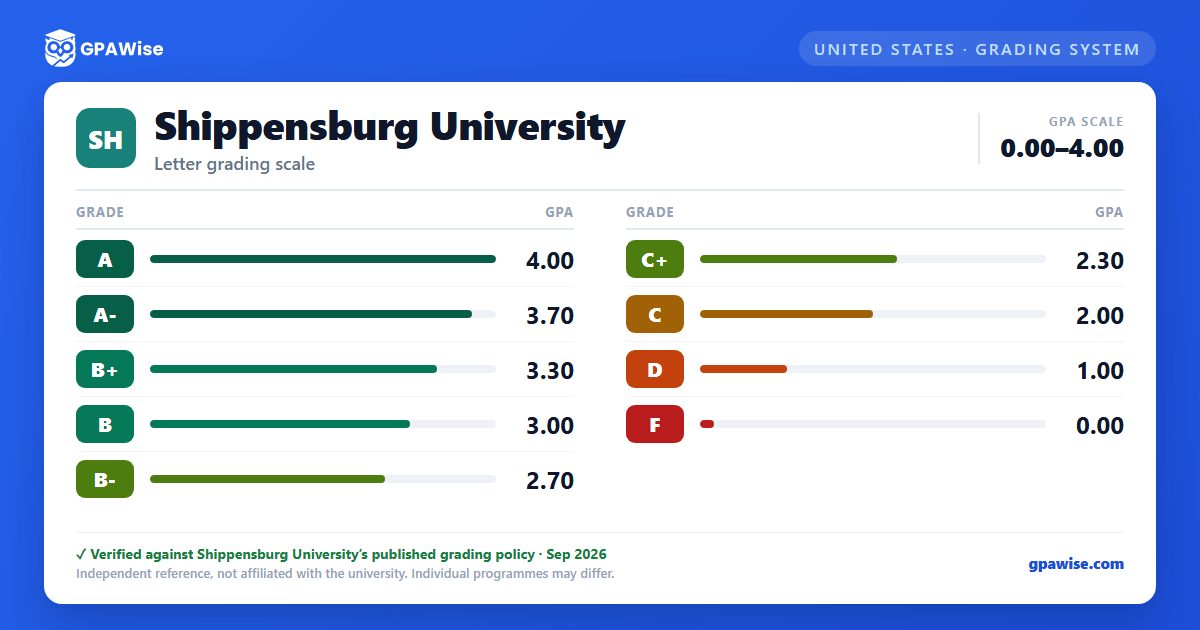

How Grades Are Assigned
Shippensburg's plus/minus letter-grade system took effect with the 1992 fall semester; before then the only regular letter grades were A, B, C, D, and F. Individual faculty members may still choose to use single letter grades and not award plus/minus grades.
In certain cases a grade of D may not be considered passing, and a student may be required to repeat the course by their major department.
Source: Academic Policies and Procedures, 2025-2027 Undergraduate Catalog, "Grading and Point System" — verified Sep 2026
What Counts Toward Your QPA
Only courses in which you received a regular letter grade (A through F) are used in calculating your quality point average (QPA). Special notations such as I, Q, S, U, P, T, TR, N, NC, PASS, and PASS* carry no quality-point value and are not used in the QPA calculation.
- Satisfactory-Unsatisfactory option: grades from courses taken S/U are excluded from the cumulative QPA; S is recorded for A/B/C-equivalent work and earns credit, U for D/F-equivalent work and earns no credit. Eligible students (one academic year completed, cumulative QPA of 2.5 or better) may take up to 3 credits per semester this way, to a 10-credit career maximum.
- Temporary grades: a Q (deferred grade) converts to F if not completed within three years; an I (incomplete) converts to F if not completed by the end of the next full semester.
- Repeated courses: the repeat/grade-replacement option may be used up to six times total, with any single course repeatable for grade improvement up to two times; the most recent grade is the one used in the QPA. Beyond those limits, both the original and new grade count.
- Fresh Start: students readmitted after withdrawing for at least three years with a cumulative QPA below 2.0 may request (once) that prior Shippensburg coursework be excluded from the QPA on subsequent work; the grades still appear on the transcript.
Source: Academic Policies and Procedures, 2025-2027 Undergraduate Catalog, "Grading and Point System" / "Academic Progress and Standing" — verified Sep 2026
Academic Probation and Dismissal
Students are expected to maintain a cumulative QPA of 2.0 (C) or better overall and in their major coursework. A student who falls below 2.0 may be granted one probationary semester to raise their average.
A student is subject to dismissal if their adjusted cumulative average beyond the first semester falls below 1.7, or their semester QPA is below 1.0 (unless their overall QPA is still 2.0 or above); first-year students who pass fewer than 3 credits in their first semester are dismissed for a minimum of one academic year. Some dismissed students must complete a Continuing Academic Progress and Success (CAPS) recovery program to return on probation.
Readmission after a first dismissal is possible after at least one calendar year; after a second dismissal, a student is ineligible for at least three years.
Source: Academic Policies and Procedures, 2025-2027 Undergraduate Catalog, "Academic Progress and Standing" — verified Sep 2026
Requirements for Graduation
To graduate, a student must complete a minimum of 120 credit hours, all required general education and curriculum coursework, and hold a cumulative QPA of at least 2.0 (C average) both overall and in their major/academic sequence.
At least 30 of the last 60 credit hours toward a bachelor's degree must be completed at Shippensburg.
Source: Academic Policies and Procedures, 2025-2027 Undergraduate Catalog, "Graduation Requirements and Majors" — verified Sep 2026
Dean's List and Graduation Honors
Dean's List: published each semester for full-time students with a semester QPA of 3.50 or better; part-time students qualify with a 3.50 QPA over their last 15 or more sequential credits.
Graduation honors are based on final cumulative QPA: Cum Laude (3.40 or better), Magna Cum Laude (3.60 or better), Summa Cum Laude (3.80 or better). Transfer and fresh-start students need at least 15 semester hours at Shippensburg to be recognized in the commencement program, and at least 30 to have honors posted on their permanent record.
Source: Academic Policies and Procedures, 2025-2027 Undergraduate Catalog, "Academic Progress and Standing" / "Graduation Requirements and Majors" — verified Sep 2026
Transfer Credit Policy
A grade of C or better is generally required for transfer credit to be accepted. Accepted transfer credit is recorded on the transcript as TR and is not used in calculating a student's QPA; transfer credit cannot be used to replace a D or F grade earned at Shippensburg.
The same rule applies to Study Abroad coursework: grades equivalent to C or above are recorded as TR (not counted in the QPA), while grades equivalent to D or F earn no transfer credit.
Source: Academic Policies and Procedures, 2025-2027 Undergraduate Catalog, "Earning Academic Credits" / "Academic Options" — verified Sep 2026