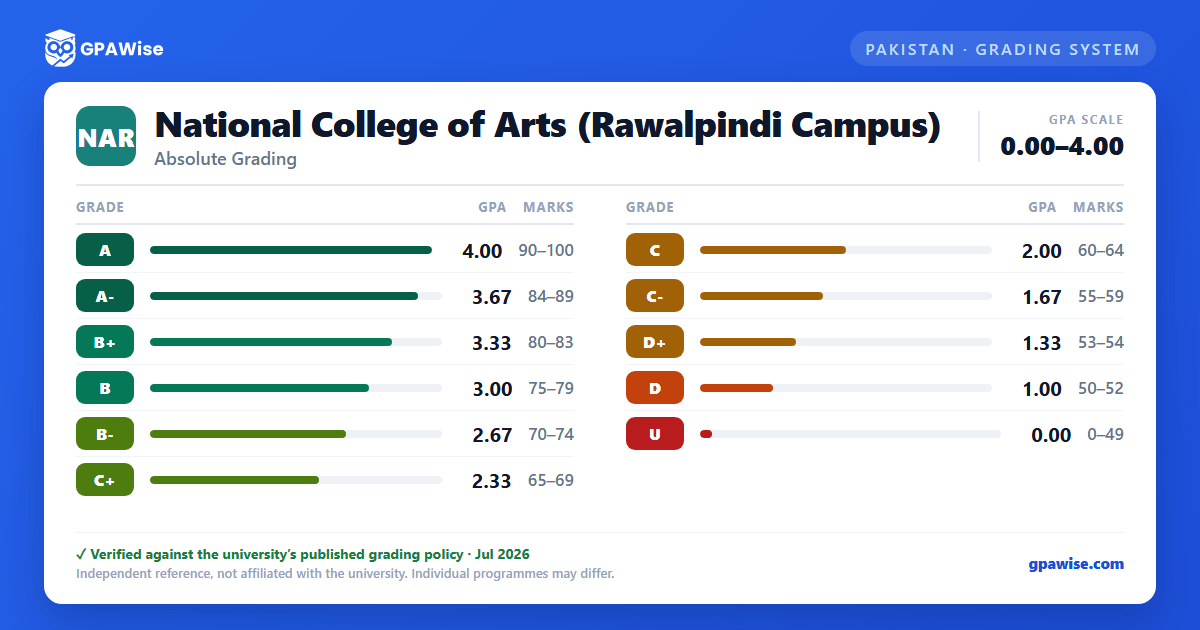

How grading works at NCA
National College of Arts (NCA) — which includes the Rawalpindi campus as well as the main Lahore campus — uses an absolute, marks-based grading system on a 0.00–4.00 grade point scale. Each letter grade corresponds to a minimum marks threshold set out in the Student Handbook; the full grade, marks, and grade-point mapping is listed in the Grade Scale Reference on this page.
Final assessment in each course combines 60% class work and 40% final examination/project evaluation. Besides the graded letters, NCA uses three special grades: U (Ungraded/Fail/no effort), which is the failing grade and does count toward GPA; W (Withdrawal, within the first weeks of a semester), which carries 0.00 but has no impact on CGPA; and I (Incomplete), awarded only in exceptional circumstances beyond a student's control.
Source: Student Handbook 2026, "Grading System" and "Assessment Criteria" (Basic Academic Information, p.39 region); Enrollment rules 6, 7, 14 — verified Jul 2026
How NCA calculates SGPA and CGPA
NCA reports a Semester GPA (SGPA), calculated at the end of each semester for all courses completed, and a Cumulative GPA (CGPA) across all semesters.
- A W (Withdrawal) grade has no impact on the CGPA calculation.
- A U grade obtained after withdrawing past the 4th week (or for non-submission) does count in the GPA and remains on the transcript.
- When a student repeats a course to clear a low grade or improve it, only the better of the two grades is used in the CGPA — both attempts still appear on the transcript, and a CGPA improved this way is annotated (Imp).
Source: Student Handbook 2026, Grading System preamble; Enrollment rules 6–7; Repeating Courses and Improving CGPA rules 1–3 — verified Jul 2026
Academic probation and dropout at NCA
NCA places undergraduate students on probation when a semester's performance falls below the college's minimum standard:
- An SGPA below 2.00 (grade C) but with no course below 1.00 GPA (grade D) — promoted on probation, with the condition of exceeding 2.0 SGPA the following semester.
- An SGPA between 2.00 and 1.00 with a U grade in any course — must repeat that course, offered via summer semester.
- An SGPA of 2.00 or above but with a failing course — promoted conditionally on probation, with mandatory summer-semester registration to clear the fail.
A student whose SGPA stays below 2.00 across two consecutive semesters, with a U grade, even after attending summer semester, is dropped from the college rolls — though re-admission may be sought once during the four-year programme, as an external candidate, after paying the full admission fee. A degree programme allows a maximum of two academic probations overall, and both may not fall within the first four semesters; a second probation within that window after summer semester also means removal from the rolls.
Source: Student Handbook 2026, Rules & Regulations for Undergraduate Programmes — Probation rules 1–6 — verified Jul 2026
Minimum CGPA and credits to graduate from NCA
To be awarded an undergraduate degree, an NCA student needs a CGPA of at least 2.00 out of 4.00, plus the prescribed credit hours: 124–140 credits for a standard four-year programme, 160–180 credits for the five-year Architecture programme, and 180 credits for a double major. It is also mandatory to score at least 50% (grade D) in each of Practical, Projects, Thesis, Assignments, Test, and Theory Paper, separately or in aggregate.
Standard programme duration is four years (five for Architecture); the maximum allowed duration is six years (seven for Architecture), extendable only with Vice Chancellor approval. Graduate (Master's/MPhil) programmes require a higher floor of CGPA 2.67.
Source: Student Handbook 2026, Minimum Degree Requirement for Undergraduate (p.39 region); Probation rule 8; Minimum Degree Requirement for Graduate Programmes — verified Jul 2026
Medals, prizes, and rolls of honor at NCA
NCA awards Medals, Prizes, and Rolls of Honor to students who pass their internal and external examinations or term papers in the first attempt; positions among students are decided by CGPA (or, in a tie, by percentage). A discipline with fewer than five students receives no position that term, and no medal or roll of honor is granted to a candidate who passed on a second attempt.
Two further exclusions apply: no medal is awarded if a candidate's result is not declared within the degree's prescribed time, and no Medal or Roll of Honor is awarded to a student whose CGPA reflects a course-improvement repeat (an "(Imp)"-annotated CGPA).
Source: Student Handbook 2026, Rules & Regulations for Undergraduate Programmes — Awards rules 1–5 — verified Jul 2026
How transfer credits work at NCA
The Vice Chancellor may accept credits a student has earned at NCA or at any other HEC-recognized institution, up to a maximum of 50% of the minimum credit requirement for the degree, provided: the transferred course's content is identical or similar to a course in the student's planned coursework; that course credit was not already used toward another degree; and courses graded below C are not eligible for transfer. The receiving department must also conduct a comprehensive admitting examination, and a course used to qualify one degree cannot be counted again toward a different, higher degree programme.
Source: Student Handbook 2026, Rules & Regulations for Undergraduate Programmes — Transfer of Credits rules 1–3 — verified Jul 2026
Frequently asked questions
Can I save my semesters and track my CGPA at NCA Rawalpindi?
How do I convert SGPA to CGPA at NCA Rawalpindi?
Can I add past semester GPAs without entering every course?
Is my CGPA tracker data sent to your servers?
Is this National College of Arts (Rawalpindi Campus) (NCA Rawalpindi) GPA calculator free?
What CGPA do you need to graduate from NCA?
You need a minimum CGPA of 2.00 out of 4.00 to graduate from an NCA undergraduate programme, along with the prescribed credit hours for your degree (124–140 for most four-year programmes, more for Architecture or a double major). Graduate (Master's/MPhil) students need a higher CGPA floor of 2.67.
Source: Student Handbook 2026, Minimum Degree Requirement for Undergraduate and Graduate Programmes — verified Jul 2026
What is NCA's failing grade called?
NCA's failing grade is U ("Ungraded / Fail / No effort by student"), carrying 0.00 grade points — not the more common F used at many other Pakistani universities. Unlike the administrative W and I grades, a U grade counts toward GPA and stays on the transcript.
Source: Student Handbook 2026, Grading System table; Enrollment rule 7 — verified Jul 2026
What is the minimum passing grade at NCA?
The minimum passing grade at NCA is D, worth 1.00 grade points at 50% marks. Students must also score at least 50% in each assessed component (Practical, Projects, Thesis, Assignments, Test, and Theory Paper) separately or in aggregate.
Source: Student Handbook 2026, Grading System table; Probation rule 8 — verified Jul 2026
Does repeating a course improve your CGPA at NCA?
Yes. If you repeat a course to clear a low grade or improve it, only the better of your two grades counts toward your CGPA, though both attempts remain on your transcript. A CGPA improved this way is marked (Imp) — and it makes you ineligible for medals, prizes, or rolls of honor.
Source: Student Handbook 2026, Repeating Courses and Improving CGPA rules 1–3; Awards rule 5 — verified Jul 2026
What happens if you're placed on academic probation at NCA?
An NCA undergraduate is placed on probation when a semester's SGPA falls below 2.00, or when a passing SGPA still includes a failed course. Probation carries a condition to raise your SGPA above 2.00 the next semester, often alongside mandatory summer-semester coursework. A student who stays below the 2.00 SGPA threshold for two consecutive semesters, with a failing grade, even after summer semester, is dropped from the college rolls — with one re-admission opportunity per four-year programme, as an external candidate.
Source: Student Handbook 2026, Rules & Regulations for Undergraduate Programmes — Probation rules 1–4 — verified Jul 2026