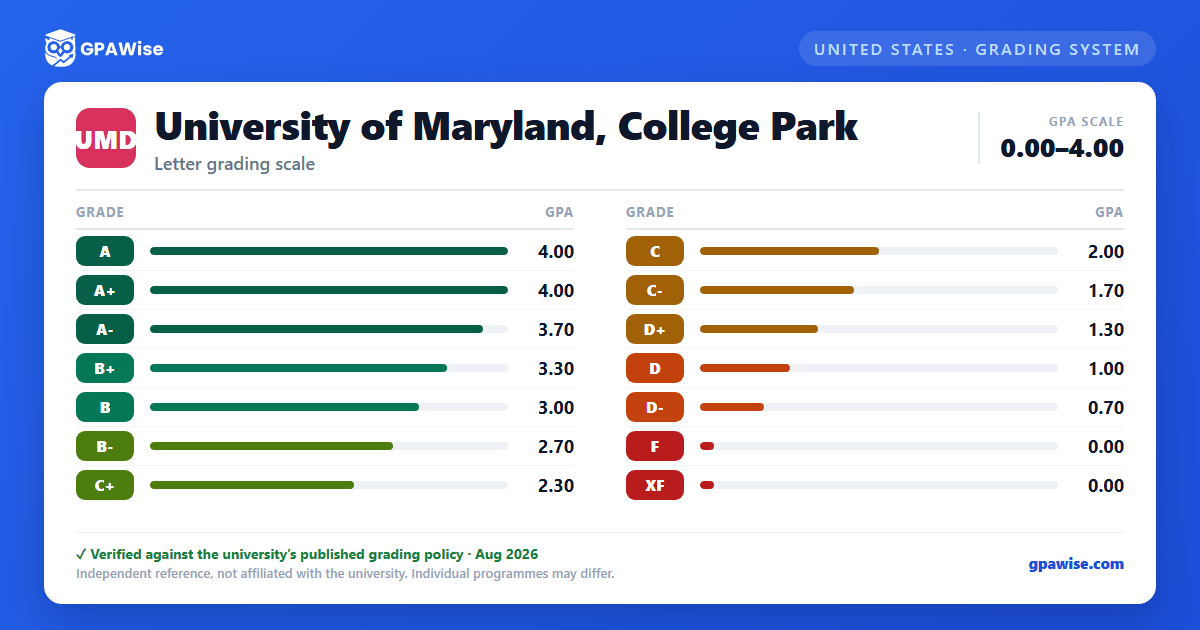

How grading works at the University of Maryland
UMD grades on a letter scale measured in quality points per credit hour, running from 4.0 down to 0.0 — see the Grade Scale Reference above for each grade’s exact value. There is no percentage scale at Maryland; the letter is the grade, and the catalog publishes no marks bands at all.
A+ and A are both worth 4.0. This is the detail most people get wrong about Maryland. UMD does award the A+ as a distinct grade on your transcript, but it carries no extra weight — the catalog assigns “a value of 4.0 quality points per credit hour” to A+ and A alike. 4.0 is the ceiling, and there is no way to push a UMD GPA above it.
Each band has a stated meaning: A+, A, A- denote excellent mastery of the subject and outstanding scholarship; B+, B, B- good mastery and good scholarship; C+, C, C- acceptable mastery; D+, D, D- borderline understanding and marginal performance, which the catalog says does not represent satisfactory progress toward a degree; and F failure to understand the subject and unsatisfactory performance. A separate XF denotes failure due to academic dishonesty.
The full set of symbols used on your permanent record is A+, A, A-, B+, B, B-, C+, C, C-, D+, D, D-, F, XF, I, P, S, W and AU. Only the lettered grades and XF carry quality points — the rest are administrative marks that stay off your GPA.
UMD’s grading symbols are set by University Senate and Presidential policy III-6.20(A), University of Maryland Grading Symbols and Notations Used on Academic Transcripts, which the Undergraduate Catalog restates.
Source: Academic Records and Regulations, 2026-2027 Undergraduate Catalog — Marking System, and Computation of Grade Point Average — verified Aug 2026
How UMD calculates your GPA
Your GPA is computed by dividing the total quality points you have accumulated by the total credits attempted in the courses that count. Multiplying a grade’s quality point value by the number of credits for that course gives the quality points you earned in it — so a 4-credit A is worth 16 quality points and a 3-credit B- is worth 8.1.
These grades count toward your GPA: A+, A, A-, B+, B, B-, C+, C, C-, D+, D, D-, F and XF.
These marks do not count toward your GPA: P, S, I, NGR and W. Each is explicitly excluded from the computation:
- P — a student option mark, equivalent to a grade of C- or better.
- S — a department option mark denoting satisfactory performance.
- I — incomplete; not used in the computation of quality points or cumulative grade point averages.
- W — withdrawal from a course after the end of the Schedule Adjustment Period.
- AU — audit; does not count as earned credit and is not used in computing the GPA.
XF counts as a zero. It denotes failure due to academic dishonesty and is treated in the same way as F for the purposes of your cumulative average.
Academic clemency: up to 16 credits can be removed from the calculation of your cumulative GPA when clemency is granted. Those attempted credits and grades still remain included in the calculation of Latin Honors.
Source: Academic Records and Regulations, 2026-2027 Undergraduate Catalog — Computation of Grade Point Average, Marking System, Incompletes, Additional Record Notations — verified Aug 2026
Academic probation and dismissal at UMD
Academic retention at Maryland is based solely on grade point average.
Satisfactory performance is a cumulative GPA of 2.0 or above. Unsatisfactory performance is a cumulative GPA of less than 2.0 — you will be placed on academic probation following any semester in which you do not achieve a 2.0 cumulative GPA.
If your semester GPA falls below 2.0 you are encouraged to meet with your advisor to build a plan for academic improvement, even if your cumulative GPA is still above the line.
While on probation: full-time students must complete 9 or more credits in each probationary semester. A completed credit means credit for any course graded A+ through D-, F, P or S. You will not be allowed to add or drop courses, or register, without an academic advisor’s approval.
Dismissal if you have earned 60 or more credits: you will be dismissed if your cumulative GPA remains below 2.0 for two consecutive semesters (excluding winter and summer terms).
Dismissal if you have earned fewer than 60 credits: you will be dismissed following any probationary semester in which you fail to attain a minimum 2.0 semester GPA and complete the requisite credits. You may otherwise continue on probation until the semester in which you reach a 2.0 cumulative GPA — but you will be dismissed if you have not reached 2.0 by the end of the semester in which you complete 60 credits.
Reaching a cumulative GPA of 2.0 in the preceding winter or summer term protects you from dismissal in the subsequent semester.
Reinstatement: dismissed students may apply to the Faculty Petition Board on the grounds of mitigating circumstance. A reinstated student who does not reach a 2.0 cumulative GPA by the end of their first semester back will be dismissed again.
Source: Academic Records and Regulations, 2026-2027 Undergraduate Catalog — Satisfactory/Unsatisfactory Performance, Academic Dismissal, Academic Probation, Application for Academic Reinstatement — verified Aug 2026
What you need to graduate from UMD
A minimum of 120 successfully completed course credits is required for graduation in any degree curriculum. Individual colleges, schools and departments may set higher requirements, so check with yours for specifics.
Because academic retention is based solely on GPA and unsatisfactory performance is defined as a cumulative GPA below 2.0, you need to be at or above a 2.0 cumulative GPA to remain in good standing through to your degree.
Applying to graduate: every candidate for a degree or certificate must file a formal application with the Office of the University Registrar. The deadline is the end of the schedule adjustment period for the semester you plan to graduate in, or the end of the first week of the second summer session for August degrees. Applications must be filed at the beginning of your final semester.
Source: Academic Records and Regulations, 2026-2027 Undergraduate Catalog — Academic Retention, Satisfactory/Unsatisfactory Performance, Graduation Applications — verified Aug 2026
Dean's List, Latin honors and Phi Beta Kappa at UMD
Semester Academic Honors (Dean’s List). Awarded in fall and spring only to undergraduates who complete 12 or more credits with the regular grading method and earn a semester GPA of 3.5 or higher. Pass-fail, satisfactory/unsatisfactory and audit courses do not count toward the credit load. The honor is noted on your academic record.
Latin honors. Summa cum laude, magna cum laude and cum laude generally go to the top 10% of students graduating in each college or school, and to all students with at least a 3.9 GPA:
- Summa cum laude — GPA at or above the highest 2% of GPAs from your college or school, averaged over the previous academic year.
- Magna cum laude — the next highest 3%.
- Cum laude — the following 5%.
You must earn at least 60 semester hours at the university to be eligible, and no more than 6 credits taken pass/fail or satisfactory/fail count toward that 60. No student with a GPA below 3.3 will be considered for a Latin honor. The Registrar publishes the current year’s minimum GPA cut-offs by college or school.
Phi Beta Kappa. The College Park chapter requires a GPA of at least 3.75 for seniors (overall and in liberal arts and sciences courses) or 3.85 for juniors, plus at least 60 credit hours taken at UMD and the chapter’s course-distribution requirements. Meeting the requirements does not guarantee election — the faculty committee’s judgment on the quality, depth and breadth of your record is the deciding factor.
Source: Academic Records and Regulations, 2026-2027 Undergraduate Catalog — Honors (Dean's List), Graduation Applications and Latin Honors, Election to Phi Beta Kappa — verified Aug 2026
Repeating a course by transfer
If you repeat a course by transfer that you originally took before or during the semester in which you reached 24 credits attempted (including transfer credits), and the transfer grade is higher, the original grade is excluded from your GPA calculation.
If the course was taken after the semester in which you reached 24 attempted credits, the original grade stays in your GPA calculation.
UMD’s repeat guidelines apply to transfer students from schools other than Maryland community colleges who began at College Park in Fall 1990 or later — including students transferring from another University of Maryland institution.
Source: Academic Records and Regulations, 2026-2027 Undergraduate Catalog — Repeat Course Guidelines (Repeat by transfer) — verified Aug 2026
Frequently asked questions
Can I save my semesters and track my CGPA at UMD?
How do I convert SGPA to CGPA at UMD?
Can I add past semester GPAs without entering every course?
Is my CGPA tracker data sent to your servers?
Is this University of Maryland, College Park (UMD) GPA calculator free?
Is an A+ worth more than an A at UMD?
No. Both are worth 4.0 quality points per credit hour. UMD awards the A+ as a distinct grade on your transcript, but the catalog states that “a grade of A+ or A will be assigned a value of 4.0 quality points per credit hour” — so an A+ carries no extra weight in your GPA, and 4.0 is the ceiling.
Source: Academic Records and Regulations, 2026-2027 Undergraduate Catalog — Marking System — verified Aug 2026
What GPA do you need to stay off academic probation at UMD?
A cumulative GPA of 2.0 or above. That is UMD’s definition of satisfactory performance. Fall below 2.0 cumulative and you are placed on academic probation following that semester; academic retention at Maryland is based solely on GPA.
Source: Academic Records and Regulations, 2026-2027 Undergraduate Catalog — Academic Retention, Satisfactory and Unsatisfactory Performance — verified Aug 2026
Do pass-fail courses affect your UMD GPA?
No. The mark of P is not used in the computation of your grade point average. If you take a course pass-fail, your instructor still submits a normal letter grade and the Registrar converts A+, A, A-, B+, B, B-, C+, C or C- to a P — so P means C- or better.
But D+, D, D- and F remain as given and do count in your GPA. Choosing pass-fail protects a C- but not a D.
To use the option you need 30+ completed credit hours with a GPA of at least 2.0 (15+ of them at UMD with a UMD GPA of at least 2.0). It applies to electives only, one course per semester, and no more than 12 semester hours over your whole career.
Source: Academic Records and Regulations, 2026-2027 Undergraduate Catalog — Marking System (P), Pass-Fail Grading — verified Aug 2026
What happens to your GPA if you repeat a course at UMD?
Normally every attempt counts — your GPA includes all attempts at a course that result in a grade of A+ through D-, or F.
There are two exceptions that let only the higher grade count, both intended to help freshmen and transfer students adjust:
- The repeated course was taken within your first semester at UMD, or
- it was taken within your first 24 credit hours attempted (including transfer credits), or within the semester in which you reached your 24th attempted credit. AP exam credits do not count toward the 24.
Either way, every grade from prior attempts stays on your transcript, whether or not it is dropped from the cumulative GPA. You may repeat a given course once (no more than two registrations), and no more than 18 credits total.
Source: Academic Records and Regulations, 2026-2027 Undergraduate Catalog — Repeat Course Guidelines — verified Aug 2026
What is an XF at UMD, and does it count in your GPA?
XF denotes failure due to academic dishonesty, and yes, it counts. UMD’s catalog lists XF among the grades whose quality points enter the GPA calculation, and states that an XF is treated in the same way as F for the purposes of cumulative average — F being worth 0.0 quality points per credit hour.
Source: Academic Records and Regulations, 2026-2027 Undergraduate Catalog — Marking System (XF), Computation of Grade Point Average — verified Aug 2026
Does an Incomplete (I) hurt your UMD GPA?
No — an I is not used in the computation of quality points or cumulative grade point averages while it stands.
An I is an instructor option, given only when your work has been qualitatively satisfactory but illness or circumstances beyond your control kept you from finishing a small portion of the course. The Incomplete Contract must reach the dean of the college offering the course within six weeks after the grade submission deadline, and the work is normally due by the end of the next semester — in any event within one year.
If you do not finish on schedule, the instructor converts the I to the grade indicated by the contract, and that grade then counts normally. You cannot clear an I by re-registering for the course or by credit by examination.
Source: Academic Records and Regulations, 2026-2027 Undergraduate Catalog — Incompletes, Marking System (I) — verified Aug 2026