
How grading works at the University of Kansas
KU uses a letter-grade system on a 0.00–4.00 scale, published by the Office of the University Registrar as “Scale 1: All schools except Medicine.” Some schools use plus/minus grading and some don't — where a school doesn't use plus/minus, you simply won't have those rows for its courses.
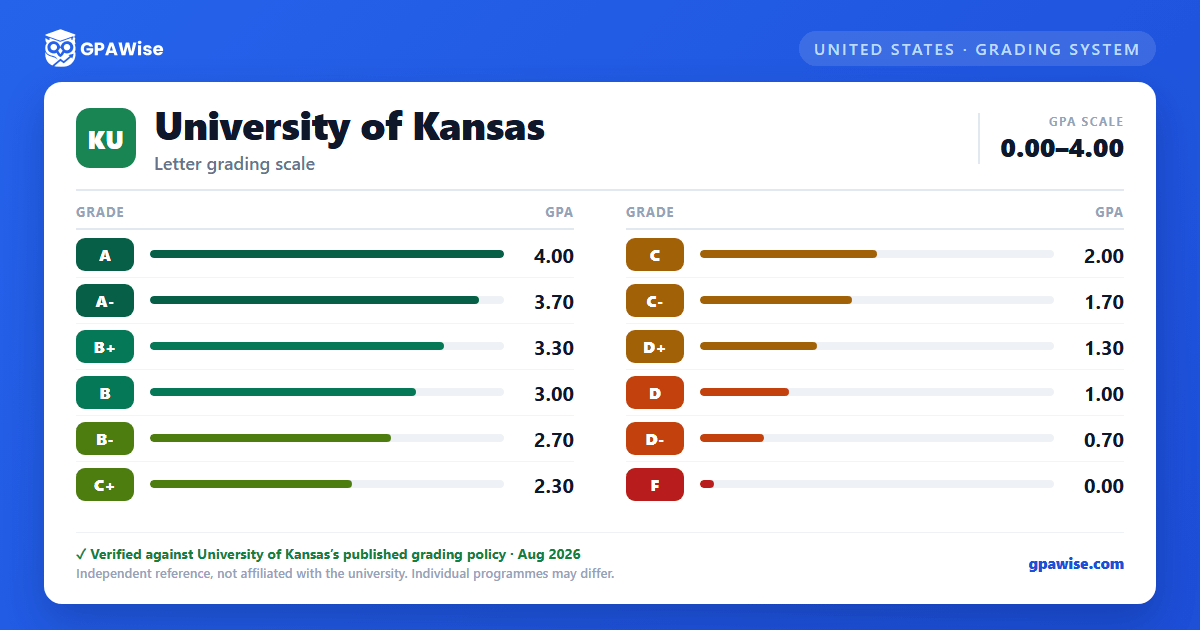
Grade points: A 4.00, A- 3.70, B+ 3.30, B 3.00, B- 2.70, C+ 2.30, C 2.00, C- 1.70, D+ 1.30, D 1.00, D- 0.70, F 0.00. KU does not award an A+ — University Senate rules define the plus/minus range as running “between a maximum of A and a minimum of F,” so A is the scale's ceiling.
This scale covers the College and schools generally. The School of Medicine uses a separate Pass/Fail/Withdrew-Failing/Incomplete scale with no grade points at all, Law students follow the Law School Catalog, and graduate coursework is governed by its own grading policy — none of those is reflected here.
Source: registrar.ku.edu/grades, 'Grading System' and 'Grading Scale' sections (Scale 1 table, carve-outs); USRR 2.5.1 (plus/minus range) — verified Aug 2026
How your GPA is calculated at KU
Your GPA is a quotient: the number of grade points you've earned divided by the number of credit hours you attempted in courses graded A, B, C, D, or F. Courses graded CR, NC, P, S, U, I, or W carry no grade points and are not counted in the GPA calculation.
Your Official KU GPA is the one shown on your transcript and used to determine graduation eligibility. It reflects only coursework taken in residence at KU — transfer credit and credit earned by examination are excluded — and it's calculated separately for each student career (undergraduate, graduate, medical, law), in both a per-term and cumulative format.
Repeating a course: if you retake a course at KU, the better of your two grades replaces the original for GPA purposes, up to five repeat opportunities total. Both attempts remain visible on your transcript, but the weaker grade is excluded from your GPA once replacement applies.
Source: registrar.ku.edu/grades, 'Grade Point Averages' section (GPA definition, Official KU GPA); USRR 2.3.10 Grade Replacement Policy in Repeat Courses — verified Aug 2026
What you need to graduate from KU with a bachelor's degree
You need at least 120 credit hours, including at least 30 hours in residence at KU and at least 45 hours in junior/senior-level courses, plus a capstone course or its equivalent.
You must also maintain a minimum 2.00 cumulative GPA for your coursework taken in residence at KU to be eligible for graduation.
Source: University Senate Rules and Regulations (USRR) 3.1.1, Requirements for Graduation with the Bachelor's Degree — verified Aug 2026
Graduating with distinction at KU
KU's College and schools may award degrees “with distinction” or “highest distinction,” but no more than 10 percent of a College's or school's graduating class may receive distinction. Departmental honors are awarded separately, under each department's own faculty regulations.
Source: USRR 3.3.1, Graduation with Scholastic Honors — verified Aug 2026
Frequently asked questions
Can I save my semesters and track my CGPA at KU?
How do I convert SGPA to CGPA at KU?
Can I add past semester GPAs without entering every course?
Is my CGPA tracker data sent to your servers?
Is this University of Kansas (KU) GPA calculator free?
Does KU award an A+?
No. KU's grading scale tops out at A (4.00). University Senate rules define the plus/minus range as running “between a maximum of A and a minimum of F,” which puts A+ above the scale's ceiling — and the registrar's own grading-scale table has no A+ row.
Source: registrar.ku.edu/grades, 'Grading Scale' (Scale 1 table); USRR 2.5.1 — verified Aug 2026
What happens if I choose Credit/No Credit (CR/NC) instead of a letter grade?
Your instructor still grades your work normally, and the registrar converts it: undergraduates get CR for C- or better and NC for D+ or below (graduate students get CR for C or better, NC for C- or below). Neither CR nor NC counts toward your GPA — CR hours count toward graduation, NC hours do not. You can use this option for at most one course per semester, and you must elect it by a set deadline (for a full semester course, the 21st through 30th instructional day).
Source: USRR 2.3.9.1–2.3.9.6, Credit/No Credit option — verified Aug 2026
How many times can I repeat a course for grade replacement?
Up to five times total, combined across all the courses you repeat. The policy applies to undergraduates only, for courses numbered 000-699, and can't be used to replace a grade you received as an academic-misconduct sanction. When you repeat a course, the better grade replaces the original for GPA purposes; the weaker grade stays visible on your transcript but no longer counts toward your GPA.
Source: USRR 2.3.10, Grade Replacement Policy in Repeat Courses — verified Aug 2026
What is Academic Forgiveness at KU?
If you're an undergraduate who took at least a two-year break from KU, returned with a cumulative KU GPA of at least 2.5 (having left with a GPA below 2.5), and have earned at least 12 credit hours since returning, you can ask the Office of the University Registrar to discount up to four academic terms from your record. The coursework from those terms stays on your transcript, but it no longer counts toward your official KU GPA or toward your degree requirements.
Source: USRR 2.9.1–2.9.5, Academic Forgiveness — verified Aug 2026
What happens if I don't finish the work for an Incomplete (I) grade?
You have up to one calendar year from the original grade due date — or until the end of your graduation term, whichever comes first — to finish the work. If you miss that deadline, the I automatically converts to an F (or U), or to whatever lapse grade your instructor specified when the Incomplete was recorded.
Source: USRR 2.3.3.1–2.3.3.2, The Grading System — verified Aug 2026
What's the difference between my Official KU GPA and the GPA shown in the DPR/Advising Tool?
There's only one Official KU GPA, and it's the one on your transcript. But the Degree Progress Report (DPR) and Advising Tool may show additional GPAs calculated under your College's or school's own policies — for example, an individual school GPA that includes transfer work, a KU-and-transfer cumulative GPA, or a KU cumulative graduation GPA. These can be used to check degree/major requirements, probation, honor roll, or distinction, and may differ from your Official GPA.
Source: registrar.ku.edu/grades, 'Grade Point Averages' section — verified Aug 2026