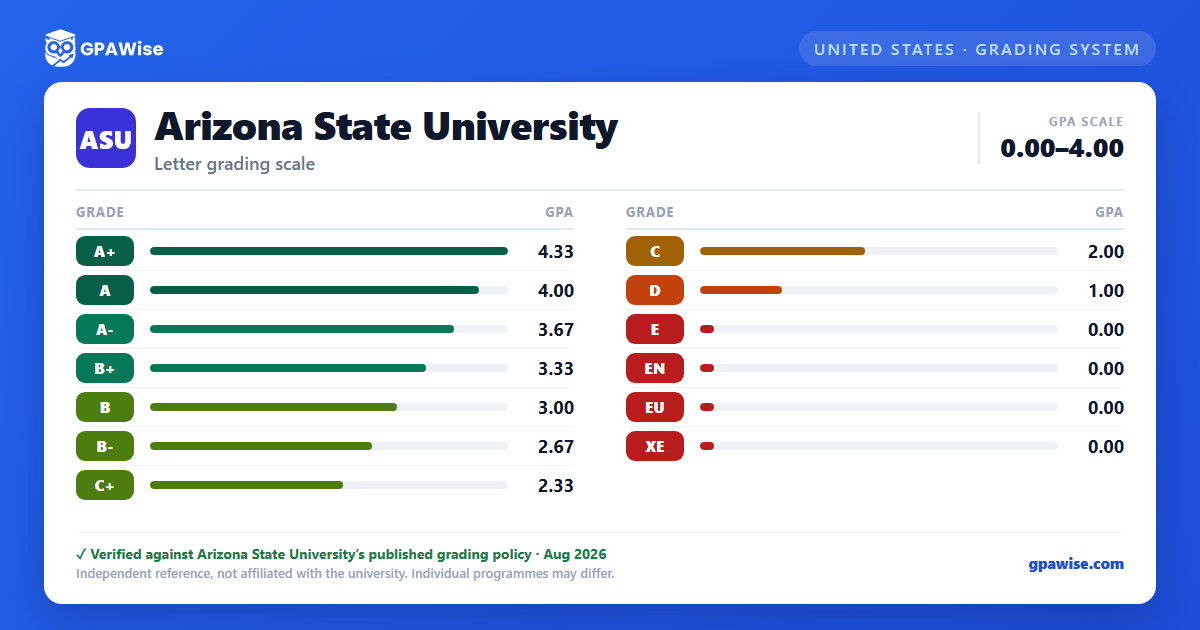

How grading works at Arizona State University
ASU grades on a plus/minus letter scale. Ordinarily you receive one of A+, A, A-, B+, B, B-, C+, C, D or E when you complete a course, unless another grading option such as audit or pass/fail was chosen at the time of registration. Grading options cannot be changed after the close of the add period.
Two details catch people out. First, ASU's failing grade is lettered “E”, not “F” — the letter F does not appear on ASU's grade roster at all. Second, A+ carries a value of 4.33, above the 4.00 that an A is worth.
Your instructor has full discretion in selecting which grades to use and report from the grading options available on the grade roster, so not every course will offer every grade.
Credit is measured in semester hours. One semester hour represents one 50-minute class exercise per week per semester, and to earn credit you must be properly registered and have paid the fees for the course.
The scale above is the one in force for fall 2004 and after. ASU publishes its earlier scales separately, on the University Registrar's prior grading scales page.
Source: Grades and Grading Policies — Credit enrollment; Grading options and definitions; Fall 2004 and After grade table with note 1 — verified Aug 2026
How ASU calculates your GPA
ASU works your GPA out from honor points and net hours:
- Multiply the grade point value by the number of semester hours the course was taken for — that gives the course's honor points.
- Add together all the honor points.
- Add together all the semester hours that received a grade counted below, to get your net hours.
- Divide the honor points by the net hours.
Honor Points ÷ Net Hours = GPA. ASU's own worked example: a 3-hour A (4.00) gives 12.00 honor points, a 3-hour B- (2.67) gives 8.01, and a 3-hour E (0.00) gives 0.00 — 20.01 honor points over 9.0 net hours is a 2.22 GPA.
GPAs are rounded to the nearest 100th of a decimal point. Your semester GPA is based on semester net hours; your cumulative GPA is based on total net hours.
The grades used in computing your semester and cumulative ASU GPA are A+ (4.33), A (4.00), A- (3.67), B+ (3.33), B (3.00), B- (2.67), C+ (2.33), C (2.00), D (1.00) and E (0.00). Grades of EN, EU, XE, E1, E2, E3, E4, E5 and E8 are equivalent to an E for GPA calculation purposes.
Other grades — W, X, Y and the like — are not included in the GPA calculation at all. A P (pass) grade earns you hours but is not used in computing your GPA, and the same is true of a Y (satisfactory). An X (audit) is not included in earned hours and is not computed in your GPA.
One quirk worth knowing: although the plus/minus scale includes an A+ worth 4.33, the cumulative GPA is capped at 4.00.
Source: Grades and Grading Policies — GPA calculation section, including the grade point values table with notes * and **, and the worked example; Pass (P), Audit (X) and Satisfactory (Y) definitions — verified Aug 2026
Repeating a course and deleting a D or E from your GPA
An undergraduate course taken by an undergraduate student at ASU may be repeated for credit if you received a D, an E (including EU, EN and XE), a W or an X. Generally you may not repeat an undergraduate course for credit when you earned a C or higher.
To have a D or E grade deleted from your GPA calculation, the conditions are strict:
- The course must be repeated at ASU.
- Independent Learning courses may not be used to repeat D or E grades.
- An undergraduate course with a D or E (including EU, EN and XE) may be repeated only once.
- Students who have already graduated are not eligible to delete the grade for a course taken before the award of their ASU bachelor's degree.
Grade adjustments are processed automatically after grades are reported each term.
Federal financial aid limits repeats separately. You may receive federal aid when repeating a course you previously failed, and you may receive it to repeat a previously passed course (D or better) one additional time. Once you have completed a course twice and earned a passing grade, you are no longer eligible for federal aid for that course, and those units are excluded from the enrollment total your aid is calculated on.
Full detail is in SSM 203-06 (Deletion of a D or E Grade Received by an Undergraduate in an Undergraduate Course) and SSM 203-05 (Duplication of Credit by an Undergraduate Student). Graduate students should see the ASU Graduate Policies and Procedures instead.
Source: Grades and Grading Policies — Repeating Courses; Financial Aid & Repeating Courses — verified Aug 2026
How an incomplete counts against your graduation check
If you are an undergraduate, marks of “I” (incomplete) are changed to a grade of “E” (0.00) for the purposes of evaluating graduation requirements. An outstanding incomplete therefore does not sit neutrally on your record when ASU checks whether you have met your requirements — it is evaluated as a failure.
Source: Grades and Grading Policies — Incomplete (I) — verified Aug 2026
Using a course from another school to demonstrate mastery
If you are an undergraduate who received a D in a course where a C or higher is required, you may use the grade from an equivalent course taken elsewhere to demonstrate mastery at the C-or-higher level.
Be clear about what this does and does not do: the outside course cannot be transferred to ASU, because credit has already been given for the course, and it is not computed in your ASU GPA. It satisfies the mastery requirement only — your original D stays in your GPA.
Source: Grades and Grading Policies — Demonstration of mastery — verified Aug 2026
Frequently asked questions
Can I save my semesters and track my CGPA at ASU?
How do I convert SGPA to CGPA at ASU?
Can I add past semester GPAs without entering every course?
Is my CGPA tracker data sent to your servers?
Is this Arizona State University (ASU) GPA calculator free?
Does ASU use E or F for a failing grade?
E. ASU's failing grade is lettered E, worth 0.00 grade points — the letter F does not appear anywhere on ASU's grade roster. The grades ordinarily given on completion of a course are A+, A, A-, B+, B, B-, C+, C, D and E.
ASU also uses three other failing marks, all worth 0.00: EN (failing, never participated), EU (failing, did not complete) and XE (failure due to academic dishonesty).
Source: Grades and Grading Policies — Grading options and definitions; Fall 2004 and After grade table — verified Aug 2026
Does ASU award A+ grades, and what is an A+ worth?
Yes. ASU's plus/minus scale includes A+, valued at 4.33 grade points — higher than the 4.00 an A is worth. A+ is listed among the grades ordinarily given on completion of a course.
Whether you can actually receive one in a given class is up to your instructor, who has full discretion in selecting which grades to use and report from the options available on the grade roster.
Source: Grades and Grading Policies — Grading options and definitions; Fall 2004 and After grade table, note 1; GPA calculation grade point values — verified Aug 2026
Can your ASU GPA go above 4.00?
No. ASU states it directly: although the plus/minus scale includes a grade of A+ with a value of 4.33, the cumulative GPA is capped at 4.00.
So individual A+ grades are worth 4.33 grade points each and do pull your average up, but the cumulative figure that appears on your record will not exceed 4.00.
Source: Grades and Grading Policies — Fall 2004 and After grade table, note 1; GPA calculation section — verified Aug 2026
What do EN, EU and XE mean on an ASU transcript?
All three are failing grades worth 0.00, and all three count in your GPA exactly as an E does.
- EN — Failing, Never Participated. Used when you never participated in the course. It is treated the same as an E for GPA, course repeatability and academic standing, and it helps ASU determine federal financial aid eligibility. EN has appeared on transcripts since fall 2016.
- EU — Failing, Did Not Complete. Used when you never officially withdrew but stopped participating before the end of the course, leaving your instructor unable to make a normal evaluation of your academic performance. EU has appeared on transcripts since fall 2019.
- XE — Academic Dishonesty. Failure due to academic dishonesty, treated the same as an E for GPA, course repeatability and academic standing. You cannot avoid the penalty by withdrawing from the course — you may be reinstated to it to receive a reduced or failing grade or an XE. It may only be assigned under ASU's Student Academic Integrity Policy, never as part of normal end-of-semester grading.
Source: Grades and Grading Policies — Failing Never Participated (EN); Failing Did Not Complete (EU); Academic Dishonesty (XE); Fall 2004 and After grade table notes 2 and 3 — verified Aug 2026
Can you repeat a course to remove a D or E from your ASU GPA?
Yes, within limits. To be eligible for deletion of a D or E from your GPA calculation, you must repeat the course at ASU — a repeat taken elsewhere will not do it, and Independent Learning courses may not be used. An undergraduate course with a D or E (including EU, EN and XE) may be repeated only once.
If you have already graduated, you are not eligible to delete the grade for a course taken before your ASU bachelor's degree was awarded. Grade adjustments are processed automatically after grades are reported each term.
Source: Grades and Grading Policies — Repeating Courses — verified Aug 2026
What happens if you don't finish a course marked I (incomplete)?
A mark of I is given when you are otherwise doing acceptable work but cannot complete the course because of illness or other conditions beyond your control. You arrange the completion terms with your instructor on the Request for Grade of Incomplete form, and the completion date may not exceed one calendar year from the date the I is recorded. Do not re-register or pay fees to complete the course.
If you miss that deadline, what happens depends on your level:
- Undergraduate course (fall 1983 onward): your grade is automatically changed to a failing grade of E.
- Graduate course (500-level or above): the I becomes a permanent part of your transcript, and you must re-register and pay fees to repeat the course for credit.
Note also that an I is evaluated as an E (0.00) when ASU checks undergraduate graduation requirements.
Source: Grades and Grading Policies — Incomplete (I) — verified Aug 2026
Do ASU graduate students use the same grade point values?
Yes — ASU's grade table lists an Undergraduate Definition and a Graduate Definition side by side against a single shared Value column, so the grade point values are identical at both levels. What changes is what the grades mean:
- C (2.00) is defined as Average for undergraduates but as Passing for graduate students.
- D (1.00) is a Passing grade for undergraduates but carries No Graduate Credit for graduate students.
- P (pass) is not applicable for graduate classes.
- An unfinished I in a 500-level or higher course becomes permanent on your transcript rather than converting to an E.
For repeating courses, graduate students should consult the ASU Graduate Policies and Procedures rather than the undergraduate repeat rules.
Source: Grades and Grading Policies — Fall 2004 and After grade table (Undergraduate Definition / Graduate Definition / Value columns) and note 4; Incomplete (I); Repeating Courses — verified Aug 2026