
How grading works at JNTUK (R23 regulations)
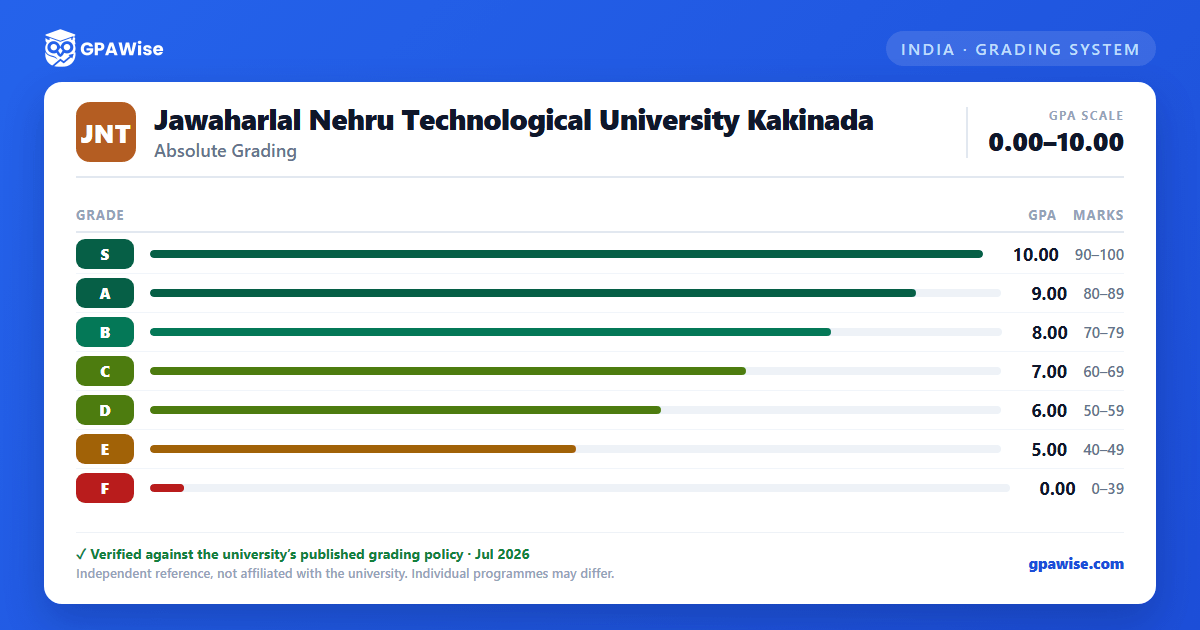
JNTUK uses a 10-point Absolute Grading System: your letter grade is set by fixed percentage-of-marks cut-offs published in the university's own Academic Regulations, not by how your class performs — there is no curve, and your grade depends only on your own marks in each course.
The scale runs from S (Superior) down to F (Fail) across seven graded bands, covering 0% to 100% with no gaps and no overlaps, so every possible mark maps to exactly one grade. A student graded F, or marked absent (Ab), is considered failed and must reappear for that subject at the next supplementary examination.
For non-credit audit courses, JNTUK records "Satisfactory" or "Unsatisfactory" instead of a letter grade, and these do not count toward SGPA, CGPA, or percentage.
Note: JNTUK runs more than one regulation year at once for different admission cohorts. This content describes the R23 regulations, effective for students admitted from Academic Year 2023-24 onward; students admitted under earlier regulations (e.g. R20) follow a different letter set and CGPA-to-percentage formula.
Source: R23 Academic Regulations, item 19 "Grading" — verified Jul 2026
How JNTUK calculates SGPA and CGPA
JNTUK reports a Semester Grade Point Average (SGPA) and a Cumulative Grade Point Average (CGPA), both on a 0–10 scale. Both are credit-weighted:
- SGPA = the sum, across a semester's courses, of (Credits × Grade Point), divided by the total credits taken that semester.
- CGPA = the same weighted average across every semester completed so far, using each semester's SGPA and its credit total.
Both SGPA and CGPA are rounded to 2 decimal places on the transcript. Subjects where a student earns zero grade points (an F) are still included in the average — there is no exclusion for a failing grade the way some universities drop a low grade from the calculation.
For transcript purposes, JNTUK also publishes a direct CGPA-to-percentage conversion formula: Percentage = (CGPA − 0.5) × 10.
On graduation, your CGPA also determines your class of degree:
| Class Awarded | CGPA Secured |
|---|---|
| First Class with Distinction | ≥ 7.5 |
| First Class | ≥ 6.5, < 7.5 |
| Second Class | ≥ 5.5, < 6.5 |
| Pass Class | ≥ 5.0, < 5.5 |
Source: R23 Academic Regulations, item 19 (SGPA/CGPA computation, CGPA-to-Percentage formula, Award of Class) — verified Jul 2026
Attendance, promotion, and readmission at JNTUK
Attendance. You need at least 40% attendance in each subject and 75% attendance in aggregate across all subjects to sit university exams. If your aggregate attendance falls between 65% and 75%, the College Academic Committee may condone the shortage (a fee applies). Aggregate attendance below 65% can never be condoned — you lose eligibility for that semester's exams and your registration for it is cancelled.
Promotion between years. Moving from 1st to 2nd year requires meeting the minimum attendance norms. Moving from 2nd to 3rd year, and from 3rd to 4th year, each require passing enough subjects to secure at least 40% of the credits offered up to that point (III semester and V semester respectively; any fraction rounds down). A student who falls short on credits can make them up through supplementary examinations before joining the next eligible semester.
Readmission. Students detained for lack of attendance or credits, or who fail or discontinue, are eligible for readmission when the semester is next offered — into the unfinished semester, under whichever academic regulations they are readmitted into (which may differ from the ones they started under).
Withholding of results. JNTUK withholds a candidate's result if university dues are unpaid, or if a case of indiscipline or malpractice is pending against them.
Source: R23 Academic Regulations, item 17 (Attendance Requirements), item 18 (Promotion Rules), item 20 (With-holding of Results), item 23 (Transitory Regulations) — verified Jul 2026
What you need to graduate from JNTUK
To be awarded the B.Tech degree, a student must register for and secure all 160 credits, completed over not less than four and not more than eight academic years. Students who don't complete all requirements within eight years forfeit their seat and their admission is cancelled.
Students approved for the Gap Year option (to pursue entrepreneurship after 2nd year) may extend this by up to two further years, added on top of the eight-year ceiling rather than counted against it.
The minimum instruction period for each semester, including exams, is 90 days.
Source: R23 Academic Regulations, item 1 (Award of the Degree), item 2, item 22 (Gap Year Concept), item 24 (Minimum Instruction Days) — verified Jul 2026
B.Tech (Honors) at JNTUK
JNTUK offers an optional B.Tech (Honors) add-on to the regular degree: earning 15 additional credits (175 total, on top of the standard 160) in your own department/discipline, completed alongside your Major rather than after it.
Eligibility. Enrollment is based on CGPA through III semester (III semester only, for lateral-entry students) — you need a CGPA of 7 or above with no backlog subjects to register.
While enrolled. You may take at most two Honors subjects per semester starting from V semester, and must maintain 75% attendance in your Honors courses, tracked separately from your Major courses. If you're detained for lack of attendance in either your Major or your Honors courses, your Honors registration is cancelled.
No separate class or division (Second Class, First Class, Distinction) is awarded for the Honors component itself — it appears on your degree certificate as "B.Tech (Honors) in {discipline}." If you drop or are terminated from the program, any Honors credits already earned don't convert into your core or open electives; they remain extra, noted on a separate grade sheet.
Source: R23 Academic Regulations, item 1(b), item 16 (Guidelines for offering Honors) — verified Jul 2026
Credit transfer at JNTUK
JNTUK's Credit Transfer Policy, as published in the R23 regulations, is scoped specifically to MOOC-based courses (offered through platforms like SWAYAM): up to 20% of a programme's total courses, capped at 32 credits, may be completed this way, and applies only to Professional and Open Elective courses. Credit is awarded only after the student submits a course-completion certificate, and any MOOC exam fee is borne by the student.
Separately, the regulations note that student transfers between institutions follow guidelines issued by the Government of Andhra Pradesh and the university from time to time — the R23 document itself does not state a specific credit-percentage cap or CGPA-treatment rule for inter-institution transfers.
Source: R23 Academic Regulations, item 12 (Credit Transfer Policy), item 26 (Student Transfers) — verified Jul 2026
Frequently asked questions
Can I save my semesters and track my CGPA at JNTUK?
How do I convert SGPA to CGPA at JNTUK?
Can I add past semester GPAs without entering every course?
Is my CGPA tracker data sent to your servers?
Is this Jawaharlal Nehru Technological University Kakinada (JNTUK) GPA calculator free?
What is the minimum passing grade at JNTUK (R23)?
Below 40% marks in a subject earns an F, worth 0 grade points — the lowest graded band on JNTUK's R23 scale. The lowest passing grade is E, awarded for 40%–49%. A student graded F, or marked absent, must reappear for that subject at the next supplementary examination.
Source: R23 Academic Regulations, item 19 — verified Jul 2026
How do I convert my JNTUK CGPA to a percentage?
JNTUK's R23 regulations publish a direct formula: Percentage = (CGPA − 0.5) × 10. This is specific to the R23 cohort (students admitted 2023-24 onward) — students under earlier regulations use a different constant.
Source: R23 Academic Regulations, item 19 — verified Jul 2026
What CGPA do I need for First Class with Distinction at JNTUK?
A CGPA of 7.5 or above earns First Class with Distinction. First Class requires 6.5 up to (but below) 7.5, Second Class requires 5.5 up to (but below) 6.5, and Pass Class covers 5.0 up to (but below) 5.5.
Source: R23 Academic Regulations, item 19 (Award of Class) — verified Jul 2026
Does JNTUK use relative (curved) grading?
No. JNTUK's R23 regulations use absolute grading — fixed percentage cut-offs set by the university, applied directly to your own marks, with no adjustment for how your class performed.
Source: R23 Academic Regulations, item 19 — verified Jul 2026
What attendance do I need to sit exams at JNTUK?
You need at least 40% attendance in each subject and 75% in aggregate across all subjects. Aggregate attendance between 65% and 75% can be condoned by the College Academic Committee for a fee; below 65% can never be condoned, and you lose exam eligibility for that semester.
Source: R23 Academic Regulations, item 17 (Attendance Requirements) — verified Jul 2026
How many credits do I need to graduate from JNTUK?
You need 160 credits for the standard B.Tech degree, completed within four to eight academic years (extendable by up to two more years if you take the Gap Year option). An optional B.Tech (Honors) add-on requires 15 further credits (175 total).
Source: R23 Academic Regulations, item 1 (Award of the Degree), item 16 — verified Jul 2026
What CGPA do I need to register for B.Tech Honors at JNTUK?
You need a CGPA of 7 or above with no backlog subjects (measured through III semester, or III semester only for lateral-entry students) to enroll in the optional B.Tech (Honors) program, which adds 15 credits to your regular degree.
Source: R23 Academic Regulations, item 16 (Guidelines for offering Honors) — verified Jul 2026